Book & Author
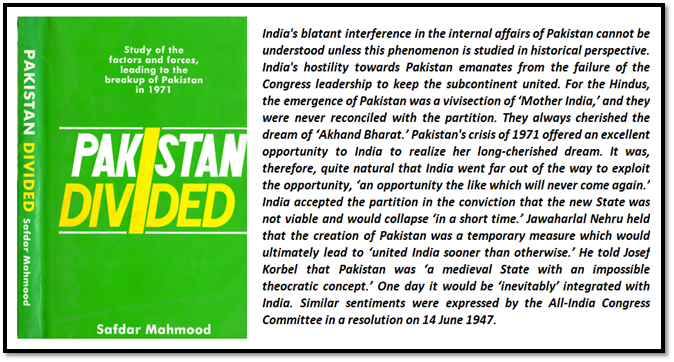
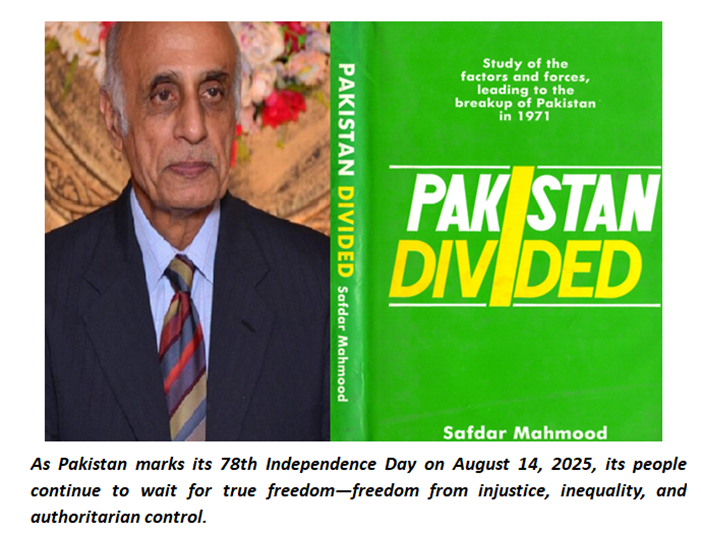
Dr Safdar Mahmood: Pakistan Divided — Study of the Factors and Forces, Leading to the Breakup of Pakistan in 1971
By Dr Ahmed S. Khan
The breakup of United Pakistan due to the fall of East Pakistan and emergence of Bangladesh is the darkest event in the history of the country. The roots of disintegration of Pakistan cannot be understood unless Pakistan's history and politics is properly analyzed.
Pakistan Divided — A Study of the Factors and Forces Leading to the Breakup of Pakistan in 1971 , by Dr Safdar Mahmood, offers a comprehensive exploration of the historical and political developments from 1947 to 1971. The book examines the roles played by political parties, key leaders, the military, and India’s involvement in the dismemberment of East Pakistan. Dr Mahmood’s scholarship is thoroughly documented and supported by an extensive range of references, including several sources cited for the first time.
Dr Safdar Mahmood (1944–2021) was a distinguished historian, a leading political analyst, and an honest bureaucrat. He earned his BA (Honors) from Government College, Lahore, and an MA in Political Science from Punjab University. He passed the Civil Service Examination in 1967 and later obtained a PhD in Political Science in 1974. Throughout his career, Dr Mahmood held several senior administrative positions, including Director of the National Research and Reference Agency, Ministry of Information and Broadcasting, Secretary of the Punjab Education Department, Secretary of the Central Ministry of Education. He also taught Political Science at Government College, Lahore and served as a visiting professor in the department of Pakistan Studies, Quaid i Azam University, Islamabad.
Dr Mahmood was a prolific writer. His major English publications include Pakistan: Political Roots and Development, Pakistan Divided, Constitutional Foundations of Pakistan, International Affairs, Founders of Pakistan, and Pakistan Affairs. His notable Urdu works include Pakistan Kyoon Toota, Pakistan: Tareekh-o-Siyasat, Mutala-e-Pakistan, Aaeen-e-Pakistan, Muslim League Ka Daur-e-Hakumat (1947–54), Dard-e-Agahi, Sada Bahar, and Taqseem-e-Hind: Afsana Aur Haqiqat. Many of these titles are used as reference books and have been translated into German, Chinese, Bengali, Uzbek, and Sindhi. He regularly contributed articles and columns to various Urdu and English newspapers. His writing often focused on Quaid-i-Azam, Allama Iqbal, and the history and ideology of Pakistan.
Dr Mahmood was elected to the Executive Board of UNESCO for a three-year term and served as Vice President of the International Education Commission of the Organization of Islamic Countries (ISESCO). He traveled extensively, representing Pakistan at seminars and conferences around the world. In recognition of his scholarly contributions to history, Dr Safdar Mahmood was awarded the President’s Pride of Performance.
The book, in addition to a preface, a bibliography and four appendices, has eight chapters: I The Process of Polarization (1947-1958), II The Widening Gulf, III Beginning of the End, IV The Election Campaign, V The Parting of the Ways, VI The Indian Involvement, VII Role of the Super Powers, and VIII The Final Act.
The Major strengths of the book are — 1. Scholarly Rigor and Depth of Research: The book is grounded in extensive documentation and archival sources, some cited for the first time. 2. Balanced and Analytical Perspective: Dr Mahmood presents a nuanced view of the political dynamics leading to the breakup. 3. Focus on Political and Institutional Failures: He critically examines the erosion of democratic institutions and the centralization of power. 4. Insight into Economic Disparities: The book highlights the unequal distribution of resources between East and West Pakistan. 5. Critical Evaluation of the Six-Point Movement: The author assesses its implications for national unity, and 6. Contextualization of India’s Role: India’s strategic involvement is analyzed within the broader geopolitical framework.
Some of the limitations and shortcomings of the book are — 1. Limited Representation of Bengali Perspectives: The book primarily reflects a West Pakistani viewpoint, underrepresenting East Pakistani voices. 2. Minimal Focus on Civilian Impact: Humanitarian consequences and civilian suffering receive limited attention. 3. Limited Use of Visual Aids or Maps: The absence of maps and timelines makes it harder to visualize complex events. And 4. Underexplored Role of Civil Society and Media: The influence of grassroots movements and media narratives is not fully addressed. Despite these limitations, Pakistan Divided remains a valuable and thought-provoking contribution to the historiography of Pakistan’s political evolution. It offers lessons that are as relevant today as they were in 1971—lessons that, tragically, continue to be ignored.
Expounding on the factors leading to disintegration of Pakistan, the author observes: “The disintegration of Pakistan has not only altered the political balance in this region but has also affected the psyche of the Pakistani Nation. This is likely to have far-reaching repercussions and may unleash the regionalist tendencies in the politically underdeveloped countries. The movement for Bengali separatism did not develop in a short period. It has deep roots in the history of Pakistan. Several attempts at national integration were made by various governments but the process of nation building was hampered by different factors which have been analyzed in this book. The phenomena of disintegration of Pakistan cannot be understood unless Pakistan's history and politics is analyzed in its proper perspective. I have, therefore, endeavored to bring under focus the significant events, explaining themes and examining the country's experimentation with a number of political frame-works along with their repercussions on the historical course of Pakistan. Apart from discussing the role of political leaders, political parties, pressure groups and army, the involvement of India and the role of superpowers in the South Asian crises has also been analyzed.”
The author further notes: “Some of the fundamental questions about the tragedy of separation continue to mystify minds of the Pakistani intellectuals making them think whether the breakup of Pakistan was due to the failure of political leadership or because of the political ambitions of the top brass of army. Some of them believe in the theory of international conspiracy while others consider it as a military defeat. I am inclined to say that each of these factors made varying contributions to the tragedy of disintegration. An attempt has been made to answer these questions on the basis of available material.”
Referring to the balanced approach of the book, the author states: “Although the disintegration of Pakistan is the most important event yet there is a great dearth of an objective analysis of the subject. Most of the books written by Pakistani, Indian and Bangladeshi scholars are biased in their approach. As a student of history, I have attempted to make a dispassionate study of diverse political forces which precipitated the emergence of Bangladesh. Material used in the book excepting classified information is documented and substantiated with source material. Some of the information has been used for the first time which distinguishes this book from other studies.”
In analyzing the disintegration of Pakistan, the author examines the roles played by the global superpowers—Soviet Union, the United States, and China. None of these powers stood firmly with Pakistan during its crisis. The Soviet Union openly supported India, supplying military hardware under the framework of their Friendship Treaty. The United States, despite being Pakistan’s principal ally, failed to take decisive action to prevent the fall of East Pakistan. China, often referred to as Pakistan’s 'iron brother,' did not fulfill its stated commitment to intervene, despite earlier assurances. Regarding this international dynamic, the author notes: “China strongly advocated the principle of peaceful co-existence and opposed the use of force to settle disputes. China's Acting Foreign Minister, at a banquet given in Bhutto's honor on 7 November, appealed to India and Pakistan to hold consultations to reduce tension on their borders. About a fortnight later, Chou-En-Lai warned India that 'once war breaks out both sides will incur losses. We firmly support Pakistan....India would in the end taste bitter fruit of its making. And from then on there would be no tranquility on the subcontinent.' In all these statements the pledge of physical intervention was neither implicit nor explicit. The people of Pakistan, therefore, were fed on wrong propaganda regarding Chinese commitment.”
Commenting on Pakistan’s flawed strategy during the 1971 war, the author observes: It appears that Pakistan's strategy was based on the presumption that India had ‘planned only a limited action’, as disclosed by General Niazi during interrogation in India. What Pakistan visualized was that India would capture a chunk of territory for establishing Bangladesh Government inside East Pakistan. As a result, Pakistan deployed her forces in penny pockets along the border spreading over twenty-five hundred miles and ordered them to hold on at any cost. Pakistani Generals failed to realize that their stranglehold on East Pakistan lay in Dacca and that its defense was the first priority. It is said that Pakistan had not prepared even an alternative plan for the defense of Dacca, hence withdrawal of forces was no longer possible once the Indian Army started by-passing them. Working on the same presumption, Niazi deployed his troops close to the border. But when the Indian forces by-passed fortified Jessore city and looked like racing towards Dacca, Pakistan realized that if even there was a plan to free some territory it had been discarded. But by then it was too late for Pakistan to change its strategy. The defense policy of Pakistan Government had all along been that the defense of East Pakistan lay in West Pakistan, but the western front was opened as late as 3 December. As a result, pressure on the Eastern front could not be released at the proper time. Second, it is now well known that Pakistan did not deploy all her forces even on the western front, thus many young officers wrote letters of protest to the General Headquarters of the Army. Pakistan did gain some territory but it was against a fairly relaxed Indian resistance which fell back initially to well-prepared positions. The fact is that ‘many major Pakistan strike units, equipped for a fast moving armored conflict in the West, never fired a shot in anger’”
Elaborating further on Pakistan’s military failure, the author notes: “Another reason for Pakistan's military failure was Yahya's indifference towards planning for war. Even during the war, he was mostly not available for briefing a consultation. After the war had started in the Eastern Wing, Yahya returned from Sialkot and found the Chief of the General Staff waiting to take him to the MI operation room for briefing. ‘Even at this point, Chief of the Staff suggested an afternoon siesta for the President and the postponement of the meeting’. On the same day, a Press Conference was arranged in the President's House in which Yahya remarked" "What can I do for East Pakistan; I can only pray". According to one of the participants in the Press Conference, the President looked casual and almost unconcerned. These small instances reflect Yahya's attitude and the nature of his interest in the war, although he was one of the main architects of the crisis. In short, the way the war was fought shocked the whole nation and many people in Pakistan thought that it was a deliberate debacle. Even on the last day, Yahya huffed the whole nation by saying that East Pakistan had fallen but that war would continue on the Western front till the achievement of victory. And it continued only for one day…The degree of Yahya's involvement in the war was disclosed later by the then Prime Minister-designate who, overwhelmed by sorrow, went to see Yahya and found the President and the Chief of Staff, Abdul Hamid, drinking and enjoying themselves at a time when Dacca was burning. When he asked about the war, Yahya said: "We are helpless, yet war will continue". The surrender came the following day. However, the most significant cause of Pakistan's military failure was an ‘astonishing lack of liaison and coordination between the Army, Navy and Air Force.’ Admiral Muzaffar Hussain, Pakistan Navy Chief in 1971, also alleged in an interview that despite his repeated requests, he was not provided air help during the Indian missile boat attack on the Pakistan Navy. Again, on 8 December, when the Indian Navy and Air Force attacked Karachi and sunk two Pakistani ships, air help was refused leaving Pakistan and Karachi Port at the mercy of the Indian forces…Obviously with all the crippling moral and material disadvantages coupled with bad planning, hostile local population and fatigued Army, Pakistan's defeat was a foregone conclusion.”
Discussing Mujib’s Six-Point program, the author observes: “The program of autonomy outlined by Mujib in October 1970, made it plain that ‘were such a program implemented it would be the end of Pakistan’. Even foreign observers and commentators had understood that the Six Points implied secession. The Indian Press comments were particularly suggestive. One weekly commented that ‘Mujib -wants an autonomous Bangladesh, i.e., a virtual break-up of Pakistan and that Awami League's Six-Point program would turn Pakistan into a sort of confederation. The Times (London) had already reported that ‘Sheikh Mujib wants to draw up a constitution which will break Pakistan up into a loose federation of five states and give the provincial government a degree of autonomy just short of independence.’ Although Mujib had been insisting, during these years, that Six Points stood for the integrity of Pakistan, his later confessions pointed to a different conclusion. While addressing the session of the Awami League Council, he recalled: ‘The final issue had come before the party in 1966 when the party declared its Six-Point Program...A clear path was charted out before the people; it was a path of different kind where Bengalis had to break the bondage of Pakistan.’”
Pakistan Divided by Dr Safdar Mahmood serves both as a historical account and a cautionary tale. It underscores the critical importance of inclusive governance, equitable development, and respect for regional identities in preserving national unity. Dr Mahmood’s work remains a significant contribution to the study of South Asian politics and the tragic legacy of 1971.
Regrettably, Pakistan’s political and economic landscape in 2025 bears a striking resemblance to the conditions that led to the 1971 crisis. Once again, the military establishment has manipulated electoral outcomes, violated human rights, installed corrupt leadership, and imprisoned the nation’s most popular political figure — Imran Khan. The parallels with the Dacca debacle are unmistakable, underscoring the military’s failure to learn from history. Today, Pakistan stands perilously close to the brink of another major civil conflict.
(Dr Ahmed S. Khan is a Fulbright Specialist Scholar)