Brood Parasitism
By Dr Khalid Siddiqui
Ohio

In brood parasitism, one bird (the parasite) lays its eggs in the nest of another bird (the host), relying on the host to raise their young. Some well-known examples are cuckoos, cowbirds, honeyguides, black-headed duck and indigo birds. This allows the parasite birds to avoid the costs of parental care, including nest building, incubation, and raising young. This practice is not restricted to the birds only. It occurs in fish and insects also.
There are two types of brood parasites:
1. Obligate Brood Parasites: These birds never build their own nests and are entirely reliant on other species to raise their young. Examples include brown-headed cowbirds and cuckoos (koel).
2. Facultative Brood Parasites: These birds typically build their own nests and raise their own young but sometimes lay eggs in the nests of other birds.
Female cuckoos have perfected brood parasitism. They secretly observe the host nest; wait until the nest is unattended; quickly lay one egg in that nest; and may remove or damage one of the host’s eggs to maintain the clutch size. It can lay 25 eggs per season in different nests.
So, why doesn’t the host bird destroy or remove the parasite’s egg? If the host does so then the parasite bird, specially the cuckoo, would destroy the entire nest. That is called the ‘Mafia Tactic’. So, the hosts accept the parasitic eggs to avoid total reproductive failure. This is one explanation.
Brown-headed Cowbird and Kirtland’s Warbler
Kirtland’s warbler is the iconic bird of Michigan. Its numbers had started dropping rapidly. The population reached a low of 167 singing males in 1974. There were two reasons for the decline: Firstly, the bird makes nests only on the lower branches of the young jack pine forest. When the trees grow older, the lower branches die and break off. So, the warblers move to a new younger forest to breed. However, because of the rapid deforestation, the new jack pine doesn’t have enough space and time to germinate and establish a new forest. Secondly, these warblers are susceptible to parasitism by the brown-headed cowbirds. See the photograph and watch the videos of cowbirds. (Male and female cowbirds look different – dimorphism.)
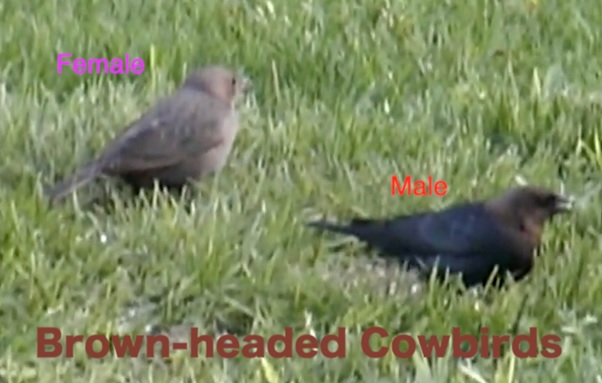
https://youtu.be/DcZUPo7wjjs
https://youtu.be/Neo1QjF81ys
The female cowbird lays as many as 3 eggs in the Kirtland’s warblers’ nest. Sadly, the warbler accepts the large brown-spotted eggs of cowbirds that are quite different from its own small white/grey eggs. See the photograph. 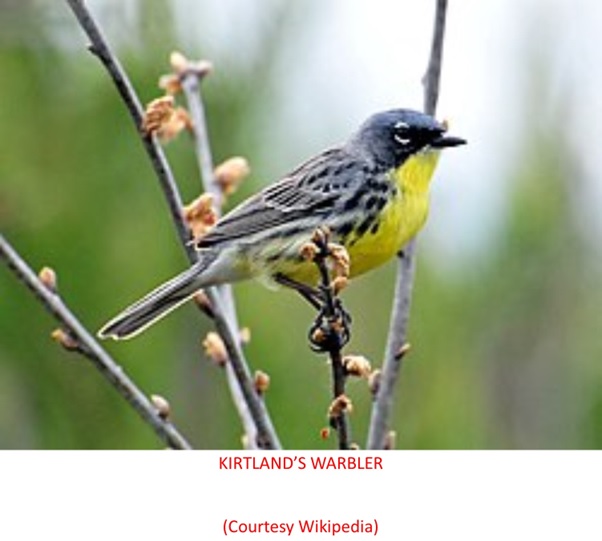
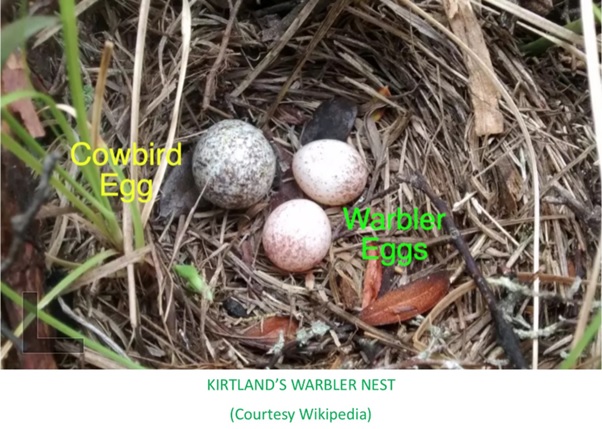
By 1971, 59% of the warbler nests were parasitized, and only 7 square miles of suitable breeding habitat was available. Usually, the parasite chicks hatch earlier and are bigger. It would try to push the host’s eggs out of the nest; and later kill the host’s own smaller hatchlings. So, the parasite chick grows at the expense of the host chicks. That accounted for the drop in Kirtland’s warblers’ numbers. Surprisingly, the host bird continues to feed the parasite chick instinctively even when it grows much larger than its foster parents!
To tackle these problems, attempts were made to set aside a pine forest in central Michigan and rotate timber harvests so that there would always be some habitat of the appropriate age jack pine available for the warblers to make nests in. For the cowbird menace, the National Audubon Society devised an aggressive plan. Cowbirds are migratory birds who arrive in the northern states in spring every year. They fly over Ohio before reaching Michigan. So, traps were set up in Ohio along their migration route. Sunflower seeds are used as bait; and 10-20 cowbirds are kept inside the trap as decoys. This lures the cowbirds flying overhead into entering the one-way traps. When enough birds have been trapped then they are shifted to a large holding area.
In Ohio, one of the traps was set up in an open area within an old NASA facility close to my home. Our bird watching group falls under the local chapter of the National Audubon Society. Because of this connection, we were allowed to visit (after security clearance) the cowbird holding area. See the photograph and watch the video. (The actual traps are set up further in, and the visitors are not allowed there.)
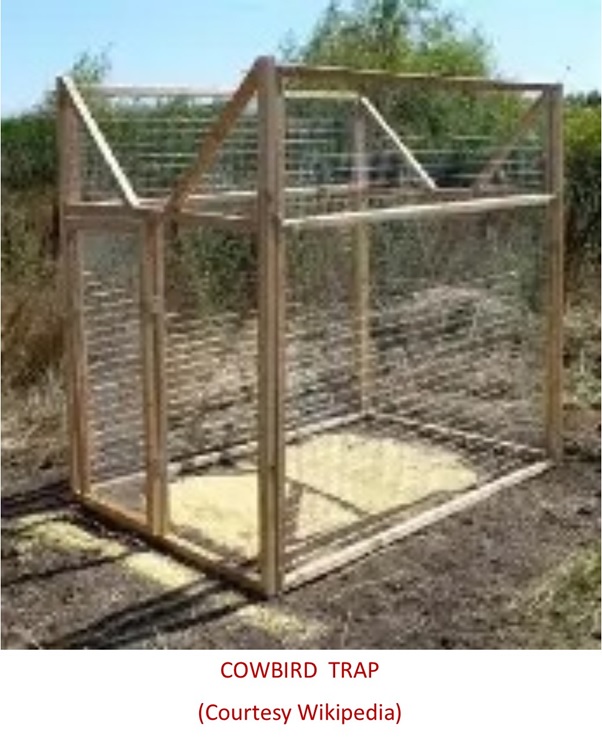
https://youtu.be/OAlT5Kw0KA0
From the holding area the captured cowbirds are transferred to Michigan where some are used as decoys in the traps there, and the rest are asphyxiated in plastic bags using car exhaust fumes. So, fewer and fewer cowbirds were around in Michigan to parasitize the warblers’ nests.
The plan has been largely successful. The nest parasitism dropped from 59% to 3%. The numbers of Kirtland's warbler in Michigan have steadily risen, with an estimated population of 5,000 in 2016.