Book & Author
Professor Dr Riaz Ahmad: Quaid-i-Azam Jinnah as Magistrate
By Dr Ahmed S. Khan
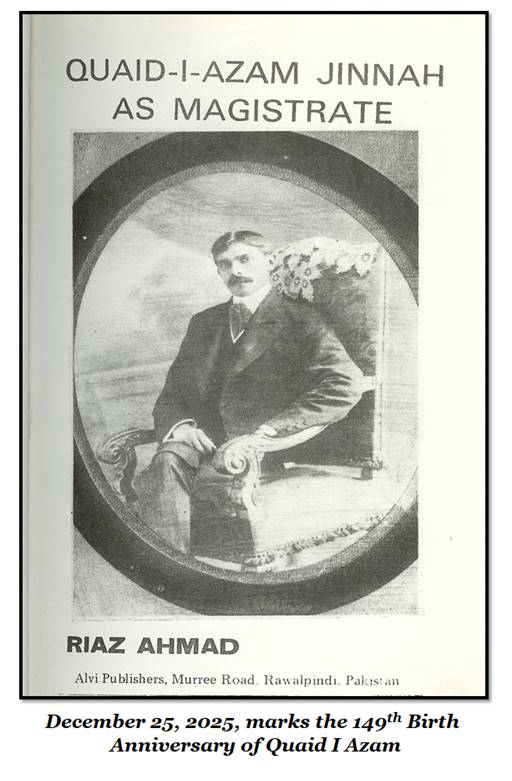
Quaid-i-Azam Muhammad Ali Jinnah (December 25, 1876 - September 11, 1948) was not only a dynamic leader, but also a world-class statesman, a witty politician, a compassionate humanitarian, a man of character and integrity, and a very astute lawyer. Many attributes of his leadership have been acknowledged in books and films during the past seven decades. But the one attribute that did not get much coverage is his role as a judge. In May 1900, Mr Jinnah at age 24 was appointed as a Presidency Magistrate in Bombay. Professor Riaz Ahmed, through his research at Quaid-i-Azam University, has put together a book titled Quaid-i-Azam Jinnah as Magistrate that provides insights into Mr Jinnah’s acumen as a judge.
Dr Riaz Ahmad has served as a professor in the departments of history, and Asian Civilization. He has more than thirty-five years of teaching and research experience in the domains of history and Pakistan studies. Dr Ahmad has also served as director of the National Institute of Historical and Cultural Research, Center of Excellence, Quaid-i-Azam University, Islamabad. Dr Ahmad is a prolific writer; he has written extensively on the history and constitutional development of Pakistan. He has authored a plethora of books on various facets of Quaid-i-Azam’s life and times, services of Mohtarma Fatima Jinnah, and history of All India Muslim League. In his book “All India Muslim League and the Creation of Pakistan,” Professor Ahmad chronicles the history of All-India Muslim League and shows how under the dynamic leadership of Quaid-i-Azam, the party brought Muslims on a single platform, and achieved its goal of creating Pakistan in a short span of time. Dr Ahmad has presented papers at national and international conferences and served as a visiting professor at the Mohammad V University, Rabat, Morocco (1992-1993). In recognition of his scholarly work, he was awarded Tamgha-i-Imtiaz by the Government of Pakistan.
Riaz Ahmed’s Quaid-i-Azam as Magistrate is a scholarly work that sheds light on an often-overlooked chapter in the life of Muhammad Ali Jinnah—the period when he served as a magistrate in British India. While most biographies focus on Jinnah’s political achievements and his role as the founder of Pakistan, this book takes the readers back to his formative years in the legal profession. It offers a unique perspective on how his early judicial experiences shaped his principles of justice, fairness, and governance.
The late 19th and early 20th centuries were transformative for British India. The colonial judicial system was both a mechanism of control and a platform for reform. Jinnah’s brief tenure as a magistrate occurred during this era, when legal institutions were evolving and professional ethics were under scrutiny. Ahmed situates Jinnah’s role within this context, arguing that his exposure to the colonial judiciary influenced his lifelong commitment to the rule of law—a principle that later became central to his political ideology.
Mr Jinnah served for only six months in this capacity, but his insight into justice for ordinary people has been preserved in 73 cases he presided over as presiding Magistrate over Esplanade Police Court between May and November 1900. The details of these cases were published in the Bombay Gazette . Professor Riaz Ahmed had collected all the information for 73 cases as a part of his PhD thesis titled “Quaid-i-Azam Mohammed Ali Jinnah: The Formative Years 1892-1920” at Quaid-i-Azam University, Islamabad. These 73 cases covered a wide array of offenses: theft, robbery, traveling without tickets, absence without leave, army desertion, claims of conveyance, gambling, cheating, disorderly drinking, breach of trust, cheating and misrepresentation, assault, stabbing, creating a nuisance, resisting policemen on duty, importing forbidden alcohol, endangering public health, extortion, importing Ganja without permit, impersonation, disobedience, brokerage enticement of a married woman, intimidation, accidental negligence, charges of a false nature, service matters, illegal possession of pearls, appointment of “approvers”, suicide, complaint against hairdresser, kidnapping, broaching cargo, lost property, etc.
The author has used the Bombay Gazette as the primary source for details of all cases and has kept the same titles used by the newspapers. The author points out that in the early 1900s newspapers used the spelling “Mohamed Ali Jinnah’ or “M.A. Jinnah,” but towards the later part of his career his name was spelled as “Mohammed Ali Jinnah.”
The book meticulously reconstructs Jinnah’s judicial career using archival records, court proceedings, and contemporaneous accounts. Ahmed highlights several cases presided over by Jinnah, illustrating his impartiality and insistence on due process. These cases reveal a young magistrate who valued justice over expediency, even when faced with pressures from colonial authorities.
One of the most compelling aspects of the book is its portrayal of Jinnah’s professional demeanor. Ahmed describes him as disciplined, courteous, and deeply committed to legal ethics. His judgments were marked by clarity and fairness, qualities that foreshadowed his later reputation as a principled political leader.
The details of 73 cases provide an opportunity for readers to observe the legal acumen, high sense of integrity, responsibility and sound character displayed by young Jinnah, and also to travel back in time to explore various aspects of Bombay society. The author mentions that in Bombay criminal cases increased from 13,880 in 1899 to 23,948 in 1900 in the whole of Bombay Presidency.
The first case Mr Jinnah heard and decided on May 2, 1900, was of a thief who stole a purse belonging to a European lady. The thief was awarded a punishment of six months’ rigorous punishment. The author points out an interesting fact that when Mr Jinnah left the service in November his own overcoat worth Rs 90 was stolen by a thief from his house at Eldon Road. It was the time when Bombay was passing through the plague epidemic that claimed numerous lives.
In some cases, Mr Jinnah’s judgment reflected his concern for the dignity of individuals. Two men and women accused of disorderly conduct were locked up by police and denied bail. The next day when they were presented before Mr Jinnah, they were fined Rs 5 each. However, Mr Jinnah observed with regret that the police should have bailed them out as the offense involved was bailable.
The author mentions another case in which a sailor assaulted a policeman when the latter refused to salute him. When the accused appeared in court and expressed his profound regrets for his offense and promised not to do it again, Mr Jinnah remarked, “Everyone will say that he is sorry after he had done a wrong thing.” In passing the judgment on the case Mr Jinnah observed that the practice of ordering police sepoys to salaam (salute) members of the armed forces, and failing which to assault them, should be stopped. Considering the statement of the accused, Mr Jinnah fined him Rs 15.
In a case of kidnapping there was a disagreement between the Victoria Company and the Parsee Theater Company, each party claiming a boy as theirs. This case received a lot of publicity in the press as the evidence involved was of a complicated nature. Disregarding the unreliable evidence Mr Jinnah decided the case by considering the boy’s wishes as to which company he wanted to join.
Mr Jinnah also believed in the social reform of criminals, especially if the offenders were women. An eight-year girl, Dwarkabai, was charged of stealing a sari valued Rs 1-4-0 (one rupee and four annas). The police told Mr Jinnah that the girl was a habitual offender. Mr Jinnah was convinced of the truth of the charge, but he disagreed with the view of sending her to jail where she would live in the company of hardened criminals, and where she would not get an opportunity to improve her moral character. Mr Jinnah considered it necessary that there should be some institution for reforming the young offenders. Since no such institution existed, Mr Jinnah ordered her detention for one day which had already passed and so the girl was released.
Mr Jinnah showed extreme concern about public health and hygiene. In a case that dealt with storing and pressing raw hides by Ismail Hajji Essac, which affected public health , Mr Jinnah personally inspected the premises located in the thickly populated areas of the city and considered the storing and pressing of raw hides in the locality a risk to public health. The court ordered the trade most injurious to public health: the accused was fined Rs 100 and ordered to discontinue his business within twenty-four hours.
Professor Riaz Ahmed has compiled this important historical document, but the book did not explore the reasons Mr Jinnah employed for reaching his decisions. The book contains a foreword written by Justice Dr. Nasim Hasan Shah of the Supreme Court of Pakistan. The book also contains three appendices: the first contains Mr Jinnah’s private confidential letter dated 5 June 1900 addressed to Mr Justice Badruddin Tyabee, Bombay High Court. The second appendix exhibits a news item from the Bombay Gazette (16 July 1900) regarding a reception given in honor of Mr Jinnah on his appointment as Presidency Magistrate. And the third appendix presents Mr Jinnah’s written answers before the Royal Commission on Public Services in India.
After he left the Magistracy, Mr Jinnah resumed his law practice and became one of the most prominent lawyers of British India, and as they say the rest is history. Mr Jinnah emerged as a dynamic leader who transformed the aspirations of Muslims into reality with the creation of Pakistan. Explaining the true genesis of Pakistan, Mr Jinnah had said, “Pakistan is not the product of the conduct and misconduct of Hindus. It had always been there, only they were not conscious of it. Hindus and Muslims, though living in the same towns and villages, had never blended into one nation, they were always two separate entities…Pakistan not only means freedom and independence but the Muslim ideology which has to be preserved, which has come to us as a precious gift and treasure and which we hope, others will share with us.”
In today’s world, where leadership is often questioned for ethical lapses, Ahmed’s portrayal of Jinnah as a magistrate offers a refreshing reminder of integrity in public service. The book demonstrates that great leaders are often shaped by early professional experiences. For students of law, history, and political science, this work provides valuable insights into the interplay between legal training and political leadership.
Moreover, the book enriches the historiography of Jinnah by challenging monolithic narratives that depict him solely as a politician. By highlighting his judicial role, Ahmed invites readers to appreciate the multidimensionality of Jinnah’s character—a man who believed in justice long before he championed the cause of a separate homeland.
Quaid-i-Azam as Magistrate is a significant addition to literature on Jinnah. It offers a fresh perspective on his formative years, emphasizing qualities that later defined his political leadership. While the book has limitations in scope and style, its scholarly rigor and originality make it a valuable resource for researchers and history enthusiasts alike.
Quaid-i-Azam as Magistrate is a fascinating read. It provides insights into young Jinnah’s potential as a great leader. It is essential reading for readers seeking a deeper understanding of Muhammad Ali Jinnah’s ethical foundations and professional evolution, and all those who believe in the supremacy of the rule of law.
(Dr Ahmed S. Khan - dr.a.s.khan@ieee.org - is a Fulbright Specialist Scholar)