Book & Author
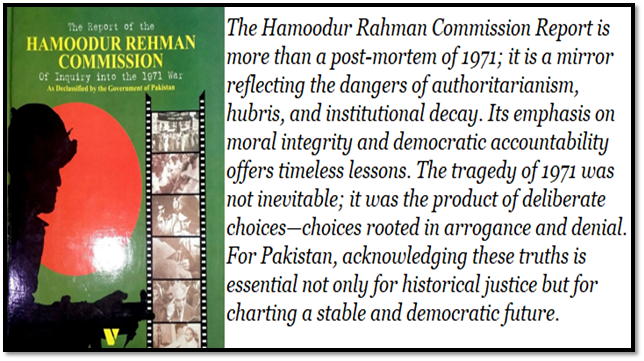
Justice Hamoodur Rahman et al.: The Report of the Hamoodur Rahman Commission of Inquiry into the 1971 War
By Dr Ahmed S. Khan
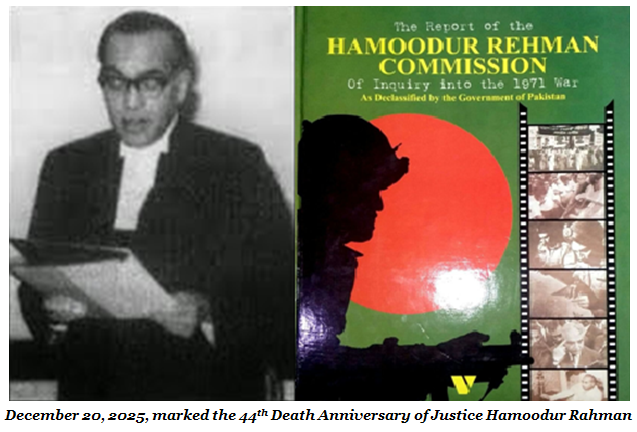
The disintegration of Pakistan in 1971 and the birth of Bangladesh remain among the most defining—and traumatic—events in South Asian history. In the wake of this national catastrophe, the Government of Pakistan established the Hamoodur Rahman Commission to investigate the causes of the debacle, identify those responsible, and recommend corrective measures. Led by Chief Justice Hamoodur Rahman, the Commission produced a report that was as candid as it was damning—yet it remained suppressed for decades. The report reflects the views of three eminent Pakistani judges—Justice Hamoodur Rahman, Chief Justice of the Supreme Court; Justice Anwarul Haq, Chief Justice of the Lahore High Court; and Justice Tufailali Abdur Rahman, Chief Justice of the Sindh High Court—on Pakistan’s history from August 1947 to October 1958, a period when the country was struggling to establish itself as a functioning democracy.
The Commission was formed on 26 December 1971, shortly after Pakistan’s surrender in Dhaka and the loss of its eastern wing. The defeat was unprecedented: 93,000 Pakistani troops became prisoners of war, and the country’s territorial integrity lay shattered. Prime Minister Zulfikar Ali Bhutto, who assumed power following General Yahya Khan’s resignation, tasked the Commission with uncovering the truth behind this humiliation.
The initial report was submitted in July 1972, but because many key witnesses were still held as prisoners in India, a supplementary report was prepared in 1974. Despite its significance, the report was classified and remained hidden from the public for nearly three decades—only leaking in 2000.
Justice Hamoodur Rahman (November 1, 1910 – December 20, 1981) was a distinguished jurist whose career spanned decades of service in Pakistan’s judiciary, academia, and public commissions. His contributions shaped legal reforms, constitutional interpretation, and accountability in Pakistan’s political and military history.
Hamoodur Rahman began his judicial career as a judge of the Dhaka High Court in 1954. In 1960, he was appointed Senior Justice of the Supreme Court of Pakistan by the President. Alongside his judicial duties, he served as Vice-Chancellor of Dhaka University from May 1958 to December 1960 and as a visiting professor of law at Karachi University. His dual roles reflected his commitment to education and legal scholarship.
From 1959 to 1960, Justice Rahman represented Pakistan as a member of the International Court of Arbitration in The Hague. His involvement in international legal forums demonstrated his stature as a jurist of global repute. Rahman chaired the Commission on Students Problems and Welfare in 1964, producing a comprehensive report submitted in 1966. Later, as a member of the Law Reforms Commission in 1967, he contributed to studies on land reforms, with recommendations presented to the government in 1970. These roles underscored his dedication to systemic improvements in education and law.
In 1968, Rahman was nominated Chief Justice by outgoing Chief Justice Alvin Robert Cornelius, and his appointment was confirmed by President Ayub Khan. His tenure coincided with political upheaval, including Ayub Khan’s resignation and Yahya Khan’s imposition of martial law in 1969. Justice Rahman presided over the landmark case Asma Jillani vs Government of Punjab, which retroactively declared Yahya Khan’s martial law unconstitutional and labeled his assumption of power as “illegal usurpation.” This judgment overturned earlier rulings that had validated martial law under the doctrine of necessity. Rahman clarified the distinction between martial law for internal disorder and its misuse for unconstitutional power grabs, reinforcing judicial independence.
He also supported the Election Commission in conducting Pakistan’s first general elections in 1970, emphasizing democratic governance. Despite being Bengali, Rahman remained loyal to Pakistan during the Bangladesh Liberation War and refrained from public commentary on the independence movement. In April 1971, he administered the oath of office to Zulfikar Ali Bhutto as President of Pakistan.
After the 1971 war, Rahman served on the United Nations Commission on Crime Prevention and Criminal Justice (1972–73). He retired as Chief Justice in 1975 with state honors and later chaired the Council of Islamic Ideology until 1977. His post-retirement roles included advising on constitutional affairs and election reforms, where he proposed proportional representation systems modeled on Germany and Sri Lanka.
In the aftermath of Pakistan’s disintegration, Justice Rahman was appointed to lead the War Enquiry Commission to investigate the causes of the 1971 debacle and the military’s role in politics. The Commission interviewed nearly 300 individuals, including senior military officers, bureaucrats, and politicians, and examined hundreds of classified documents.
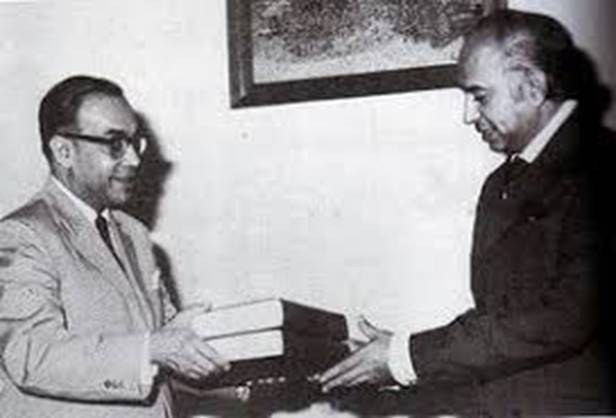
The Hamoodur Rahman Commission Report , submitted in October 1974, exposed grave misconduct by military officers, including atrocities against civilians, looting, smuggling, and indiscipline during the war. It recommended courts-martial for top commanders such as Lt Gen Tikka Khan, Gen A.A.K. Niazi, and others. However, no action was taken by Prime Minister Bhutto or subsequent governments. The report was classified as Top Secret and suppressed for decades, with portions leaked only in 2000.
Justice Rahman’s analysis extended beyond military failures to political roots of the crisis. He criticized Yahya Khan for failing to seek a political settlement and implicated Bhutto for manipulating decisions that led to military action. Bhutto, angered by these findings, claimed the Commission exceeded its mandate and ensured the report remained unpublished.
Justice Hamoodur Rahman lived quietly after retirement, continuing advisory roles and legal scholarship. He died of cardiac arrest on December 20, 1981, in Lahore and was buried with close associates in attendance.
Rahman is remembered as an honest and patriotic jurist. His Commission remains a landmark in Pakistan’s history for its courage and integrity. Senior Justice Khalil-ur-Rehman Ramday later praised it as “the most honorable commission investigated by a Bengali Chief Justice, despite the East Pakistan disaster.”
Justice Hamoodur Rahman’s career reflects unwavering commitment to law, education, and accountability. His judgments strengthened constitutionalism, while his Commission exposed systemic failures that shaped Pakistan’s trajectory. Though his recommendations were ignored, his work endures as a testament to judicial independence and moral courage.
Key findings of the Hamoodur Rehman Commission Report are:
1. Political Mismanagement and Democratic Breakdown
The Commission categorically rejected the official narrative that external aggression was the sole cause of Pakistan’s breakup. Instead, it traced the crisis to Islamabad’s refusal to honor the results of the 1970 general elections, in which the Awami League, led by Sheikh Mujibur Rahman, won an absolute majority. Rather than transferring power, the ruling elite chose confrontation, culminating in Operation Searchlight—a brutal military crackdown on March 25, 1971. This decision turned a political dispute into a full-scale civil war, alienated the Bengali population, and invited Indian intervention.
Justice Rahman’s analysis extended beyond military failures to political roots of the crisis. He criticized Yahya Khan for failing to seek a political settlement and implicated Bhutto for manipulating decisions that led to military action. Bhutto, angered by these findings, claimed the Commission exceeded its mandate and ensured the report remained unpublished
2. Military Failures and Leadership Collapse
The report delivered a scathing indictment of Pakistan’s senior military leadership. General Yahya Khan, then President and Army Chief, was accused of gross professional negligence, incompetence, and moral corruption. Lt Gen A.A.K. Niazi, Commander of Eastern Command, faced charges of indiscipline, corruption, and personal misconduct. The Commission concluded that the leadership failed both strategically and morally, abandoning professionalism at the moment of greatest national responsibility.
3. Moral and Ethical Decay
One of the most sensational aspects of the report was its emphasis on moral degeneration among senior officers. It documented widespread debauchery, misuse of authority, and corruption—arguing that these factors eroded discipline and contributed to operational failures.
4. Human Rights Violations
The report acknowledged allegations of atrocities committed by the Pakistan Army in East Pakistan, including mass killings, rapes, and destruction of property. While cautious in its language, the Commission admitted that such actions severely damaged Pakistan’s international standing and hardened Bengali resolve for independence.
The Commission proposed sweeping reforms: a. Court-martial and strict accountability for officers implicated in misconduct. b. Structural changes to prevent the concentration of power within the military, including stronger civilian oversight and adherence to democratic norms. Tragically, these recommendations were ignored. No significant trials were conducted, and the report remained buried for decades.
The key strengths of the Report are : a. Comprehensive Scope: Unlike narrow military inquiries, the Commission examined political, social, and institutional dimensions of the crisis. b. Courageous Conclusions: It challenged the dominant narrative of external blame and placed responsibility squarely on Pakistan’s leadership, and c. Judicial Integrity: Headed by the Chief Justice, the inquiry maintained a formal, evidence-based approach, lending credibility to its findings.
Some of the limitations of the Report are : a. Delayed Publication: Suppressed for nearly three decades, the report’s impact was diluted. By the time it surfaced, much of its relevance for immediate reform had faded. b. Provisional Nature: The initial report acknowledged its conclusions were tentative due to missing testimony from key figures, later addressed in the supplementary report, and c. Political Constraints: Despite strong recommendations, the political environment under Bhutto and subsequent regimes lacked the will to implement reforms.
The Hamoodur Rahman Commission Report is not merely a post-mortem of 1971; it is a stark warning against authoritarianism, hubris, and institutional decay. Its call for moral integrity and democratic accountability offers lessons that remain timeless. The tragedy of 1971 was not inevitable—it stemmed from deliberate choices rooted in arrogance and denial. For Pakistan, confronting these truths is essential not only for historical justice but for building a stable and democratic future. The Report remains one of Pakistan’s most important yet underutilized documents. The report underscores a vital truth: national unity cannot be sustained through coercion; it requires political accommodation, respect for democratic mandates, and institutional integrity.
Half a century later, the report’s warnings remain profoundly relevant. Pakistan still struggles with civil-military tensions, weak governance, and unresolved questions of accountability. The moral and professional standards of military leadership—central to the Commission’s critique—remain pressing concerns. Revisiting the report is not mere historical reflection; it offers a blueprint for reforms that were tragically ignored. Had its findings been published and decisive action taken against those responsible for the country’s breakup, Pakistan might have evolved into a more politically stable, economically resilient, and militarily secure nation—one where generals did not repeatedly abrogate the constitution or violate human rights.
(Dr Ahmed S. Khan - dr.a.s.khan@ieee.org - is a Fulbright Specialist Scholar. Professor Khan has more than 40 years of experience in Higher Education as professor of Electrical Engineering, Chair and Dean of the College of Engineering and Information Sciences. He is the author of many academic papers, technical and non-technical books, and a series of books on Science, Technology & Society (STS) used globally in academic programs of more than 200 universities. His most recent books are Mashriq-o-Mugrib Ki Mumtaz Shaksiaat (Prominent Personalities of the East and the West), and Nanotechnology: Ethical and Social Implications .)