Book & Author
Juan M. Chomón: The Rare Earths Era — Strategic Metals Dependency & World Order
By Dr Ahmed S. Khan
“Controlling about 60% of global rare earth production and nearly 90% of refining, China tightened its grip... exposing US vulnerabilities, as the country lacks domestic refining capacity.” — DW News
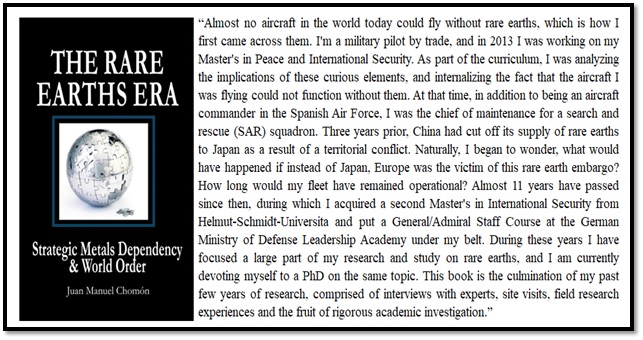
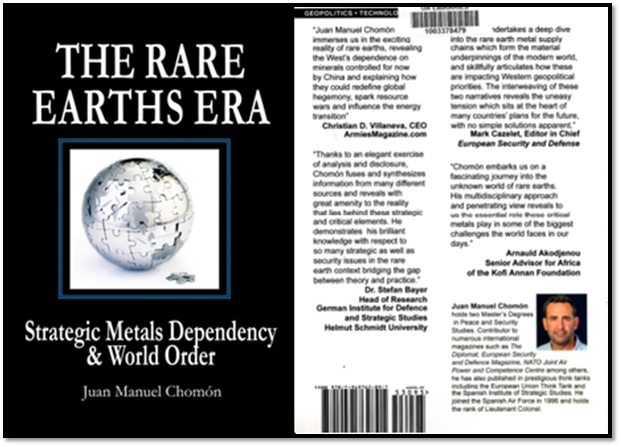
The Rare Earths Era: Strategic Metals Dependency & World Order by Juan Manual Chomón explores the critical importance of rare earth minerals in modern technology, defense systems, and the global energy transition. The book explores the geopolitical, economic, and environmental implications of the global reliance on rare earth elements (REEs). These 17 metallic elements — are difficult and environmentally damaging to extract — making them strategically vital and geopolitically sensitive.
Juan Manuel Chomón is a geopolitical analyst and author with a specialized focus on strategic resources, particularly rare earth elements and their role in shaping global power dynamics. He brings a multidisciplinary perspective to his writing, combining insights from international relations, economics, environmental science, and military strategy. His work reflects a deep understanding of how access to and control over strategic materials—especially those dominated by China—can influence national security, economic sovereignty, and the future of global governance.
He holds two master’s Degrees in Peace and Security Studies and has contributed to numerous international magazines such as The Diplomat, European Security and Defense Magazine, NATO Joint Air Power and Competence Centre among others. He has also published in prestigious think tanks including the European Union Think Tank and the Spanish Institute of Strategic Studies. He joined the Spanish Air Force in 1996 and holds the rank of Lieutenant Colonel.
In The Rare Earths Era, Chomón warns of the West’s overreliance on Chinese rare earth supply chains and calls for a coordinated response to mitigate strategic vulnerabilities. He advocates for diversified sourcing, investment in recycling technologies, and greater political awareness of the critical minerals sector.
Chomón’s work continues to resonate with policymakers, academics, and industry leaders seeking to understand the intersection of natural resources and global power. His contributions are helping to shape the discourse on how nations can navigate the challenges of the 21st-century resource economy.
The book has ten chapters: 1. Rare Earths: The Holy Grail of the 21st Century, 2. How China Cornered the Global Rare Metals Supply, 3. The West Wakes Up, 4. Second Front: The Struggle Against Climate Change, 5. The Dark Side of the Climate Crusade, 6. The Mineral Yuan, 7. Rare Earths and World Hegemony, 8. Western Armies with Feet of Clay, 9. The First Battles, and 10. New Resource Territories, New Laws, New Solutions.
The author begins the book by explaining the vital role rare earths play in modern science and technology. From smartphones and electric vehicles (EVs) to advanced military hardware and green energy infrastructure, REEs play a pivotal role in the growth of the 21st-century economy. Their novel properties — such as super magnetism, luminescence, and conductivity— make them irreplaceable in many high-tech systems and applications.
The book’s major focus is on the world's overwhelming dependence on China for rare earths. China controls the majority of global REE production and refining capacity, giving it significant geopolitical leverage. The author delves into how this dominance developed and traces policy decisions and industrial strategies that allowed China to outpace the West in this critical domain.
The book raises important questions about the strategic vulnerabilities this dependency creates.
The author explores various scenarios in which China could use its control over REEs as a geopolitical tool — potentially disrupting supply chains or influencing international policy. The author also examines the implications for national security, particularly for Western countries whose defense systems rely heavily on REEs.
The book also offers an insight into the environmental concerns — the extraction and processing of REEs are extremely polluting, often involving toxic chemicals and generating radioactive waste. The author highlights the environmental cost in regions like Inner Mongolia, where lack of regulation has led to severe ecological disasters. He contrasts this with the West’s struggle to balance environmental standards with the need for domestic REE processing.
The author connects REEs to global trends, such as the transition to green energy and the de-dollarization of the global economy. The author argues that as nations race to build green technologies, demand for REEs will skyrocket — increasing competition and potentially leading to new global conflicts. He also speculates on how China’s control over REEs could shift the balance of global power, challenging the current US-led world order.
Throughout the book, the author calls for a more coordinated and strategic response from Western nations. He advocates investment in alternative sources, green technologies, and international cooperation to reduce dependency and ensure sustainable access to REEs.
The book has a number of strengths:
1. Timely and Relevant Topic: It tackles one of the most pressing and under-discussed issues of our time: the global dependency on rare earth elements (REEs),
2. Geopolitical Insight: The author offers a detailed analysis of how rare earths influence global power dynamics, particularly the West’s dependence on China,
3. Comprehensive Scope: It offers a well-rounded understanding of the issue by delving into environmental, political, and strategic dimensions,
4. Clear Explanations of Complex Concepts: The author explains complex science in an accessible manner for the general readers,
5. Forward-Looking Perspective: The author offers potential solutions, such as diversifying supply chains, investing in green technologies, and fostering international collaboration, and
6. Environmental Awareness: The author highlights the ecological damage in regions like Inner Mongolia and calls for more sustainable practices for processing of REEs.
The book is widely praised for its depth and relevance, but it has several limitations and shortcomings;
1. Limited Regional Perspectives: The book primarily focuses on China and Western nations, particularly the US and EU. It lacks discussion on the emerging players in REEs, such as countries in Africa, Latin America, and Southeast Asia, which are becoming increasingly important in global supply chains,
2. Lack of Technical Depth for Specialists: While the book is accessible to general readers, some specialists in geology, materials science, and mining may find the technical discussions too shallow,
3. Limited Policy Discussion: Although the book raises urgent issues, its proposed solutions are too broad or idealistic, lacking concrete policy recommendations tailored to specific governments,
4. Lack of in-depth Environmental Analysis: The book focuses mostly on adverse environmental impact in China and lacks a balanced global environmental analysis, and
5. Narrative Bias: The author’s framing of rare earths as a Western strategic vulnerability comes across as overly alarmist or one-sided. A more balanced discussion could have included perspectives and strategies of non-Western countries for providing a broader global view.
The author, referring to public discussions of REEs, states: “The critical strategic importance of rare earths is slowly emerging into the public forum, yet for all of their importance their procurement is concentrated in just two countries, China and Australia. Even then, the Asian giant controls 80% of the rare earths market, and if we look specifically at heavy rare earths, these figures nearly reach 100%. In the context of supply chain security, it's a figure that is as alarming as it is astonishing to contemplate. Given the growing tensions between China, the US, and the rest of the Western world, it's understandable why there is a growing chorus of defense and policy experts concerned about China's rare earth monopoly.”
The author answering the question, “But why should the lay person going about their everyday life care about rare earth metals?” observes: “At an individual level, they have slipped under our skin and injected themselves into our lives without our realization. You carry them around with you every day. In your wallet, your banknotes are marked with europium in order to prevent counterfeiting. For those not inclined to carry cash, you could pay with your cell phone, which is full of rare earths (usually lanthanum, terbium, neodymium, praseodymium, europium, and dysprosium) or pay with your smart watch, which essentially contains the same elements. If you are listening to music with the latest model of wireless headphones, the technological miracle of their miniaturization and lightness is based on the use of internal magnets manufactured with neodymium and praseodymium. Let's imagine that by some magic all those rare earths you're carrying disappear. Faced with the inability to shop and no handheld entertainment, you decide to return home. If you live in an apartment with an elevator, it is very likely that the electric motor of the elevator works with neodymium and praseodymium super magnets.”
Commenting on the lack of regulations for REEs processing, the author notes: “So far, regulations and laws regulating rare metals markets aimed at increasing traceability and protecting human rights have had very limited success. Without universal, enforceable laws, the sharing of critical materials on a global scale is a chimera. If some regulate and others do not, if some prosecute the crimes associated with unethical mining and others look the other way, the pressure for access to scarce resources will seek an outlet and deepen its negative impact on developing countries. Therefore, there will continue to be manipulated or obscured markets for critical materials, unprotected countries with great mining potential but low levels of governance, and unscrupulous companies and countries willing to take advantage of the situation. Armed groups, governmental or otherwise, will be able to continue to use poorly regulated minerals as a means of financing and competition between nations will intensify leading to violent conflicts over resources.”
Expounding on “A New Roadmap for Rare Earths Security” the author observes: “Faced with the catastrophe posed by the shortage of rare earths and its consequences for the safety of citizens, well combined political-industrial decisions and legal measures represent a powerful fire extinguisher to put out emergencies, as we have seen with the corona-virus health crisis. But we do not need to wait for a fire to break out before we act. We need a strategy to build an industrial base that takes into account not only national security, but citizen safety, by ensuring a minimum of autonomy in vital supply chains. We can legislate early to curtail the problems, else we may find ourselves legislating late and poorly with national emergency laws, when a rare earth supply disruption finally emerges. We can legislate even 25 years from now as the climate deteriorates by enacting climate emergency laws.”
Elaborating further on a new roadmap for REEs security, the author states: “The creation of national strategies to orchestrate measures to avoid a rare earth supply disruption should have a preventive character. Inter-ministerial commissions focused on critical materials could assess risks, supply options, mitigation measures and medium-term solutions. Coordination at the international level is also of paramount importance. Proof of this is the now almost forgotten problem of the ozone layer. Thanks to the international coordination embodied in the Montreal Protocol, which banned the use of a total of 96 substances 35 years ago, the ozone layer is expected to be partially restored by 2040 and fully restored by 2060. In our roadmap, the first step should be to obtain a minimum degree of self-sufficiency to avoid any kind of collapse. Beyond a first minimum supply of "war reserves" and encouraging recycling and substitution, there are our own mines. Many Western countries have open mines in whose by-products there are sufficient concentrations of rare earths.”
The Rare Earths Era — Strategic Metals Dependency & World Order by Juan Manual Chomón is a timely and important book — offering both a wake-up call and a roadmap. Its framing of REEs as a matter of national and global security elevates the conversation beyond economics, urging policymakers to treat access to REEs as a strategic priority. It warns of the risks of complacency in the face of growing strategic dependencies and offers insights into how countries can navigate the complex intersection of technology, geopolitics, and sustainability in the age of REEs. It is essential reading for all students, educators and policy makers interested in geo-politics, and new and emerging technologies.
(Dr Ahmed S. Khan is a Fulbright Specialist Scholar)