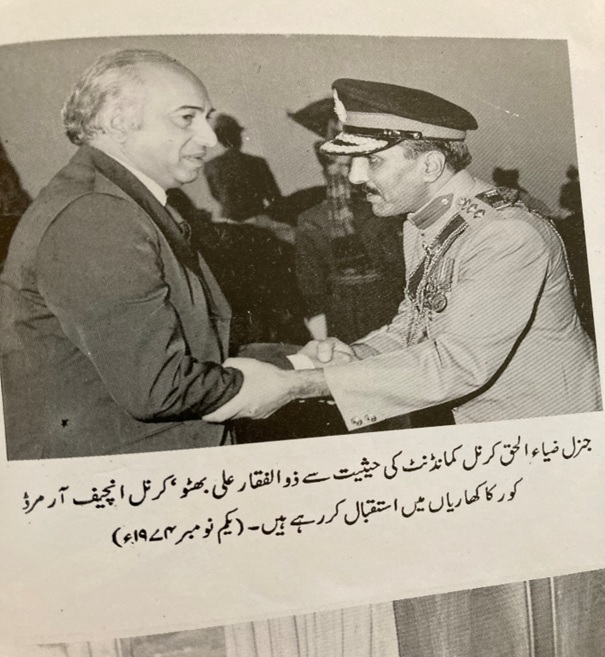
If a gold medal for sycophancy was ever to be awarded, Zia will easily make it to the final list, if not emerging as the outright winner
About Sycophants
By Dr Asif Javed
Williamsport, PA
Early in Donald Trump’s first term, there was a cabinet meeting. The cabinet members, sitting around the table, gushed about “the great privilege and honor” of serving Trump. It was being recoded and was later shown on TV. Trump’s first Secretary of State, Rex Tillerson, was among the attendees. A few months later, after he was unceremoniously dismissed from his job, Tillerson described Trump as a “moron.” It would have been amusing to ask him as to which of the two descriptions of his about the president was correct.
Decades ago, when this scribe was in training in a hospital in Pittsburgh, the residents were once asked to gather in a room. The reason: to celebrate the birthday of the program director. Most of the residents had come from SE Asia and were from middle class background where birthdays were rarely, if ever, celebrated at the time we were brought up. Regardless, we obeyed, clapped and sang happy birthday for the director. Later, it transpired that it was the idea of a bona fide flatterer who wanted to stay in the good books of the director, and he did.
Sycophant denotes “an insincere flatterer who uses it to gain personal advantage,” so says the dictionary. The sycophants have always existed, and they always will. No society is immune from them. Still at times it seems that we have more of them back home than anywhere else. Let’s go over a few examples:
Back in the 1970s, ZA Bhutto was at the peak of his power. There was only one TV channel and there was Radio Pakistan. There used to be a radio program from Lahore. It played music with some social and political talk interspersed. One day, the host, an obvious PPP sympathizer, praised Quaid-e-Awam and Fakhar-e-Asia for several minutes and then made the following announcement: “PM Bhutto has become the heartbeat of the Pakistani people. And listeners, now let’s play the next song.” A few months after his overthrow, when Bhutto was confined to jail, he was overheard saying, “where are those…who claimed to have me in their hearts.” Bhutto’s last interview recorded by Inam Aziz in Lahore, days before his final arrest, is revealing: “I chose the wrong advisors (read sycophants),” he lamented. “I received misleading advice…From now onwards, I intend to stay close to my real strength, the ordinary people.” ZA Bhutto, a man of extra ordinary talent, and a student of history, did not get another opportunity. Instead, his name was added to a long list of victims of sycophancy.
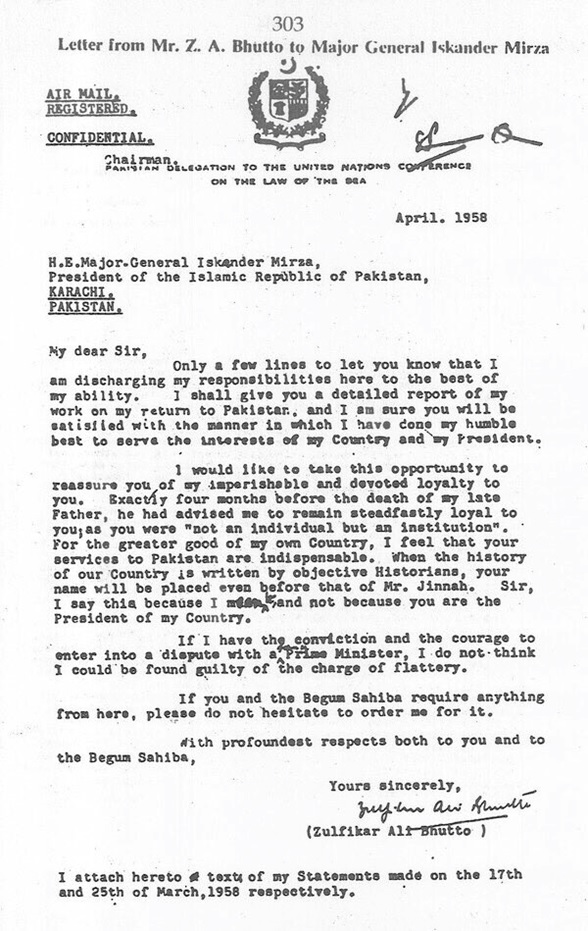
It is ironic that sycophancy played a role in both Bhutto’s rise and fall. His infamous letter to Iskandar Mirza is widely known. Image Annus Raza on X
It is ironic that sycophancy played a role in both Bhutto’s rise and fall. His infamous letter to Iskandar Mirza is widely known. What is less known is a chance encounter in NY, a few years later, when Mirza, then in exile, had turned up in the UN lobby. Javed Iqbal who was in UN as part of the Pak delegation recognized and, likely out of courtesy, greeted the ex-president. Javed then noticed that Bhutto, then a federal minister, tactfully avoided meeting Mirza, the man who had appointed him to his first cabinet post. The times had changed.
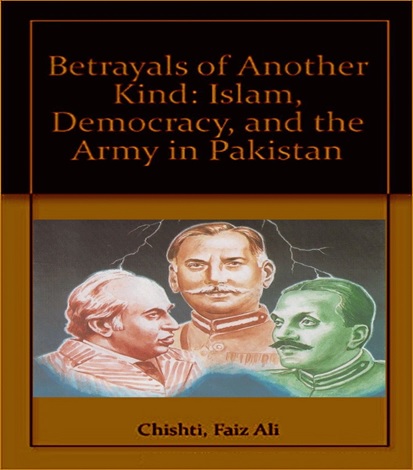
General FA Chishti (Zia’s murshid) narrates an interesting incident in his autobiography Betrayals of Another Kind. There was an eminent lawyer who hated Bhutto. Naturally, he gravitated towards Zia after the military coup. One day that lawyer bumped into Chishti (who was close to Zia) and did what you would not expect from a man of his stature: he tried to flatter Chishti. It was so irritating, Chishti writes, that he felt annoyed and moved away.
And who can possibly forget the sycophant-in-chief of our generation! It was none else but mard-e-momen and mard-e-haq, Zia ul Haq. Zia did it so well that a man of Bhutto’s genius was deceived. He promoted his future executioner over several more senior, and more capable, generals. Zia had, over the years, managed to get in the good books of Bhutto. While a corps commander at Multan, he missed no opportunity to see Bhutto whenever he visited Multan. During one visit to Multan Garrison, women and children-presumably army officers’ wives and children-were made to throw rose petals on the PM. In 1973, Zia had been head of the military court that tried officers accused of 1973 conspiracy. Zia had endeared himself to Bhutto by giving relatively heavy sentences to the accused. Zia was also involved in bestowing the rank of honorary Colonel-in-Chief of the armored corps to Bhutto. The picture of Zia receiving Bhutto at Kharian Cantt. for that event speaks volumes. Bhutto did promote him but had hardly any respect for Zia. Several authors, including General Gul Hasan (former C-in-C of army) and Stanley Wolpert, have given the embarrassing details of the humiliation inflicted upon Zia by Bhutto. If a gold medal for sycophancy was ever to be awarded, Zia will easily make it to the final list, if not emerging as the outright winner.
The menace of sycophancy has been written about by Shakespeare too. The old monarch in King Lear became its victim when he asked his daughters how much they loved him. It was at that point that sycophancy raised its ugly head and the king’s downfall began. Napolean Bonaparte was desperate for an heir. He divorced Katherine, who was unable to produce one, and married an Austrian princess who duly obliged him with a son. Having mastered most of Europe at the time, megalomaniac Napolean, gave the title of King of Rome to his son, likely at the suggestion of a sycophant courtier. After the disaster in Russia, and later at Waterloo, while Napolean ended up at St Helena, the King of Rome spent the rest of his short life in Austria with his mother’s family. There is no record that the King of Rome ever set foot in Rome.
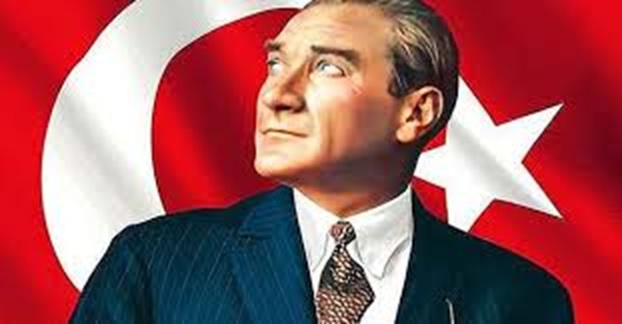
Ataturk, the founder of modern Turkey, once had a failed attempt on his life. Sometime after that, as he sat in the national assembly, this is what he heard from a sycophant: “Oh great genius! These wretches (suspected assassins) do not belong to the Turkish nation…Even hell will not accept them.” -
Ataturk, the founder of modern Turkey, once had a failed attempt on his life. Sometime after that, as he sat in the national assembly, this is what he heard from a sycophant: “Oh great genius! These wretches (suspected assassins) do not belong to the Turkish nation…Even hell will not accept them.” “Sycophancy had a free rein in the assembly,” writes Ataturk’s biographer Andrew Mango. Celal Bayar, Minister of Economy, once sent the following telegram to Ataturk: “I will work as your idealistic laborer, on the radiant road opened by your great genius.” Ataturk had allowed several statues of himself to be placed in several cities, financed by public subscription that created resentment. But Ataturk was also lucky. Ismat Inonu “a man of singular intelligence, of exceptional cunning, a profound observer, animated by highest ideals, most cultivated,” was at his side who more than “made up for Ghazi’s shortcomings.” Love of flattery was one of them. “While monetary corruption is often debated, a form of the same evil, is more rampant and has not received any attention is flattery,” writes Khushwant Singh who
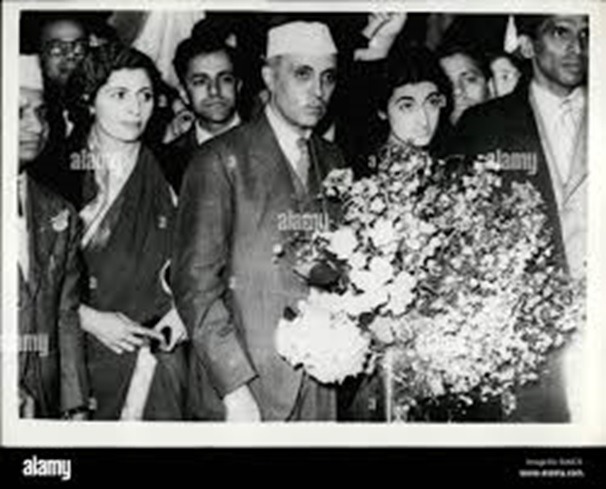
At the end of each meeting, a girl would shout at the top of her voice: Tum jeo hazaroon saal, saal ke din hoon pachaas hazaar. Pandatji, who was notoriously short-tempered with his countrymen, lapped up this flattery, and appeared highly pleases with himself.” – alamy
served in the Indian embassy in London back in the 50s. “It takes many forms but the objective is the same-to promote oneself. I recall some meetings of the Indian students in England, addressed by PM Nehru. At the end of each meeting, a girl would shout at the top of her voice: Tum jeo hazaroonsaal, saal ke din hoon pachaas hazaar. Pandatji, who was notoriously short-tempered with his countrymen, lapped up this flattery, and appeared highly pleases with himself.”
The British left in 1947. That should have been the end of Sirs, Khan Bahadurs and the like. But no, we have invented several titles of our own. A few days before every March 23 and August 14, the nation receives a list of the awardees. And while some are likely deserving, many more have gotten on the list by using their connections and the time-honored formula of sycophancy. The nation has been going through the nauseating spectacle of these medals being placed on the chest of its citizens by corrupt and incompetent leaders for decades. More recently, the title of field marshal is in vogue. India has produced two of them. One of the recipients was Sam- Manekshaw. Manekshaw, a Zoroastrian, was highly respected and had led his country to a decisive victory over the adversary that produced one of the largest unconditional surrenders in the recent history of warfare. Not to be left behind, we, in the meantime, have also produced two of our own. Our first Field Marshal had a dubious record in the 2 nd WW, was responsible for delivering the first blow, not to an enemy, but to democracy, in Pakistan. He was forced out of office by his chosen successor, with the country in turmoil. He had no victories to his name, none. So, what made him get that
title? Dear readers, just close your eyes and imagine that cabinet meeting at Rawalpindi in the early 60s. Those present are Altaf Gohar, Bhutto and the like. The cabinet members are trying to outdo each other in flattering the boss who is blushing. And then someone comes up with this brilliant idea. There is no record of anyone having opposed it.
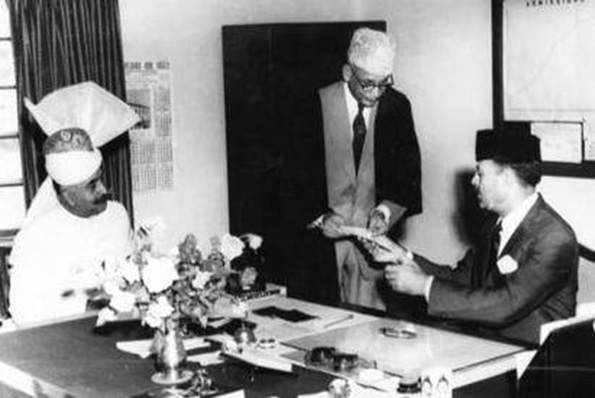
Amir Mohammad Khan, Governor of West Pakistan, used to deliver a monthly radio address. He had given strict instructions to his speech writer that every speech of his - no matter what the context - must mention the name of Ayub Khan, at least twice
Our first Field Marshal was inherently insecure. The cabinet members were aware of it and would miss no opportunity to flatter him. Amir Mohammad Khan, Governor of West Pakistan, used to deliver a monthly radio address. He had given strict instructions to his speech writer that every speech of his-no matter what the context-must mention the name of Ayub Khan, at least twice. Ayub’s insecurity had made him remove popular East Pakistan Governor Azam Khan and replace him with a sycophant Monim Khan. Monim Khan was once in a meeting at Dhaka. In a relaxed mood, he had removed his Jinnah Cap. Having received an unexpected phone call from Ayub, a startled Monim Khan promptly placed the Jinnah Cap back on his head before picking up the phone.
The latest-and international-manifestation of sycophancy was seen recently when the British PM was seen sitting at the feet of President Trump at the recently concluded G7 summit collecting papers supposedly dropped by Trump. Trump must have enjoyed the moment for having inflicted humiliation on Mr Starmer who, on the other hand, may have used the opportunity to flatter Trump. Tony Blair was called Bush’s poodle for blindly following him into the Iraq War. Blair’s labor successor, it seems, is trying to one-up him.

There are nine circles to Dante’s hell, and the flatterers are in the eighth circle while the murderers and tyrants are in the seventh circle - Prezi
Dante sees flattery as a sin that undermines the social fabric. He places flatterers in a lower circle of hell than murderers. There are nine circles to Dante’s hell, and the flatterers are in the eighth circle while the murderers and tyrants are in the seventh circle. The author of Divine Comedy lived seven hundred years ago. But if he were around today, and visited Pakistan, he will be shocked to see an abundance of the future residents of his eighth circle of hell. For now, several of them are sitting in high places with impressive insignias and medals. And that is our Islamic Republic’s misfortune.
As for our recently promoted Field Marshal, he reminds one of Napolean at Moscow in 1812. Napolean at that point felt invincible. With his Grande Armee, he appeared to have defeated Russia, had occupied Moscow, and was expecting a request from the Czar for surrender. Little did he know that ‘Gen Winter’ awaited him just a few weeks down the road. Waterloo and St Helena were far from his mind. Our Field Marshal too is surrounded by sycophantic advisors and politicians who have deluded him. No one is telling the emperor the truth. Let us wait for the verdict of history.
References : Apna Grebaan Chaak by Javed Iqbal; Working With Zia by Gen KM Arif; Betrayals ofAnother Kind by Gen FA Chishti; Ataturk by Andrew Mango; Stop Press by Inam Aziz; Pakistan:Qiadat Ka Bohran by Gen Jahandad Khan; Khushwantnama by Khushwant Singh
(The writer is a physician in Williamsport, PA and may be reached at asifjaved@comcast.net)