Book & Author
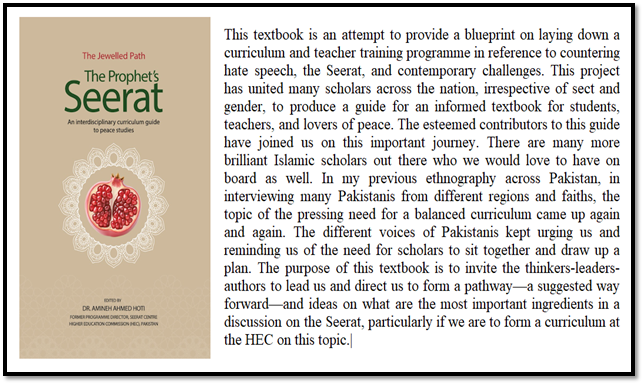
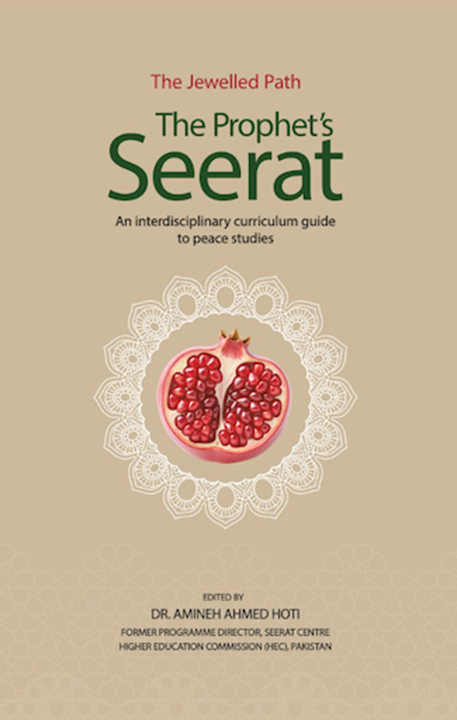
Dr Amineh Ahmed Hoti (Editor): The Prophet’s Seerat — An Interdisciplinary Curriculum Guide to Peace Studies
By Dr. Ahmed S. Khan
"Key Muhammad say wafa tu Nay to Hum Teray haiN,
Yah jahan cheez hay kya, Lauh-o-Qalam Teray haiN
If You are loyal to Muhammed, We are yours
This World is nothing — destiny itself is yours
The couplet form Bang-e-Dara (published 1924) encapsulates Dr Muhammed Iqbal’s belief that devotion to the Prophet (pbuh) is the lifeblood of Muslim identity. According to prominent Islamic scholar, Professor Dr Annemarie Schimmel, Allama lqbal sums up what millions and millions of pious Muslims have felt over the centuries and still feel about the Prophet [pbuh]: Love of the Prophet [pbuh] runs like blood in the veins of his community.
The heart of every Muslim is filled with extreme love and utmost respect for the last Prophet Muhammad (pbuh) — the greatest benefactor of Humanity, and Mercy to Humanity. The noble Qur’an mentions him as Rahmatul-lil-Alameen: “And we have not sent you, [O Muhammed], except as mercy to the worlds.” (Qur’an, 21:107)
Commenting on the central role of Prophet Muhammed (pbuh) and the challenges facing Islam in the contemporary world, prominent scholar Qutubuddin Aziz observes: “In the galaxy of God's Messengers and Prophets who showed mankind the righteous path, the resplendent' glory of the achievements of the Prophet of Islam has remained undimmed over the past fourteen hundred years. Unfortunately, the Western world's understanding of him remained warped for many centuries because of the hostile propaganda waged against Islam, particularly during the Crusades. God be thanked that during the second half of the 20th Century, with the emergence of more than 45 independent Muslim States, the tide has turned and the non-Muslim communities, especially the Christians in those countries where sizable groups of Muslims now live, want to know more about Islam and its Prophet. In the course of the present century, far more literature on Islam, the Prophet and related Islamic themes has appeared in the West than ever before in the history of Islam. Nevertheless, many cobwebs of misunderstandings still persist in many parts of the West about Islam. It is the duty of conscientious Muslims and their fair-minded non-Muslim friends, especially amongst the "People of the Book," i.e. Jews and Christians, to remove these misunderstandings and misconceptions. We must build bridges of concord and amity with non-Muslim communities and stress the fact that Islam and its Prophet sought the good of the entire human race. (Qutubuddin Aziz, Karachi, Pakistan December 1, 1988, Preface, The Prophet of Peace and Humanity).”
The Prophet’s Seerat — An Interdisciplinary Curriculum Guide to Peace Studies edited by Dr Amineh Ahmed Hoti, a scholar in interfaith dialogue and peace education, brings together fourteen chapters authored by academics and practitioners, each exploring — Seerat— the life and teachings of Prophet Muhammad (pbuh: peace be upon him) through the lens of peace, compassion, and ethical conduct. A detailed biography of Dr Amineh Ahmed Hoti is available at: https://www.alumni.cam.ac.uk/alumni-stories/a-blueprint-for-world-peace-%E2%80%93-dr-amineh-hoti
Dr Hoti’s introduction sets the tone for the book, framing the Prophet’s Seerat (biography) as a foundational source for peace studies. She emphasizes the need for interdisciplinary approaches that bridge religious teachings with contemporary global challenges. Her vision is to cultivate a generation of learners who are not only knowledgeable but also morally grounded and socially responsible.
In the introduction, Dr Hoti, commenting on challenges faced by Islam and how to deal with them, observes: “Islam’s image, at present, however, is going through a problematic period with its followers, particularly the youth, sometimes being labeled as violent terrorists and extremists. The reality is far more complex. Interpretations, misinterpretations, and misrepresentations of Islam lead a part of the world to view the religion taught by the Prophet Muḥammad (pbuh) in a negative light. Internationally, Pakistan, as one of the largest Muslim nations, is at the forefront of this negative image. For neighbors, more understanding, calmness, and a strategy of peace is needed. Less hate, more love. Less accusations, more understanding, less building of walls and more building of bridges. It is time to face these challenges head-on and confront the reality rather than adopting a policy of non-question as we have so far in matters of religion. To break away from this negative image and imbue our youth with confidence in their own religion, Pakistanis must return to the Seerat, appreciating its relevance to all times. We all must read and understand the body of Seerat in order to see the religion of Prophet Muhammad in the light of love, beauty, knowledge, and creativity.”
The editor further observes: “With this in mind, the Higher Education Commission, or HEC, has launched the Seerat Centre, which is dedicated to modernizing the education system of Pakistan to be able to address and deal with these contemporary challenges in the light of the Seerat. Initiated in 2014 by the Government of Pakistan, the Seerat Chairs Project has identified nine contemporary challenges and aims to set heads of chairs for each area of focus to oversee curriculum revision, teacher training, research, and dissemination of knowledge. As director of the project, I have, therefore, requested scholars to write a guidance chapter on each of these topics for this handbook.”
Each chapter in the book offers a unique perspective, in an attempt to weave together Islamic teachings with modern academic disciplines. The diversity of topics—from sustainable development to gender equity—reflects the holistic nature of the book.
In Chapter 1 “Islamic Approaches to Sustainable Development,” the authors, Asad Zaman and Junaid Qadir explore how Islamic principles, such as stewardship (khalifah) and balance (mizan), align with global sustainability goals. The authors argue that ecological consciousness and resource conservation offer a model for environmentally responsible living.
In Chapter 2 “Teaching Social Justice and Welfare: A 21st Century Approach,” the author Mahboob Mahmood presents a case for integrating social justice into education. The chapter outlines pedagogical strategies that promote equity and civic engagement.
Chapter 3 “Significance of Seerat for Education in Light of the Vision of Pakistan” authored by Ayesha Leghari connects Seerat-based teachings to Pakistan’s educational vision, highlighting how Seerat-based curricula can foster national unity, moral development, and peace building.
In Chapter 4 “Seeking Knowledge’ the author Muhammed Aamir Tauseen attempts to showcase emphasis on lifelong learning. The author tries to show how the pursuit of knowledge is vital for personal and societal growth via Seerat context.
In Chapter 5 “Empathy: A Sunnah of the Prophet (pbuh)” the author Safdar Ali Shah delves into the Prophet’s empathetic interactions with people of all backgrounds. The chapter argues that empathy is not only a moral virtue but also a strategic tool for conflict resolution and community cohesion.
Chapter 6 “Mercy: A Sufi Perspective,” by Tanvir Anjum, offers a mystical interpretation of the Prophet’s mercy, drawing from Sufi traditions. The chapter enriches the discourse by highlighting the spiritual dimensions of compassion and forgiveness.
In Chapter 7 “Sufism: A Code of Peaceful Conduct,” the author Sahibzada Sultan Ahmad Ali expands on the role of Sufism in promoting peace and tolerance. He links the Sufi practices to inner purification and harmonious living.
Chapter 8 “Building a Gender-Sensitive Curriculum in Light of the Seerat,” by Shahida and Zahra Rao, addresses gender equity through respectful treatment of women. The authors advocate for curricula that empower female students and challenge patriarchal norms.
In Chapter 9 “Transition of Women from ‘Imperfect’ to ‘Perfect’ Legal Capacity” the author Aayesha Rafiq explores the Islamic legal reforms that enhanced women’s rights. The chapter provides historical context and suggests contemporary applications in legal education.
Chapter 10 “Compassion in Islamic Teachings” by Monazza Hayat examines compassion as a core Islamic value. She argues that compassion should be central to educational philosophy and interpersonal relationships.
In Chapter 11 “Business Ethics in the Seerat of Prophet Muḥammad (pbuh),” Mohsin Naqvi discusses the Prophet’s ethical conduct in trade and commerce. The chapter highlights principles such as honesty, fairness, and social responsibility, offering a blueprint for ethical entrepreneurship.
Chapter 12 “The State of Madinah and the Accessibility of a Leader,” by Tughrul Yamin, analyzes the governance model of Madinah, emphasizing transparency, justice, and participatory leadership.
In Chapter 13 “The Search for Global Peace: Implementing the Idea of a United Empathy in an Age of Collective Conflict,” authors Muḥammad Ilyas and Anjum Malik propose a global framework for peace based on empathy and mutual understanding.
And the final chapter “Living Harmoniously—Lessons from a Global Role Model” by Asad Zaman and Junaid Qadir reflects on the Prophet’s universal appeal as a role model for harmonious living. They advocate educational reforms that prioritize character development and intercultural dialogue.
One of the book's major strengths lies in its interdisciplinary approach. In its attempt to bridge Islamic teachings with modern academic fields—education, law, environmental science, gender studies, and political science— the book offers a comprehensive framework for peace education. It challenges readers to rethink conventional curricula and consider how values like empathy, justice, and sustainability can be embedded in educational systems.
Expounding on the challenges of finding scholars with appropriate background, the editor states: “ In putting the Seerat program together and in finding scholars for the Chairs we had great challenges…I was told that finding scholars who had some grasp of knowledge of both East and West had been a big challenge. There were either scholars who were orientalists—mainly Western scholars who studied Islam and Muslims societies from the point of view of “the Other”, sometimes in problematic ways. Or there were scholars who were primarily Urdu speaking and had very little command of the lingua franca, English. This meant they could neither write nor communicate to the world about either their point of view or their strengths. Scholars of other countries and faiths often spoke about and for them, many times misinterpreting and misrepresenting their communities, their perspectives, and the diversity and essence of their faith. When I first came to HEC, my office was visited by individuals from both of these groups. The HEC had already selected its three chairs who were mainly Urdu speakers and from conservative backgrounds. In the research we were doing we needed both the balance of perspectives and of young scholars. So, I decided to get my team to take in young scholars from LUMS and other Pakistani universities who were also postgraduates of Western universities such as the LSE and Columbia…”
While The Prophet’s Seerat: An Interdisciplinary Curriculum Guide to Peace Studies edited by Dr Amineh Ahmed Hoti is an important work, it is not without limitations. Here are some of the key shortcomings and areas where the book could be further strengthened.
1. Lack of Pedagogical Design: The book is positioned as a “curriculum guide,” yet it lacks a structured pedagogical framework. There are no lesson plans, learning outcomes, and modules that would help educators use the Prophet’s biography in a systematic way. It may not fully meet the needs of educators seeking to design a Seerat-based peace education curriculum. Future revisions should ensure that all chapters follow a standardized format, including: an introduction, clearly defined learning objectives or outcomes, a content outline, recommended teaching methods and pedagogical approaches, a list of educational resources, and assessment and evaluation rubrics.
2. Lack of Diverse Perspectives: The work reflects Pakistani viewpoints. The global relevance of the Prophet’s teachings could be better illustrated by incorporating perspectives from other global communities. Future editions could benefit from contributions by international scholars to broaden the cultural and contextual scope. Moreover, all authors should use the same format for listing references for their work. Some authors have not listed any references and some have used Urdu language to cite their references in an English language book. All authors must be required to cite references in English using a specific style.
3. Lack of Content and Context Validity: The majority of contributors have strong backgrounds in their respective domains, but they lack credentials in pedagogical training and Islamic scholarship — which makes their work lag in content validity and context validity.
4. Thematic Drift from Core Seerat: Although the book is titled around the Seerat, many chapters only loosely connect their themes to the Prophet’s biography. The Seerat is often used as a moral or inspirational backdrop rather than being the central subject of analysis. This may leave readers expecting a more direct engagement with the Prophet’s life feeling underwhelmed. The book risks being perceived as a thematic anthology on peace and ethics in Islam rather than a focused Seerat-based curriculum.
5. Minimal Use of Visual Aids: The book is largely text-based, which may limit its appeal in educational environments that benefit from visual learning. Charts, infographics, timelines, and illustrations could enhance engagement and comprehension. A companion workbook or multimedia version could enrich the learning experience.
6. Lack of Thematic Anchoring: Each chapter could have been more explicitly anchored in specific episodes or traits from the Prophet’s life. For example, a chapter on sustainability could have been drawn from the Prophet’s water conservation practices. A chapter on gender equity could have explored his relationships with women like Hazrat Khadijah (RA) and Hazrat Aisha (RA). A chapter on governance could have analyzed the Constitution of Madinah in detail. Implication: The book sometimes feels like it uses the Seerat as a symbolic reference rather than a substantive foundation.
While the book is a valuable interdisciplinary contribution to peace studies and Islamic ethics, its title may set expectations for a more focused and structured engagement with the Prophet’s Seerat. A future edition could benefit from a clearer integration of Seerat into each chapter. All chapters must be revised with the help of seerat scholars, pedagogical and linguistic experts.
Dr Hoti concludes the book with the following statement: “In these difficult global times of the post-pandemic corona virus and particularly with so many Muslim communities directly suffering from genocide, wars, immigration, and Islamophobia, this is the right time to inculcate the Seerat, our beloved Seerat, and become the embodiment of it in our lives through practicing empathy, firmness in faith, compassion, forgiveness, and above all holding fast to the rope of Rabbee on the path, the siraat al mustaqeem.”
The Prophet’s Seerat: An Interdisciplinary Curriculum Guide to Peace Studies is an important work that explores education through the lens of Islamic ethics and peace building. The book serves both as a supplementary resource and a moral compass for educators, students, and policymakers. In an age marked by polarization and unrest, it offers a meaningful path toward unity, compassion, and understanding.
(Dr Ahmed S. Khan is a Fulbright Specialist Scholar)