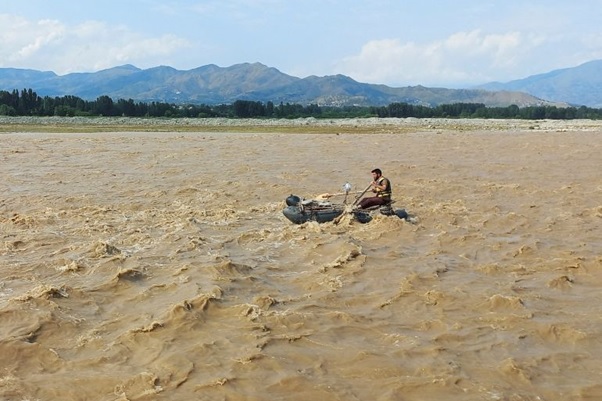
At least nine members of a family were swept away by overflowing floodwaters in the Swat River last month – Photo Hazrat Ali Bacha/Reuters
What Are Flash Floods and Landslides and Why Do They Occur?
An NDMA (National Disaster Management Authority) report reveals that a total of 234 people, including 112 children, have died across Pakistan since June 26.
With the onset of the monsoon season, which typically lasts from late June to September, different parts of the country are witnessing heavy rainfall and a heightened risk of extreme weather events like flash floods and landslides, especially in its northern and western regions .
According to the Global Climate Risk Index, Pakistan ranks as the fifth most vulnerable country to climate change. Devastating flash floods in 2022 killed at least 1,700 people, affected more than 33 million, swept away swathes of agricultural land, and caused losses worth $30 billion, according to governmental estimates.
This year, floods and rain-related incidents like roof collapses and electrocution have killed at least 234 people, including 112 children, since June 26, according to a report by the National Disaster Management Authority (NDMA).
What are flash floods?
According to the World Meteorological Organisation (WMO), flash flood is “a flood of short duration with a relatively high peak discharge in which the time interval between the observable causative event and the flood is less than four to six hours.”
It is generally characterised by raging torrents after heavy rains, a dam or levee failure or a sudden release of water in a previously stopped passage that rips through riverbeds, urban streets, or mountain canyons, sweeping away everything in its path.
They differ from riverine floods in terms of their rapid onset and decline, high intensity, and unpredictability as well as their usually more localised impact in hilly and mountainous areas rather than the plains.
The Pakistan Meteorological Department (PMD) has previously highlighted the danger to local and seasonal streams in areas like Murree, Galiyat, Mansehra, Kohistan, Dir, Swat, Shangla, Nowshera, Swabi, Islamabad, Rawalpindi, Dera Ghazi Khan, northeastern Punjab, and Kashmir.
Besides natural causes, a number of anthropogenic (deriving from human activity) factors contribute to either creating the conditions that favour the development of flash floods or increase the associated risk, such as settlements on flood plains, urbanisation, deforestation, and failure to maintain or manage drainage systems.
What are landslides?
A landslide, on the other hand, is defined as the movement of a mass of rock, debris, or earth down a slope. The term encompasses five modes of slope movement: falls, topples, slides, spreads, and flows.
Landslides usually have multiple causes. Slope movement occurs when forces acting down-slope (mainly due to gravity) exceed the strength of the earth materials that compose the slope.
Causes include factors that increase the effects of down-slope forces and factors that contribute to low or reduced strength.
What to do during a flash flood or landslide
According to the NDMA , communities and individuals can take several preventive measures to reduce the impact of flash floods as well as landslides. These include:
- Stay informed about weather forecasts and flood alerts.
- Evacuate to higher ground immediately if advised by authorities.
- Assess property damage and prioritise safety during cleanup efforts.
- Prepare an emergency kit with essentials like food, water, medications, and documents.
- Avoid walking or driving through floodwaters; they may be deeper or faster-flowing than they appear.
- Seek medical attention for injuries or illnesses related to the flood.
- Follow instructions from emergency services and local authorities.
- Organise community cleanup efforts to remove debris and restore infrastructure.
- Establish and maintain early warning systems to alert residents of potential floods.
- Engage volunteers for emergency response and build shelters for displaced residents.
- Provide support services such as counselling and relief assistance to affected individuals and families.
- Conduct drills and exercises to practice evacuation procedures.
- Coordinate with neighbouring communities and authorities for flood conditions, mutual aid and support.
- Implement long-term flood mitigation measures like improving drainage systems and resilience. – Dawn.com
Al Jazeera adds: Lahore, the provincial capital of Punjab, saw heavy, intermittent rains last week which left several low-lying areas in the city without electricity and resulted in severe waterlogging of the city’s narrow streets. Other areas in central and southern Punjab also suffered heavy rainfall, with the country’s meteorological department predicting further rain in the coming days.
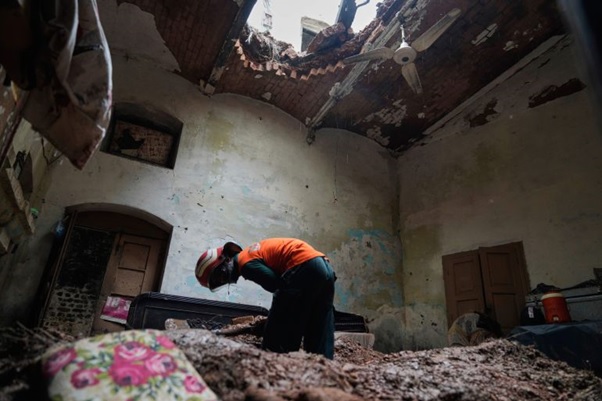
A rescue worker removes debris from a house that collapsed after heavy rain in Lahore on July 10 – photo K M Chaudhary/AP Photo]
Similarly, the Khyber Pakhtunkhwa province, where at least nine people of one family drowned in Swat River while having a picnic last month, also faced heavy rain in various areas.
The Pakistan Meteorological Department (PMD) has warned that another strong monsoon weather system will hit most parts of Khyber Pakhtunkhwa in the next few days, while Punjab is expected to receive heavy showers.
An NDMA official, who requested anonymity as he was not authorised to speak to the media, told Al Jazeera that, according to weather forecasting, the authority is not expecting a repeat of 2022-like “large-scale riverine floods at this stage”.
But the official added that localised flash floods and urban flooding remain a significant concern across the country.
“The NDMA has issued early warnings and advisories to provincial authorities and the public and has pre-positioned critical relief supplies at vulnerable locations. We continue to monitor the situation through satellite-based systems, weather models, and real-time ground reporting,” the official added.
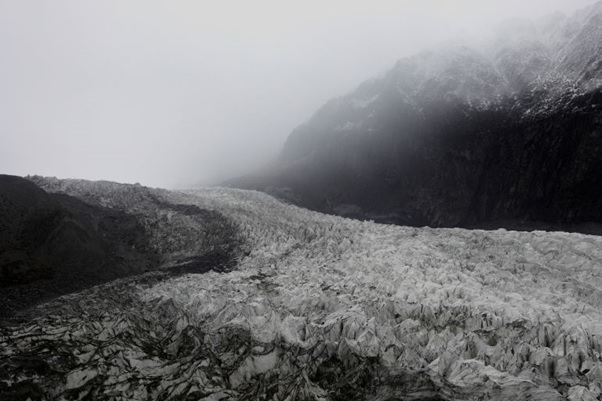
Pakistan’s Gilgit Baltistan region is home to thousands of glaciers, giving it the moniker of ‘the third pole’, but the excessive heat this year has led to rapid melting, causing a risk of floods - Photo Akhtar Soomro/Reuters
How is climate change affecting the crisis?
South Asian nations, including Pakistan, typically receive 70 to 80 percent of their annual rainfall during the monsoon season, which lasts from late June to September. This year, damage caused by monsoons is compounded by extreme heat in the country’s northern Gilgit-Baltistan region, dubbed the “third pole” as it is home to many of the world’s important glaciers .
According to the PMD, parts of the mountainous region recorded temperatures above 48 degrees Celsius (118 degrees Fahrenheit), despite being situated at least 1,200 metres (4,000ft) above sea level.
Gilgit-Baltistan is home to thousands of glaciers and attracts climbers from across the globe. A study last year by Pakistan’s Ministry of Climate Change and the Italian research institute EvK2CNR estimated that the country hosts more than 13,000 glaciers.
Excessive heat has accelerated the melting of these glaciers this year, heightening the risk of floods and infrastructure damage, as well as posing a severe threat to life, land and water security.
Sitara Parveen, an environmentalist and assistant professor at Fatima Jinnah Degree College in Gilgit, said the June heatwave triggered rapid glacial melting, with temperatures in some areas breaking nearly three-decade records.
“However, risk of floods with monsoon is high, considering the evidence from ‘Little Ice Age’, where precipitation remained high with high temperature and there was less precipitation with low temperature,” Parveen told Al Jazeera.
The “Little Ice Age” was a period of regional cooling, primarily affecting the North Atlantic, from the early 14th to the mid-19th centuries.
Zakir Hussein, director general for Gilgit Baltistan’s Disaster Management Authority, told Al Jazeera: “Given the rise in temperatures and anthropogenic climate change, the fragile ecosystem in Gilgit Baltistan is facing imminent flash flooding and risk of Glacial Lake Outburst Flood (GLOF) – a type of flood caused by the sudden release of water from a glacial lake.”
Who is to blame for the crisis in Pakistan?
Pakistan says the international community is not doing enough to help.
In 2023, United Nations Secretary-General Antonio Guterres argued that the international community is obligated to provide assistance, as Pakistan is responsible for only half a percent of global greenhouse emissions but its people are 15 times more likely to die from climate-related disasters.
Following the 2022 floods, Pakistan hosted a global donor conference with support from the UN in January 2023, at which approximately $10bn was pledged by donor nations – albeit much in the form of loans. But by 2024, Pakistan had received only $2.8bn of those pledges.
Earlier this year, a former head of Pakistan’s central bank said the country would need annual investments of $40-50bn until 2050 to address its escalating climate challenges .
However, while Pakistan faces genuine climate risks, some experts argue the crisis has been worsened by longstanding governance failures and poor policy decisions.
In several recent incidents, civilian casualties in Punjab and Khyber Pakhtunkhwa were traced to the illegal construction of homes near riverbeds and flash floods sweeping away poorly built houses.
A 2023 report by UN-Habitat, which promotes environmentally sustainable cities and towns, highlighted Pakistan’s problem of disorganised urban planning, revealing that rapid rural-to-urban migration has led to sprawling slums due to an acute housing shortage.
“This unmet demand has led to over 50 percent of the urban population residing in slums or informal settlements known as katchi abadis,” the report stated.
NDMA officials say the agency has taken a multi-tiered preparedness approach where the focus is not just on emergency response, but also risk reduction and early evacuation…