Book & Author
Daniel H. Joyner: Iran's Nuclear Program and International Law —From Confrontation to Accord
By Dr Ahmed S. Khan
The Israeli attack on Iran has triggered significant and far-reaching repercussions across political, military and diplomatic domains. The major consequences unfolding from this event are:
1. Massive Military Escalation: Israel launched a large-scale airstrike involving over 200 jets targeting more than 100 sites across Iran, including nuclear facilities, military command centers, and key infrastructure. The attack also killed several high-ranking Iranian military officials.
2. Civilian Casualties and Infrastructure Damage: In addition to military targets, residential areas were hit killing dozens of people.
3. Regional Tensions: Political analysts expect other countries in the region to get involved in the conflict.
4. Global Reactions: The UN Secretary-General António Guterres condemned the escalation and called for “maximum restraint.” The UN Security Council held an emergency session at Iran’s request, supported by Russia and China. The International Atomic Energy Agency (IAEA) expressed deep concern over the attack on nuclear facilities. NATO Secretary General Mark Rutte emphasized the need for urgent de-escalation and diplomatic engagement.
5. Impact on Nuclear Diplomacy: The attack occurred amid the ongoing nuclear negotiations involving Iran and the US. The massive strikes are seen as a deliberate attempt to undermine diplomatic progress and derail any chances of reviving or renegotiating JCPOA.
6. US Political and Strategic Implications: Contrary to the Trump administration’s claim that the US did not participate directly, Israeli strikes were coordinated with or tacitly supported by the US. This action has sparked debate within the US Congress about the risks from being drawn into a wider Middle East conflict.
7. Risk of Wider Regional/Global War: The Israeli attack has significantly increased the risk of a broader regional conflict potentially involving Iraq, Lebanon, Syria and the Gulf countries. Many political analysts warn that any more miscalculations could trigger wars in South Asia and Europe.
8. President Trump’s credibility and Popularity: The recent Israeli attack and the "No Kings Day" parades have had notable implications for President Trump's popularity, both domestically and internationally— especially considering his “No New Wars” pre-election stance and promise to end the war in Ukraine, and perpetual genocide of Palestinian people in Gaza. President Trump has strongly supported Israel's recent military strikes on Iran, calling them "excellent" and warning that "more is to come." His efforts to negotiate a new nuclear deal with Iran may be undermined by the Israeli strikes.
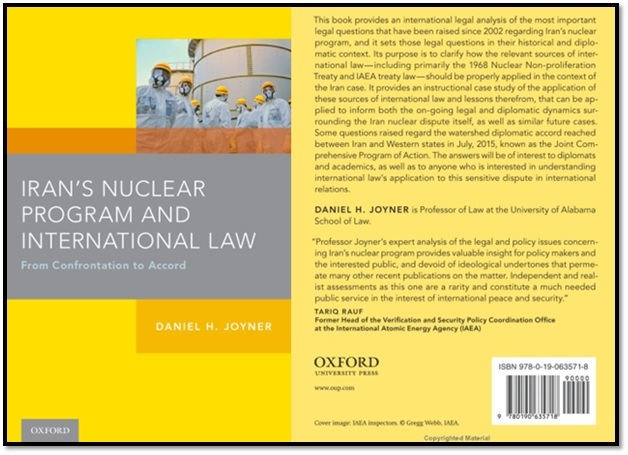
Iran did not start its nuclear program recently, rather it was established in the 1950s with the help of the United States. Iran’s Nuclear Program and International Law: From Confrontation to Accord (2016) by Daniel H. Joyner is a well-researched and intellectually rigorous examination of one of the most contentious international legal disputes of the 21st century. The book offers a comprehensive legal analysis of the international community’s response to Iran’s nuclear program — focusing particularly on the period from 2002 to the landmark Joint Comprehensive Plan of Action (JCPOA) in 2015.
The author, Daniel H. Joyner, a professor of law at the University of Alabama and a recognized expert in international nuclear law, approaches the Iran nuclear issue not from a political or security perspective, but through the lens of international legal norms. This framing is both refreshing and essential — as it allows the reader to disentangle the legal obligations and rights of Iran from the often politically charged narratives shown in the media.
The book is divided into two parts: “Confrontation” and “Accord.” The first part narrates the legal and diplomatic developments — from the early 2000s, when Iran’s nuclear activities came under intense scrutiny — through to the years of escalating tensions and sanctions. The second part focuses on the Joint Comprehensive Plan of Action (JCPOA) and the legal implications of the agreement and its aftermath.
Part I, Confrontation, covers the topics of: Iran’s Nuclear Program and the Period of Confrontation from 2002 to 2015, Has Iran Violated the NPT? Was Iran in Violation of Its Safeguards Obligations in 2003? What about Its Failures to Timely Declare Nuclear Facilities? Was Iran in Violation of Its Safeguards Obligations in July 2015? And, Did the IAEA Use Proper Standards in Its Assessments of Iran’s Compliance? What Were the Implications of the Actions of the UN Security Council?
Part II, Accord, delves into the details of the Joint Comprehensive Plan of Action (JCPOA) and Developments since July 2015.
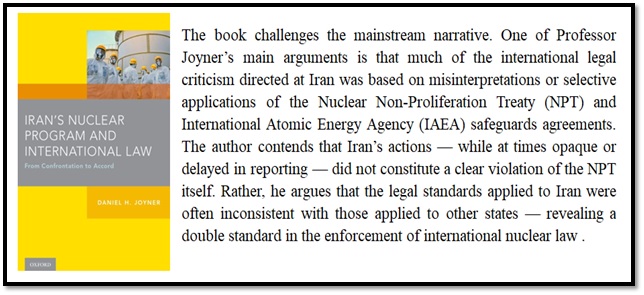
The book challenges the mainstream narrative. One of Professor Joyner’s main arguments is that much of the international legal criticism directed at Iran was based on misinterpretations or selective applications of the Nuclear Non-Proliferation Treaty (NPT) and International Atomic Energy Agency (IAEA) safeguards agreements. The author contends that Iran’s actions — while at times opaque or delayed in reporting — did not constitute a clear violation of the NPT itself. Rather, he argues that the legal standards applied to Iran were often inconsistent with those applied to other states — revealing a double standard in the enforcement of international nuclear law.
His argument is particularly compelling in Chapter 3, where he dissects the claim that Iran violated the NPT. He demonstrates that the treaty does not prohibit uranium enrichment per se — and that Iran’s enrichment activities — while controversial — were not in themselves illegal under the NPT. He further critiques the IAEA’s evolving interpretation of its mandate, suggesting that the agency at times overstepped its legal authority in assessing Iran’s compliance.
Another significant contribution of the book is its analysis of the United Nations Security Council’s role in the Iran nuclear dispute. The author questions the legality of the Council’s resolutions imposing sanctions on Iran, arguing that they were based on political judgments rather than clear legal violations. The author raises important questions about the balance of power in international law and the potential for politicization of legal processes by powerful states.
In the second part of the book, the author focuses his attention on the JCPOA — the multilateral agreement reached in July 2015 between Iran and the P5+1 (China, France, Russia, the United Kingdom, the United States, and Germany). The author provides a detailed legal analysis of the agreement, its implementation mechanisms, and its implications for international law. The author views the JCPOA as a pragmatic diplomatic solution that — while not perfect — represents a significant achievement in non-proliferation diplomacy.
The author emphasizes that the JCPOA is not a legally binding treaty under international law, but rather a political agreement forced by the powerful states. This distinction has profound implications —particularly in the light of the US withdrawal from the agreement in 2018. The author’s analysis helps readers understand why the agreement’s legal status made it vulnerable to unilateral abandonment, and what that means for future diplomatic efforts and initiatives.
The book has several major strengths:
1. Rigorous Legal Analysis: The author’s expertise in international law is evident throughout the book. He provides a thorough and precise interpretation of the Nuclear Non-Proliferation Treaty (NPT), International Atomic Energy Agency (IAEA) safeguards, and United Nations Security Council resolutions. His legal reasoning is meticulous, offering readers a clear understanding of the legal frameworks governing nuclear activities.
2. Challenging Dominant Narratives: One of the book’s most compelling strengths is its critical stance on the mainstream Western narrative regarding Iran’s nuclear program. The author argues that many of the accusations against Iran were based on politically motivated interpretations rather than objective legal violations. This perspective encourages readers to question assumptions and consider the role of power politics in international law enforcement.
3. Clarity and Accessibility: One of the book’s greatest strengths is its clarity and precision. The author writes with the authority of a legal scholar but avoids unnecessary jargon, making the book comprehensible to general readers with interest in international law or nuclear policy. His arguments are well-supported by references to treaty texts, legal precedents, and official documents, and he consistently distinguishes between legal analysis and political opinion.
4. Balanced and Fair Approach: While the author is critical of the West’s approach to Iran, he does not exonerate Iran of all responsibility. He acknowledges Iran’s shortcomings to fully cooperate with the IAEA and its sometimes confrontational posture. However, he insists that legal analysis must be grounded in objective standards, not political expediency and pressure tactics. His balanced approach enhances the credibility of his arguments and underscores the importance of fairness in international legal processes.
5. Insight into the JCPOA: The author offers a detailed legal examination of the Joint Comprehensive Plan of Action (JCPOA) explaining its structure, legal status, and implications. His analysis helps readers understand why the JCPOA was a diplomatic breakthrough and why its non-binding nature made it vulnerable to political shifts —such as the US withdrawal in 2018.
6. Contribution to Legal Scholarship: The author’s scholarship fills a critical gap in the literature by providing a legal-centric analysis of the Iran nuclear issue —which is often discussed in political or security terms. His scholarship contributes to a better understanding of how international law couples with global security concerns.
7. Use of Primary Sources: The book is well-supported by an extensive list of references to treaties, official documents and legal texts. The author’s use of primary sources strengthens his arguments and enhances the academic rigor — providing a solid ground for further research.
The book has some shortcomings too: while it is a masterpiece in terms of legal analysis, it lacks a broader geopolitical context. The author avoids delving deeply into the strategic motivations of the various major actors involved, focusing instead on legal principles. This is both a strength and a limitation — it keeps the analysis focused but may leave general readers wanting a fuller picture of the global political dynamics. Moreover, the book was published shortly after the JCPOA was signed, and thus it does not address subsequent developments — such as the US withdrawal from the agreement or Iran’s responses and major actors’ repeated threats of military action.
In a chapter titled “History, Origin, Development, And Structure of Iran's Nuclear Program” discussing the birth of Iran’s nuclear program, the author observes: “In the 1950s Shah Mohammad Reza Pahlavi became motivated to develop nuclear technology in Iran for a number of reasons. One of these was generally to develop Iranian independence and strength. As with many countries in the Middle East, Iran viewed itself as having been historically exploited by stronger Western powers, particularly with regard to its natural oil wealth. In light of this history, and particularly in light of the overthrow of the democratically elected prime minister of Iran, Mohammed Mossadegh, in a coup orchestrated by the United States and the United Kingdom in 1953, many Iranians at the time felt that Iran was ‘a weak country that must do what it can to protect itself against stronger and more aggressive ones to achieve some kind of ‘independence’ within a Western-dominated world that is historically hostile.’”
The author further states: “For the Shah, developing nuclear technology presented one means by which Iran could break from this history of exploitation and ‘modernize’ itself. The Shah did not view rebelling against Western ideas to be an effective means of breaking away from Western dominance but instead believed that ‘modernization and Westernization were synonymous’ and that by emulating the West, he could modernize Iran and help it join the ranks of the most powerful countries in the world.”
Referring to the establishment of Iran’s nuclear program, the author notes: “In 1957, the United States and Iran signed a bilateral agreement entitled ‘Cooperation Concerning Civil Uses of Atoms.’ This agreement laid the framework for Iran's pursuit of nuclear technology for peaceful purposes, with Western assistance. The agreement provided for US technical assistance, the lease of US origin uranium, and the delivery from the United States of a light-water research reactor. That same year, the International Atomic Energy Agency was created, in implementation the goals outlined in US President Eisenhower's 1953 ‘Atoms for Peace’ speech, including positive international assistance particularly to developing states in their acquisition of nuclear technology for civilian purposes. 9 Beginning with the 1957 bilateral agreement, the United States was to play a central role in the successful development of Iran's nuclear program. In the words of David Patrikarakos, ‘nuclear power was born in Iran; the USA was its midwife.’”
Expounding further on the development of the nuclear program, the author states: “In 1967, the Tehran Research Reactor (TRR), a pool-type, water-moderated reactor, was supplied to Iran by the United States firm GA Technologies. The United States also supplied Iran with 5.54 kilograms (kg) of enriched uranium to use in this reactor, along with other countries, arranging visits and exchanges. Relations were especially good between the United States and Iran during this period. US President Richard Nixon and the Shah were close friends, and Nixon approved of the idea of Iran acting as a ‘regional policeman’ of the Middle East. In the early 1970s, Iran's nuclear program continued to grow and develop with the support of the United States and other Western powers… The Atomic Center of Tehran University was soon renamed the Tehran Nuclear Research Center (TNRC).”
Discussing Iran’s intentions for using nuclear energy for peaceful purposes, the author notes: “During this time, Iran was eager to cooperate with other states, and to show that it intended to pursue nuclear energy for peaceful purposes. It signed the Limited Test Ban Treaty in 1963 and the Nuclear Nonproliferation Treaty (NPT) on the first day that it was open for signatures, July 1, 1968. The NPT was subsequently ratified by the Iranian parliament, the Majlis, on February 2, 1970. Iran further signed a comprehensive safeguards agreement with the International Atomic Energy Agency (INFCIRC/214), which came into force on May 15, 1974. On March 13, 1969, the US-Iran nuclear cooperation agreement was extended for another ten years. On December 18, 1972, Iran announced its intention to begin constructing nuclear power plants, and its ministry of water and power began researching the feasibility of constructing a nuclear reactor in southern Iran. ”
Commenting on nuclear program development during Shah’s Reign, the author states: “The Shah continued to push for nuclear energy development in Iran throughout the 1970s, thinking that this would be one of the quickest ways to modernize Iran. Money was no object. With the country's booming oil export trade, the Shah was willing to invest almost unlimited resources in Iran's nuclear energy program…The official US posture toward Iran during this time was generally hopeful and cooperative. A 1978 US State Department memorandum stated regarding Iran's nuclear ambitions: ‘we have been encouraged by Iran's efforts to broaden its non-oil energy base. We are hopeful that the US-Iran Nuclear Energy Agreement will be finalized soon and that American companies will be able to play a role in Iran's nuclear energy program.’ Throughout the 1970s the Shah publicly maintained that he was pursuing nuclear technology for peaceful purposes. In his autobiography, Mission for My Country, the Shah contends that he was developing the nuclear program ‘for a future of prosperity and peace, not of war and devastation.’ He stated that his chief goals for the program were economic and industrial. He saw nuclear energy as a source of cheap power that could improve his country's economy and meet its growing energy demands. He further saw nuclear power as a means of aligning Iran with the industrialized countries of the West.”
Discussing Iran’s need for nuclear energy, the author observes: “When the Iran-Iraq War began in 1980, Iran faced not only a military threat but also decreasing oil revenues and increased domestic energy demand, including for its war effort. This led some Iranian officials to tum to Iran's nuclear energy program as a possible solution. A 2009 International Atomic Energy Agency (IAEA) internal report shows that in April 1984, then Iranian President Ali Khamenei officially announced that Iran would ‘reactivate the nuclear program as the only way to secure the Islamic Revolution from the schemes of its enemies, especially the United States and Israel.’”
Commenting on Iran’s request to IAEA for cooperation, the author observes: “In 1983, Iran asked the IAEA for assistance in setting up a plant for production of uranium hexafluoride, to be used in the enrichment process. In October 1983, the IAEA sent a team to Iran to visit ENTEC and discuss the assistance requested. The team recommended to Hans Blix, the director general of the IAEA, that the IAEA provide assistance in the development of Iran's nuclear research program. The subsequent IAEA report stated that ‘a timely cooperation of the IAEA (with ENTEC) is highly recommendable' to overcome 'a lack of practical experience and perhaps ... a lack of contact with other scientists in more advanced institutes.’ However, this assistance was never provided. It appears that this was due in large part to US opposition.”
Discussing the US interests in the region, the author states: “The Islamic revolution in Iran upset the entire strategic equation in the region. America's principal ally in the Persian Gulf, the Shah, was swept aside overnight, and no one else on the horizon could replace him as the guarantor of US interests in the region. With US-Iran relations strained, the United States began looking for another ally in the Middle East…The United States eventually found its desired ally in Iraq and its leader, Saddam Hussein. Hussein sought to capitalize on Iranian weakness in the wake of the revolution by invading Iran. It appears that the United States at least tacitly assented to Iraq's plans to invade Iran from the very beginning.”
Referring to Iran’s intentions to acquire nuclear technology, the author notes: “… as early as 1983, Iran informed the IAEA of its intentions to renew its development of civilian nuclear technology and attempted to operate ENTEC with assistance from and under the supervision of the IAEA; however, as in this first instance, it would face Western opposition at every step.”
Commenting on Iran’s plans for pursuing nuclear technology for peaceful purposes, the author states: “…During this period, the Iranian government continued to maintain that it was pursuing nuclear technology for peaceful purposes. In 1984, Ayatollah Khomeini, Iran's supreme leader and the ‘guardian jurist’ of the Islamic Republic, issued a fatwa, or religious injunction, against nuclear weapons, declaring them ‘un-Islamic.’ In the UN General Assembly, Iran spoke out against the insanity of the Cold War arms race. It also consistently voted in favor of disarmament and nonproliferation measures. Yet Western suspicions concerning Iran's intentions remained. With the emergence of nuclear weapons in India and Pakistan, many thought that Iran might soon similarly turn to the development of a nuclear weapon as a security measure.”
Iran’s Nuclear Program and International Law — From Confrontation to Accord by Daniel Joyner is an essential read for anyone interested in exploring the intersection of international law and nuclear non-proliferation. Professor Daniel H. Joyner offers a meticulously argued case that challenges dominant narratives and underscores the importance of legal consistency and fairness in international relations. By grounding his analysis in legal texts and principles, the author provides a valuable counterpoint to the often politicized discourse surrounding Iran’s nuclear program.
The author’s scholarship is a reminder that international law — while not immune to power politics— remains a vital tool for understanding and resolving global disputes without a colonial mindset. For legal scholars, diplomats, and policy analysts alike — this book is both a thought-provoking critique and a valuable resource.
(Dr Ahmed S. Khan is a Fulbright Specialist Scholar)