Book & Author
Parveen Shakir: Khushboo
By Dr Ahmed S. Khan
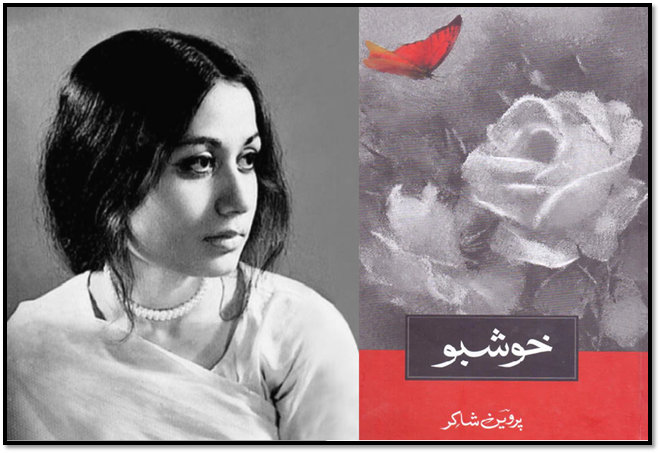
November 24, 2025, marks the 73 rd birth anniversary of Parveen Shakir. In 1977 a nascent Parveen Shakir announced her arrival on the horizon of Urdu poetry by publishing her first collection titled Khuhsboo (fragrance). In the introduction, describing the nature of the title, she wrote: “When the breeze kissed the flower, fragrance (Khushboo) was born. Fragrance is like the smile of a bud transforming into a flower. ”
SamaatooN Koo Naveed Hoo Kay
HayaiaN Khushboo kay Geet lay kar
Darecha e Gul say Aaa Rahee haiN
Greetings to the moments, breezes are bringing in
Songs of fragrance, through the windows of flowers
Khushboo was revolutionary because it combined classical ghazal structure with modern sensibilities, creating space for feminine voices in Urdu literature. The main themes of Khushboo are Love and Romance from a Feminine Perspective, Separation and Longing, Distrust and Infidelity, Feminism and Emotional Boldness, Nature as Metaphor, and Inner Strength and Self-Reflection. Khushboo remains a symbol of romantic expression and feminist courage.
Referring to self-respect and individuality, Parveen observes;
Tumhare liye maiN khud koo badal dooN?
Yeh mumkin nahi, maiN apnee pehchaan hooN
Should I change myself for you?
Impossible —I am my own identity.
Combining longing with nature, Parveen notes:
Barish key BoondaiN yaad dilati haiN tumheiN
Har Qatra Jaise tumhari baat karay
Raindrops remind me of you,
Each drop whispers your name.
Connecting silence and emotional stress, Parveen notes:
Tumhari khamooshi bhi Sawal bun gayi
Jawab dhoond’tay dhoond’tay raat guzar gayi
Your silence turned into a question,
Night passed searching for its answer.
Referring to broken dreams, Parveen observes:
Mohabbat ka Pahlah khawab Toot gaya
AankhooN meiN name rah gayi, khawab nahi
The first dream of love shattered,
Moisture stayed in eyes, not the dream.
Combining nostalgia and obsession, Parveen notes:
Tumhari Yaadoo ka aik jungle hay
JahaaN maiN roze kho Jaati hooN
There’s a forest of your memories,
Where I lose myself every day.
Using analogy of fragrance (Khusboo) for expression of love, Parveen states:
Tumhari baton maiN khushboo thi
Joo dil kay koo’nah tak phayl gayi
Your words carried fragrance,
That radiated to the corners of my heart.
On the paradox of separation, Parveen observes:
Tum say juda ho kar bhi tumharay pass hooN
Yah faasla bhi ajab Qurbat hay
Even apart, I am close to you,
This distance is a strange intimacy.
Parveen Shakir’s use of unorthodox and novel approaches to express her experiences and emotions in free form made her an instant celebrity. Her romantic poems and ghazals resonated well with the young and old Urdu poetry lovers. The boldness of her style also gave a feminine voice to the Urdu ghazal, which for ages was taken captive by exclusive masculine voices and mindset. Talking about feminine issues and feelings was considered a taboo at the time. She was a prolific poetess, even Faiz Ahmed Faiz was surprised by her copious intellectual output. A sampling of her poems reveals her stature among the modern Urdu poets:
Indecision
The night stands on the first threshold of loneliness;
hand outstretched, it signals me.
I wonder, should I take these hands
And step by step
Descend into the basement of quiet,
Or stay in my room?
The moon knocks at my window!
Love
Holding the face of the flower
In its baby-pink hands,
The breeze
kissed it so gently
That all the flower’s sorrows
Melted into fragrance.
Couplet from Sadburg
The intent of the heart
Is written between the lines.
Explanations of words can’t be found
In the forewords of books.
Couplet from Khud Kalami
The elements have conspired
with time
Trees were injured
By both the rain and the sun.
Syeda Parveen Shakir was born at dawn on November 24, 1952, in Karachi. Her mother, Afzal-un-Nissa, named her Parveen, Persian for the Pleiades, the star cluster north-west of constellation Taurus. Her father, Syed Shakir Hussain Zaidi migrated to Pakistan in 1947 from Bihar, British India. She passed her matric exam in 1966 while attending Rizvia Girls High School, Karachi. She attended Sir Syed College, Nazimabad, which like many other colleges in Karachi during 1960s and early 1970s, was a bastion of academic excellence. She obtained her BA (1971), her MA in English literature (1972), and her second MA in linguistics (1980) from University of Karachi. She served as a teaching Fulbright scholar at University of Harford, Connecticut, USA (1990). She also obtained an MPA (1992) from John F. Kennedy School of Government, Harvard University.
She had an illustrious professional career. She taught English at Abdullah Girls College for nine years. In 1981, she secured second position in the civil service of Pakistan (CSP) exam. After completing her professional training, she joined the civil service and held an array of senior positions: A.C. Customs, Karachi (1984), Second Secretary of Central Bureau of Revenue (CBR) presently known Federal Board Revenue (FBR) (1986), Islamabad, Assistant Director, and Deputy Collector (1991); and Deputy Director Inspection and Training, Customs and Central Excise (1993).
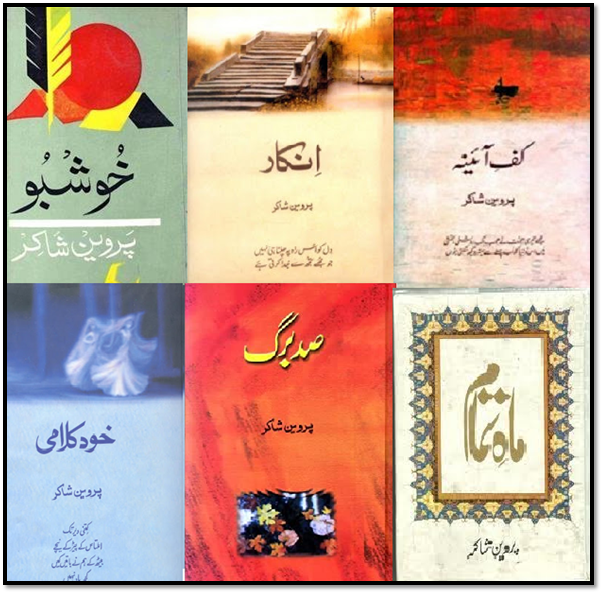
Parveen Shakir started her poetic journey while attending Sir Syed College where dedicated professors instilled in her strong foundations of literary skills; she initially used the pen name of Beena, and later changed it to Perveen. Her poetic and prose works were published in Urdu and English newspapers. She also participated in various literary programs at Radio Pakistan and Pakistan Television (PTV). Her poetic collections include Khusboo (Fragrance:1977), Sadburg (Marsh Marigold:1980), Khud Kalaami (Talking to self:1985), Inkaar (Denial: 1990), Mah-e-Tamaam (Full Moon:1994). Her collection of work based on her diaries was published as Kaf-e-Aaina (Edge of Mirror), and her collection of newspaper columns was published as Gosh-e-Chashm (Nook of Sight).
She received many accolades for her literary excellence at national and international levels, which include Best Poetess USIS, Karachi (1970), Adamjee Award (1978), Gold medal for the best poet of the year 1979, at the Silver Jubilee celebrations of Sir Syed College for Women, Karachi, Allama Iqbal Hijra Award for Poetry (1985), Zahoor Nazr award for Urdu Nazm, India (1986), Faiz Ahmed Faiz International Award for Poetry (1989), and Pride of Performance (1991).
In 1976, she married Dr Naseer Ali; the couple had a son Syed Murad Ali (b. 1978), but the marriage ended in divorce in 1987. Reflecting on the pains of relationship, she had observed:
Taluqaat key Barzakh main he Rakha muj koo
Wo meray haq main na tha aur Khelaaf bhi na huwa
In relationship, I was kept in state of limbo, between death and resurrection
He was neither in favor of me, nor against me.
Parveen Shakir’s poetry is an exquisite interplay of words expressing different thoughts intensities and modulating feminine emotions longing for love. She employs various icons of nature as metaphors to express her feelings and emotions; she associates badal (cloud) for love, title (butterfly) for a passionate person in love (AashiQ), barish (rain) for love, Khushboo (fragrance) for unfaithful to one’s beloved (MashooQ), Aandhee (gale) for impediments, and phool (flower) for one who is being deceived. The following couplets illustrate her powerful use of icons and metaphors:
Woo too Khushboo hay, hawaooN maiN bekhar jayae gah
Maslaa phool ka hay, phool kedher jaye’gah?
He is fragrance and will radiate through breeze
The dilemma is with the flower, where will the flower go?
Hussan kay Samajnay koo Sahar Chai’yay
Doo GhuRee key Chaa’haat say laRkee’yaan naheiN KhulteeN
It takes dawn of the day to discover the beautiful
Just two moments of desire not enough to discover girls
Barish maiN Kyatanhaa bheegna LuRkee!
Usay bulaaJiss key cha’haat maiN
Tera tun mun bhee’gha hay
Payar key barish say BaRh kar Kya barish hoo gee
Aur jub Iss barish kay baad
HiJr kee pehli dhoop khilaay gee
Tujh par rang kay Issm KhulaiN gay
Why to soak solo in the rain, O Girl!
Invite him in whose desire
Your body and soul are saturated
There is no rain more intense than the rain of love
And when after this rain
The first sunshine of separation would appear
The mysteries of colors would dawn upon you.
Her poetic spectrum covers a wide range of topics that reveal truths about love, human behavior, societal issues, and challenges of modern times.
MaiN Such Khahoon Ghi magar pher bhi haar JayooN Ghi
Woo Jhoot bolay Gaa Aur LaGawab kar daa Gha
I will utter the truth but will loose
He will lie and make me speechless
Aapnay Qatil key Zahanat say PereshaN hooN
Roze Aik Moot Nai Turz key Aejaad Karay
I am worried by the intelligence of my assassin
Every day he invents a new a way to kill
Jugnu koo din kay waqt parakhNay key Zid KaraiN
Bach’chay hama’ray ehed kay cha’laak hoo gaye
They insist on assessing the firefly during daylight
The children of our age have turned smart.
She loved people and cities of Pakistan. She was always very vocal in highlighting their plight; observing the lack of attention given to the development and progress of Karachi, she observed:
Karachi is like a harlot
To whom
People coming from mountains, plains, and deserts
Spend the night
And in the morning
Slaps her right cheek
Expecting a surrender, to slap the other cheek
Soaked in the intoxication of the next night
Once she was asked “would you like to address any specific people regarding any particular topic?” she answered: “This is my request for the policy makers and educators…please pay attention to educating the masses…it in no more an issue for our progress, rather it has become a serious matter for our survival.”
Contrary to popular belief that only literary people are concerned with intellectual activities, the ordinary people are very much interested in the activities and news of literary people. Like, Dr Annmarie Schimmel who got surprised when a waiter of a small restaurant in Eastern Anatolia, Turkey, requested her to translate more of Allama Iqbal’s poetry into Turkish; prominent writer Ashfaq Ahmed recalls the grief and sorrow of Parveen Shakir’s untimely death experienced by a vegetable vendor in Lahore: “I said who came so early at the door, let him come in and be seated. When I entered my drawing room to meet him. I saw a person sitting wearing a woolen cap, a shirt with open sleeves, and wrapped in an old blanket; he had removed and placed shoes outside. When I entered, he stood up and said, ‘I am sorry I caused you inconvenience so early in the day, but I could not control and resist myself, I am saddened by Bibi’s (respected lady’s) death, I was not sure where to go and offer my condolences. Since I see you passing through the bazar going for a haircut. I know you a little bit, my name is Channandeen, I am a vegetable vendor and run a small shop at the base of Mosque’s stairs, I have left my shop unattended to come.’ I inquired, “Are you interested in poetry?” He replied ‘no’ but said: ‘For the past couple of days I have been very sad and felt so much weight on my chest. I could not control myself emotionally, but I believe that I have reached the right place, where we can offer prayers for her.’ He said: ‘Please raise your hands and pray with me.’ When I raised my hands for prayers, he said, ‘Bibi fell victim to an accident, let’s pray that Allah SWT bless her soul with His mercy.’” (Khusboo key Humsafar, Dr Sultana Bukhsh, p. 459).
Commenting on the ultimate end of life, Parveen Shakir had observed:
To its conclusion the life has come
But its story remained controversial
The time has been angry correctly because I
Remained contrary to its dictates.
Au revoir , Khushboo, Adieu Parveen Shakir. Indeed, all the flowers of Gulistan-e-Urdu are wondering where have their Khusboo (fragrance) gone?
Parveen Shakir’s poetry is a blend of beauty and boldness. Her influence endures, making her a timeless figure in Urdu poetry. The themes of love, individuality, and resilience transcend time, making her poetry a bridge between classical tradition and modern sensibilities. Khushboo remains essential reading for new generations.
(Dr Ahmed S. Khan – dr.a.s.khan@ieee.org – is a Fulbright Specialist Scholar.)