Book and Author
Hashmat Sohail: Kiran Kiran Tabassum (Every Ray a Smile)
By Dr Ahmed S. Khan
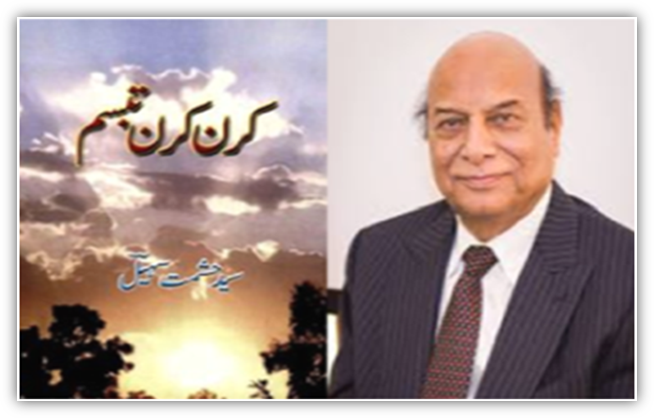
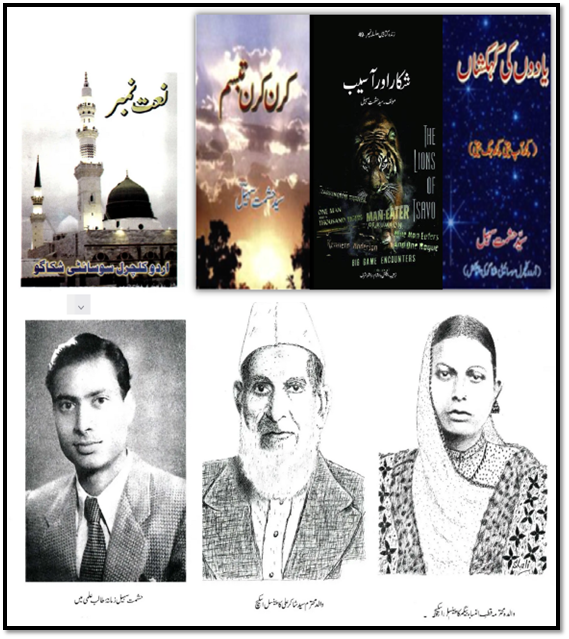
The Urdu literary world lost one of its most vibrant voices on November 10, 2025, when Hashmat Sohail, celebrated poet and humorist, passed away in Chicago, Illinois. He was widely admired for his participation in mushairas across Chicago and other North American cities. Known for his infectious wit and unique recital style, Sohail was more than a poet—he was a cultural ambassador who carried the warmth of Urdu across continents. He authored three notable books:
- “Kiran Kiran Tabassum” (2010) – a collection of humorous poetry
- “Yadon Ki Kahkashan” (2017) – an autobiography/memoir
- “Shikar aur Aasayb”(Hunting and Haunted, 2019): Urdu translation of global hunting literature.
His works are available online at: https://www.rekhta.org/authors/syed-hashmat-sohail/ebooks?lang=ur
Hashmat Sohail was born on November 3, 1935, in Shahpur, UP, British India. His father, Syed Shakir Ali, served in the British Army and lived to the age of 102. Hashmat lost his mother when he was just two years old.
He attended the University of Lucknow, earning master’s degrees in both English and Urdu. After completing his law degree (LLB), he practiced law in Lucknow. Following the passing of his first wife, Hashmat moved to Dubai in 1985, where he practiced law for 14 years. In 1998, he married Yasmin in Karachi, and the family relocated to the United States in 1999.
Hashmat Sohail played a pivotal role in promoting Urdu in North America. He co-founded the Urdu Cultural Society, Chicago (UCSC) with his wife, Mrs Yasmin Hashmat Sohail, and colleagues including Anjum and Kishwar Gohar, Dr Ahmed Shahzad Khan and Tasneem Nuzhat, Najmul and Shahida Hasan, Amin and Nasim Haider, Aslam and Farheen Kabir, and Mazhar and Mumtaz Alam.
Under his leadership, UCSC organized monthly literary and cultural events at Schaumburg Library, Illinois, and published several books, including a collection of Naats ( Natia Majallah ) written by poets in Urdu, Persian, Arabic, and regional languages of Pakistan and India. UCSC also supported peace initiatives between Pakistan and India through events celebrating the Aman Ki Asha campaign.
Kiran Kiran Tabassum (2010), authored by Hashmat Sohail (November 3, 1935 – November 10, 2025), is a luminous collection of humorous poetry (mazahiya shayari) that stands as a testament to the enduring charm of wit and satire in contemporary Urdu literature. The book is a cultural artifact that reflects the vibrancy of Urdu humor, the resilience of diasporic identity, and the poet’s mastery in blending laughter with subtle social critique.
Hashmat Sohail, widely admired for his unique recital style in mushairas across North America, carved a niche for himself as a humorist who could evoke laughter without compromising literary depth. His work resonates with audiences who appreciate the delicate balance between entertainment and intellectual engagement—a hallmark of classical Urdu humorists like Akbar Allahabadi, Ibn-e-Insha, Dilawar Figar and others.
The book’s title, Kiran Kiran Tabassum (Every ray a smile), is emblematic of its thematic essence: an invitation to embrace optimism and joy in fragmented yet persistent doses. Stylistically, Sohail employs simple diction, colloquial idioms, and playful metaphors, making his poetry accessible while retaining aesthetic sophistication. His humor is never crude; rather, it is layered with irony and cultural references that reward attentive readers. For instance, his verses often juxtapose traditional values with modern absurdities, exposing contradictions in social norms without resorting to bitterness.
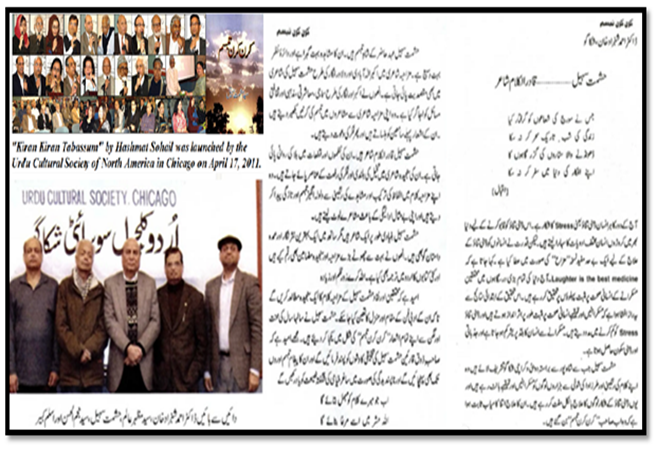
Kiran Kiran Tabassum was launched at an event organized by the Urdu Cultural Society Chicago on April 17, 2011. The event was a book-signing and inauguration ceremony held to pay tribute to the humorous Urdu poet. The program included recitations and discussions where members of society and other speakers praised Hashmat Sohail's work, which is known for its humor. The book itself was published in 2010.
Kiran Kiran Tabassum emerges from a rich lineage of Urdu humorous poetry, echoing voices like Akbar Allahabadi, Patras Bokhari, and Ibn-e-Insha. The strengths of the book are simplicity of language, wide emotional range and cultural relevance. One of the limitations of the book includes contextual dependency — certain jokes rely on cultural references that may elude non-South Asian readers.
This book opens with insightful commentaries from distinguished literary voices—Dr Farman Fatehpuri, Qamar Ali Abassi, Allama Niaz Gulbergvi, Razia Fasih Ahmad, Syed Anjum Gohar, Professor Masroor Qureshi, Professor Dr Ahmed Shahzad Khan, Hamid Amrohavi, and others. Enriched by their perspectives, the collection brings together thirty-eight captivating poems, by Hashmat Sohail, that showcase the depth and beauty of his poetic expression.
The following selection of his poetry demonstrates his mastery of the poetic craft.
Praise of the Almighty (Hamd e Bari Tala)
This honor is mine, for God Himself did call,
He granted me the chance to stand before Him, after all.
May my humble prayer and gratitude be accepted above
In Your presence, O Lord, accept this offering of love.
We Are Poets (Hum Shaair HaiN)
We are poets—our verses reach the hearts’ domain,
Our voices echo, young and old, again and again.
The debt of their message, the wise must repay:
“My message, my “Smile”, must reach where souls stray.”
Neighbor’s Wife (PaRoo’Sun)
One day,
my wife declared with a sigh:
“How strange you are!
Look at the neighbor—
see how he showers
love and affection
on his wife.
Why can’t you try?”
I grinned,
ready for the game,
and said:
“I will…
but first,
the neighbor’s wife
must agree!”
The Husband, the Wife, and Ghalib
A quarrel flared between husband and wife,
Ghalib’s verses fueling their strife.
No verdict came, the debate rolled on—
Until the wife, with a mischievous smile,
said:
“When I reach Paradise, serene and bright,
I’ll ask Ghalib myself to set it right.”
The husband laughed:
“Wife, don’t you know?
He was a sinner, a drinker—so,
Hell will surely be his abode!”
She winked and replied without delay:
“Then you can ask him there, anyway!”
The Beggar’s Experience
A beggar roamed from street to street,
Seeking coins to make ends meet.
By mosque and temple, churchyard gate,
He found a little—never great.
One day he reached a dazzling hall,
A casino loud with fortune’s call.
He begged in God’s most holy name,
Hoping mercy would look the same.
The broken gamblers, pockets bare,
Could only offer a hollow stare.
The modest winners, shy and small,
Dropped a coin—no gift at all.
Then came a man with luck divine,
The jackpot struck, his stars align!
He poured a heap of coins with pride,
The beggar’s joy could not be denied.
He raised his eyes to heaven’s dome,
And laughed aloud at fate’s strange home:
“O Lord of worlds, what grand disguise!
Your shrine is here—where dice arise!”
Sir, I am Deaf
Poetry—
the bread of the soul,
yet for some,
too rich a meal to swallow whole.
On a rattling train,
a voice declared,
“I am a poet.”
The other turned,
face like a closed door,
and answered softly:
“Sir, I am deaf.”
Hashmat Sohail’s work shows a lifelong devotion to Urdu—a language that carries centuries of poetic tradition and emotional depth. In his famous nazm “Urdu,” (which was broadcast by Radio Lucknow) Hahmat Sohail honored the language as a vessel of love, beauty, history, and identity.
Urdu My Urdu (Urdu Meri Urdu)
From Hind and Pakistan, a twin-born light,
A garden where knowledge and art unite.
On its brow, the crown of wisdom gleams—
A vision that sparkles with radiant dreams.
It is the tongue of saints and kings,
Of Rama’s tales and Sufi rings.
A thousand melodies, a thousand springs,
In every word, a new hope sings.
This is the language of love’s embrace,
Of subtlety, beauty, and gentle grace.
A single flower with countless hues,
Its fragrance fills the world anew.
No tongue as sweet, no voice as mild,
No other speech so pure, so styled.
It binds the hearts of East and West,
A silken thread, a lover’s quest.
In freedom’s dawn, its song was heard,
A message bright in every word.
It crossed the walls, it broke the chains,
It healed the wounds, it soothed the pains.
Hindu and Muslim, all take pride,
In Urdu’s shade, they all reside.
Brahmin and Sheikh, with stars aligned,
In Urdu’s verse, their souls entwined.
Yet why today does its beauty fade?
Why is its grace in shadows laid?
Why does the world ignore its art,
And let indifference break its heart?
Let us revive its gentle tune,
Let Urdu’s garden bloom and swoon.
Let every heart, both young and old,
Embrace its stories, bright and bold.
So said Iqbal, and Ghalib too,
Urdu’s the song that must renew.
Let’s cherish it with all our might—
A language born of love and light.
Kiran Kiran Tabassum is more than a collection of humorous verses; it is a cultural bridge connecting tradition with modernity, homeland with Diaspora, and laughter with introspection. Hashmat Sohail’s artistry lies in his ability to transform humor into a vehicle of empathy—a means to navigate personal grief, social absurdities, and existential uncertainties.
For readers seeking a joyous yet thought-provoking engagement with Urdu poetry, this book is indispensable. It affirms the enduring relevance of humor in literature. Indeed, Hashmat Sohail leaves behind a legacy of laughter and light. In his words — every smile is a ray—and his rays will continue to illuminate hearts for years to come.
(Dr Ahmed S. Khan - dr.a.s.khan@ieee.org - is a Fulbright Specialist Scholar. Professor Khan has more than 40 years of experience in Higher Education as professor of Electrical Engineering, Chair and Dean of the College of Engineering and Information Sciences. He is the author of many academic papers, technical and non-technical books, and a series of books on Science, Technology and Society (STS) — used globally in the academic programs of more than 200 universities. His most recent books are Mashriq-o-Mugrib Ki Mumtaz Shaksiaat (Prominent Personalities of the East and the West), and Nanotechnology: Ethical and Social Implications .)