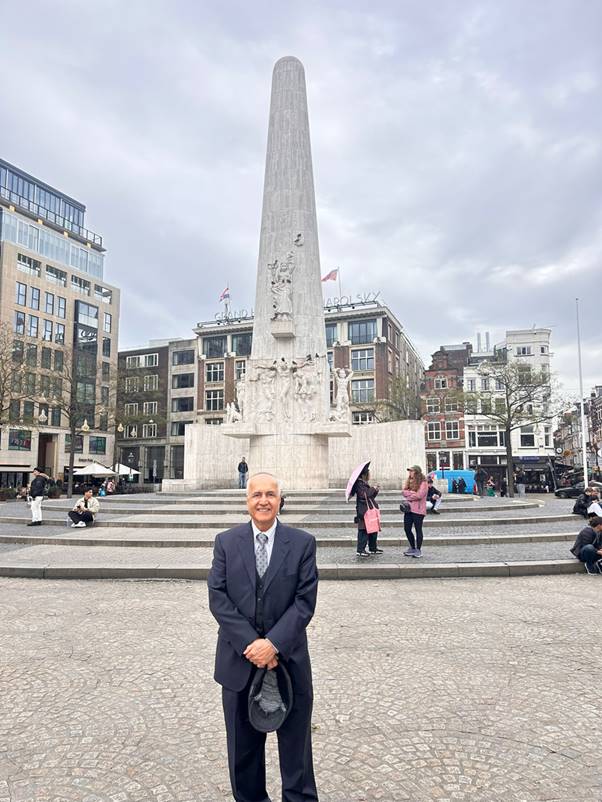
The author in Amsterdam
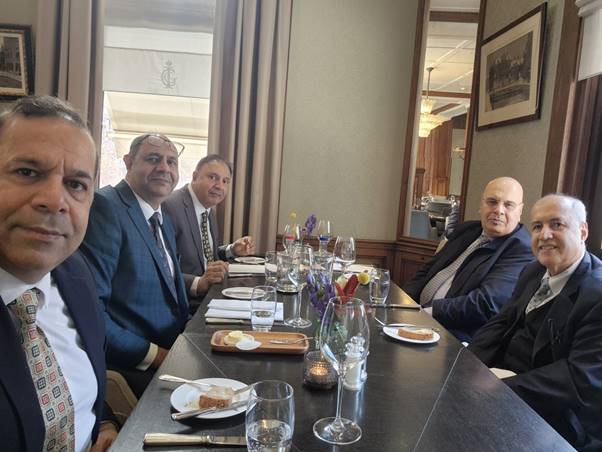
Lunch at a private club
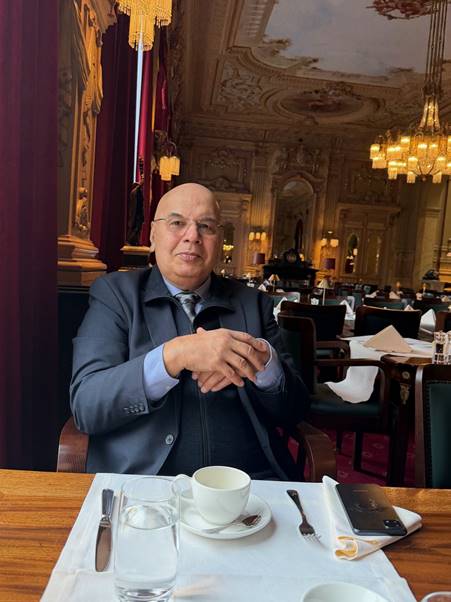
Safeer Ahmad, the Hague
From the Rose to the Battlefields: A Journey of Remembrance
By C. Naseer Ahmad
Washington, DC

Some say love, it is a river
That drowns the tender reed
Some say love, it is a razor
That leaves your soul to bleed
Some say love, it is a hunger
An endless aching need
I say love, it is a flower
And you, its only seed
In 1979, Bette Midler lifted her voice to sing “The Rose,” a ballad Amanda McBroom had written almost in secret, unsure of its worth. McBroom later recalled with wry humor that “the producers hated it.” Yet the song, tender as a whisper and steadfast as prayer, found its way to the hearts of millions. Midler’s rendition—quiet, luminous, resolute—earned a Grammy and has since become an anthem of resilience, a reminder that beauty often germinates in unlikely soil.
That same year my own life turned a corner: I married, and on my way to Pakistan before the wedding, paused briefly in the Netherlands to visit my Uncle Zaffar Ahmad and his family. At the time, such visits were little more than gentle interruptions in a hurried itinerary. His children—once toddlers clinging to their mother’s dupatta—ran through the house with the incandescent energy of youth. Even now, those moments shimmer in memory like fleeting scenes from an old film, fragile yet enduring. Most families, I suspect, carry such small, perfect fragments tucked quietly inside them.
This year, however, I returned to the Netherlands with intention. I wanted to seek out the cousins I had not seen in years, to touch the threads of kinship that stretch across oceans but never quite fray. My thoughts, too, turned often to my father and to his brother’s family—to the ways families drift apart, circle back, and surprise us with their gentle, persistent constancy. I also carried another purpose: a long-held desire to walk the World War II landscapes where my father, Lt Colonel Aziz Ahmad, had once served. The pull was both historical and deeply personal, as if by stepping onto those fields I might brush against the contours of a chapter he rarely spoke about.
Of all the battles of that war, the Battle of the Bulge had always stirred in me a particular solemnity — a frozen struggle that reshaped the war’s direction. Luxembourg, where thousands of American soldiers rest beneath quiet rows of white crosses, including General George S. Patton, drew me with its solemn gravity. I was eager, too, to finally meet my friends Geoff and Ruth Thompson, after more than a decade of writing for the Luxembourg Chronicle. It felt like the sort of journey where history, family, and friendship could be held in the same hand without contradiction.
“Bhai Jan, I have taken time off from work, and I will be happy to drive you,” my cousin Safeer wrote. His generosity warmed me, though I wondered how the journey would unfold; after all, our childhoods had unspooled in different cities, our lives shaped by different rhythms. But once we set out, the miles dissolved any imagined distance. The road became our companion—nearly a thousand miles through the Netherlands, Belgium, Luxembourg, and Germany—and Safeer proved to be a storyteller of the best kind, turning even silence into something companionable. He joined me for lunch with Geoff and Ruth in downtown Luxembourg, and afterward we visited the American Military Cemetery, where winter sunlight drifted over the graves. At General Patton’s resting place, I whispered prayers for my father, and for the uncle of my friend, Mike Pocalyko. It felt like placing a small stone on the cairn of memory.
My timing in the Netherlands held its own quiet magic. I arrived shortly after the Dutch elections and found my younger cousins full of opinions, unafraid of their own distinct voices. To my surprise—and admiration—each had voted for a different political party. When I asked whether this stirred any tension, they dissolved into laughter. Even the cousin who had voted for Geert Wilders explained his reasoning without defensiveness or heat. Their ease with one another felt like a breath of fresh air: a reminder that divergence need not fracture the bonds of affection.
I had also hoped to visit a few of the private clubs I can access through reciprocal arrangements. Going alone might have been dutiful; going with my cousins turned it into something buoyant and unexpectedly memorable—a glimpse into the social rhythm of their world.
In these moments—some small, some solemn, all quietly luminous—I felt the truth of what “The Rose” has always whispered: that what is planted in love endures. Even across continents, even after long seasons apart, family blooms again—softly, improbably—yet with a strength that feels almost like grace.
When the night has been too lonely
And the road has been too long
And you think that love is only
For the lucky and the strong
Just remember in the winter
Far beneath the bitter snows
Lies the seed that with the sun's love
In the spring becomes the rose.
During this trip, I rediscovered the roses in my family: Imran, Aliya, Amri and Aisha, their wonderful spouses and their beautiful children.