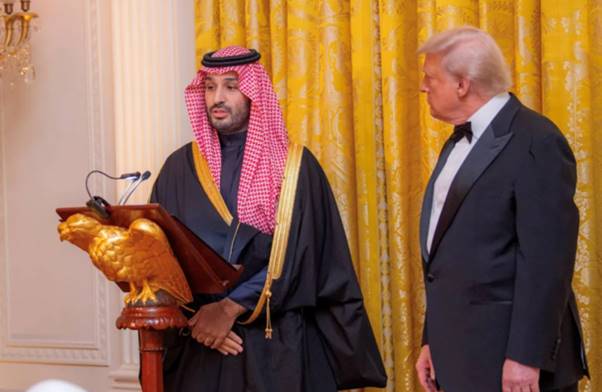
The crown prince's recent Washington visit encapsulated a Saudi-US partnership rooted in aligned ambitions - SPA
Crown Prince’s Visit Signals Dawn of Saudi-US AI Diplomacy
By Dr Turki Faisal Al-Rasheed
As a seventh-generation steward of Saudi Arabia’s legacy, I pen these reflections with profound gratitude for the enduring bond between my homeland and the US, a connection that first drew me to American shores in the mid-1970s as a scholarship student. Today, in November 2025, that alliance gleams anew under President Donald Trump’s second term, illuminated by Crown Prince Mohammed bin Salman’s first White House visit in seven years.
In a candid Oval Office exchange with Arab News Editor-in-Chief Faisal Abbas, Trump invoked his own sleepless nights, driven by a vision to “make America great again,” and drew a poignant parallel to Crown Prince Mohammed bin Salman: “The crown prince thinks about his country, and I think about mine.” He lauded their shared tenacity, saying: “Trump is stubborn in his dream for America, and Mohammed bin Salman is stubborn in his dream for Saudi Arabia,” adding that “the future is made by dreamers, especially when they possess the ability to bolster their dreams with numbers.”
These words encapsulate a partnership rooted in aligned ambitions: Saudi Arabia’s Vision 2030 and America’s innovative edge, converging to navigate a multipolar world. Far from transactional oil-and-arms deals, this recalibration prioritizes technological sovereignty, regional stability, and global prosperity, offering a rational counter to conflict profiteers who thrive on the Arab world’s unmet basic needs.
On Nov 18, 2025, against the crisp autumn backdrop of Washington, the crown prince’s arrival transcended protocol, unveiling a blueprint for collaborative progress. The centerpiece was the Strategic Artificial Intelligence Partnership, inked by US Secretary of State Marco Rubio and Saudi Foreign Minister Prince Faisal bin Farhan. This accord, backed by a $1 trillion Saudi pledge in US sectors such as rare earth minerals, nuclear energy, and semiconductors, heralds a pivot from energy security to tech interdependence.
Saudi Arabia, with its Neom megacity and burgeoning AI hubs, bridges Eastern ingenuity and Western computational might. The US, leveraging Silicon Valley giants such as Nvidia and Elon Musk’s xAI, contributes expertise in model training and ethical governance. As the crown prince noted during the joint presser, these ventures yield “benefits for both the US and Saudi Arabia, and indeed the world.”
This alliance elevates AI beyond bilateral gains, positioning it as a catalyst for humanity’s shared challenges. In an age in which algorithms can either amplify potential or entrench divides, the pact embeds safeguards for transparency and inclusivity. Tools forged here are climate models for drought-resistant crops, predictive analytics for pandemics, and equitable platforms for remote education addressing existential threats head-on.
Economically, it sparks prosperity: Saudi Arabia’s Humain AI partnering with xAI on data centers could create thousands of high-skill jobs, integrating the Kingdom into the global digital economy.
Culturally, it mends historical rifts, proving innovation’s power to foster trust. Trump’s endorsement “honoring Saudi Arabia and the crown prince” through deals that “make America and the world greater” underscores a symbiotic model. By intertwining supply chains in chips and cloud infrastructure, such ties deter aggression: Isolation becomes economically ruinous, reducing proxy war incentives, and paving a prosperous path for the Middle East.
Yet, this technological synergy gains urgency amid cascading conflicts, where AI emerges as a peace multiplier. The visit spotlighted Riyadh’s diplomatic push to end wars in Sudan and Syria, amplified by US support. In Sudan, two years of civil strife have displaced millions and scorched ecosystems; the crown prince urged Trump to advance the 2023 Jeddah Declaration, co-mediated by Riyadh and Washington. A September 2025 Saudi-US Arab League-Egypt roadmap charts ceasefires and power-sharing, unlocking $10 billion in reconstruction for reforestation and water restoration.
(Dr Turki Faisal Al-Rasheed is an adjunct professor at the University of Arizona’s College of Agriculture, Life and Environmental Sciences, in the Department of Biosystems Engineering. He is the author of “Agricultural Development Strategies: The Saudi Experience.” - Arab News)