Migration of Birds
By Dr Khalid Siddiqui
Ohio

Where do birds like geese, storks, swallows, etc. go in winter? They seem to disappear suddenly at the onset of winter but reappear in spring the next year. This was a big unsolved mystery in Europe over centuries.
Explorers and European colonizers had seen the same species all over Africa but they never realized that they were not only the same species but the SAME birds. It was inconceivable to think that the birds were capable of flying a distance of thousands of miles. Various theories were advanced: In the fourth century BC, Aristotle suggested that the birds transformed into other kinds of animals suitable for winter weather. But at the same time he had a suspicion that common cranes migrated from Iran to the marshlands of Egypt. But, no one believed him. Others suggested that during the European winter the birds hibernated at the bottom of the lakes. In the 1600s, the British scientist David Morton, proposed that the birds migrate to the moon!
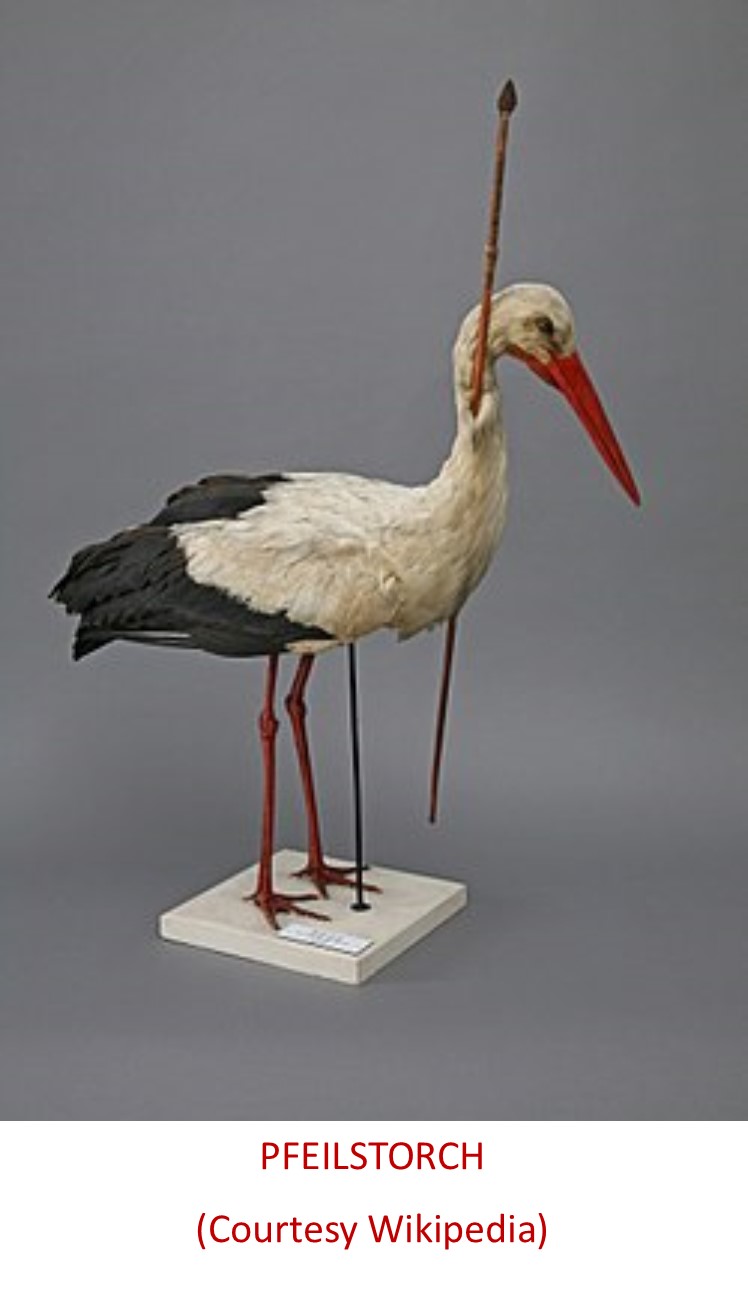
These ideas persisted for as late as 1822 when an apparently insignificant event changed the thinking forever. In the spring of 1822, a white stork was spotted on the property of a landowner in Mecklenburg, Germany. It had a spear poking through its neck. A few days later it was shot by a hunter. The stork’s body was examined by the botanist Gustav Florke. The spear was 30-inch long and was made of fine-veined tropical wood with a broad iron tip. Further investigation revealed that such type of arrows were commonly used by the inhabitants of Sudan in hunting and warfare. The stork was injured but had survived to make the 1,200-mile journey. This was the first clue of the bird’s migration. This stuffed bird is on display at the University of Rostock in Germany. It has been named pfeilstorch (German for “Arrow Stork”).
Later, 25 more such White Storks, with arrow fragments in them, were found. See the photograph of Pfeilstorch.
To explore this finding further, German ornithologist Johannes Thienemann (1863-1938) and other researchers fitted 2,000 birds with aluminum bands with unique numbers and contact information. Thienemann received thousands of letters, with numerous birds being sighted in Africa. With this information he was able to chart the migration route of the birds.
A German ornithologist, Ernst Schuz (1901-1991) documented many different birds with pieces of arrows in them all over Europe. He also found swans and eiders with Inuit arrows. (The embedded arrows are not seen anymore because bows and arrows have been replaced by guns.) His experiments showed that the young birds who were moved to a new location and not released until after all the adults have migrated, would not take the shortest route but follow the same longer route that had been programmed in their system. Based on his expertise on bird migration, he was asked by Nazi leader Himmler to assess the possibility of spreading Nazi propaganda to the South Africans using White Storks. Extrapolating the recovery rate of only 1% of the branded birds, he pointed out that as many as 1,000 storks would be needed to deliver just 10 leaflets. So, the idea was dropped.
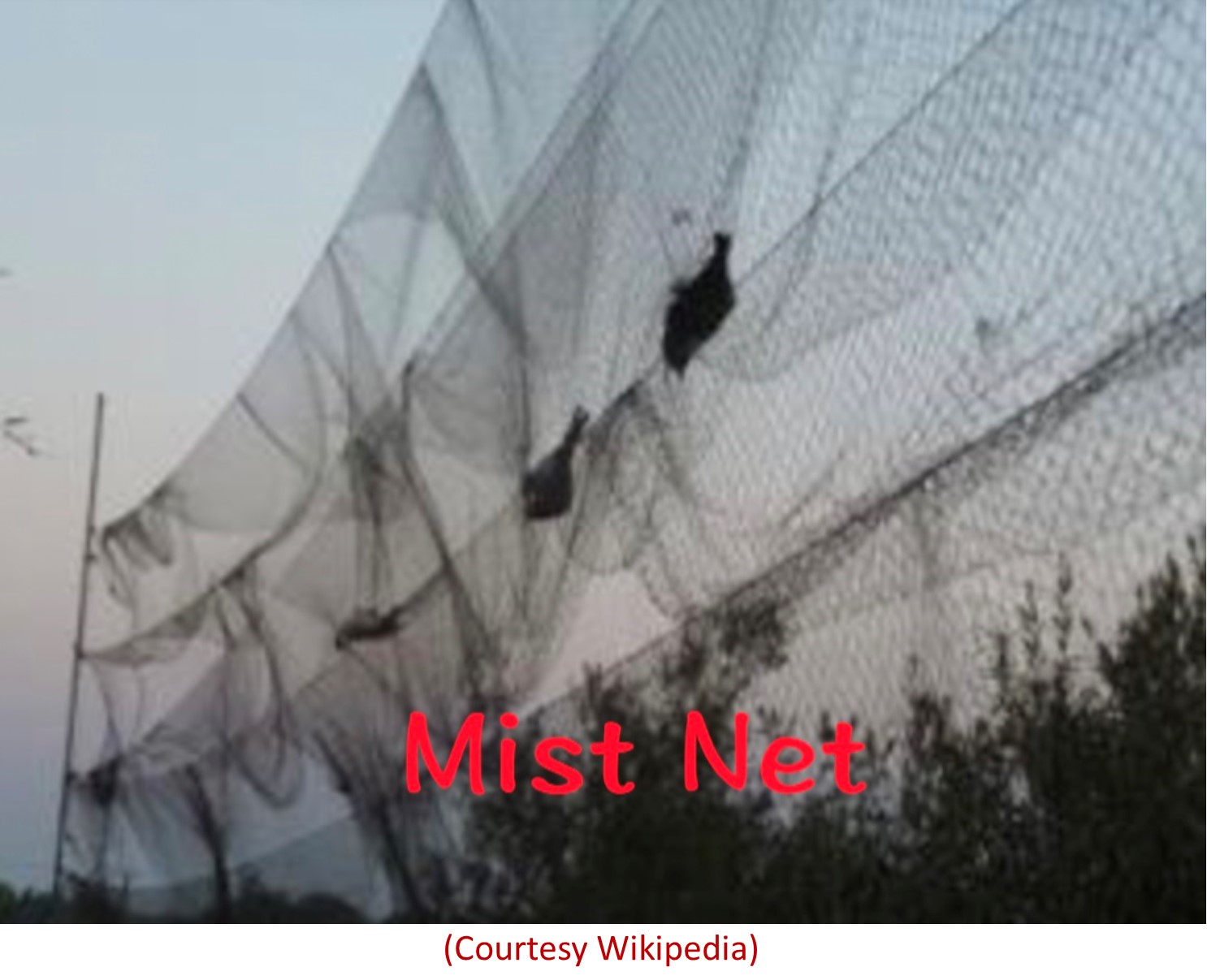
A few years back, as member of the National Audubon Society, I was invited to help with the banding of the birds. The birds were caught using mist nets. Please see the photograph of the mist net and watch the short video clip of a House Finch banding.
Video
As not all birds can be banded for one reason or the other, many newer techniques have been utilized to chart out the birds’ migratory patterns. Recordings of nocturnal flight calls proved that the birds primarily migrate at night and make distinctive calls to keep the flock together. Satellite and radio tracking are common methods used. Stable isotope analysis of the feathers of the bird is a new tool. By analyzing the specific isotope ratios in the feathers, the researchers can understand the foraging patterns and dietary shifts in the birds. This, in turn, could determine its migration route of the birds.