Book & Author
Walter Isaacson: Einstein — His Life and Universe
By Dr Ahmed S. Khan
"God does not play dice with the universe."
"Imagination is more important than knowledge. For knowledge is limited, whereas imagination embraces the entire world."
"Life is like riding a bicycle. To keep your balance, you must keep moving."
"Insanity is doing the same thing over and over again and expecting different results."
"Try not to become a man of success, but rather try to become a man of value."
"The important thing is not to stop questioning. Curiosity has its own reason for existing."
Albert Einstein, one of the most influential physicists in history, transformed our understanding of the universe through his revolutionary theories and profound philosophical insights. Born in 1879 in Ulm, Germany, Einstein’s insatiable curiosity and unconventional thinking led him to challenge the foundations of classical physics and reshape the course of modern science.
His most celebrated achievement is the Theory of Relativity, which comprises Special Relativity (1905) and General Relativity (1915). Special Relativity introduced the idea that the laws of physics are the same for all observers in uniform motion and that the speed of light remains constant regardless of the observer’s frame of reference. This theory led to the iconic equation E = mc², revealing the equivalence of mass and energy—a principle that underpins nuclear energy and particle physics.
General Relativity expanded these concepts to include gravity, proposing that massive objects distort the fabric of spacetime, creating what we perceive as gravitational attraction. This theory replaced Newton’s classical view of gravity as a force acting at a distance. It has been confirmed by numerous experiments, including the bending of light around stars and the recent detection of gravitational waves. Today, General Relativity remains a cornerstone of cosmology and astrophysics.
In 1905—often referred to as Einstein’s “miracle year”—he published four groundbreaking papers that reshaped physics. In addition to Special Relativity, he explained the photoelectric effect, demonstrating that light behaves as discrete packets of energy, or quanta. This work laid the foundation for quantum mechanics and earned him the Nobel Prize in Physics in 1921. His other papers that year addressed Brownian motion, providing empirical evidence for the existence of atoms, and further elaborated on mass-energy equivalence.
Despite his pivotal role in the development of quantum theory, Einstein was deeply unsettled by its probabilistic nature. He famously remarked, “God does not play dice with the universe,” expressing his belief that the universe operates according to deterministic laws. His philosophical debates with Niels Bohr over the interpretation of quantum mechanics remain central to discussions in theoretical physics.
In contrast, the 2025 Nobel Prize in Physics was awarded to John Clarke, Michel H. Devoret, and John M. Martinis for their pioneering work in quantum mechanics. Their discovery of macroscopic quantum tunneling and energy quantization in electrical circuits demonstrated that quantum effects are not confined to the microscopic realm—they can be engineered and observed in large-scale systems. Their research laid the foundation for technologies such as quantum computing, quantum sensors, and quantum cryptography. While their work confirms the probabilistic nature of quantum mechanics, it does not support Einstein’s deterministic view. Nevertheless, his quest for a deeper, more complete theory continues to inspire research in hidden variable theories and quantum foundations.
Einstein’s legacy extends far beyond science. He was a passionate advocate for human rights, civil liberties, and intellectual freedom. After fleeing Nazi Germany, he settled in the United States and worked at the Institute for Advanced Study in Princeton. His theories have enabled technologies like GPS, lasers, and nuclear power, and continue to guide research in fields such as black holes, cosmology, and quantum computing. More than a scientist, Einstein remains a symbol of human curiosity and imagination. His ability to envision the universe in radically new ways has inspired generations to explore the unknown and question the very nature of reality.
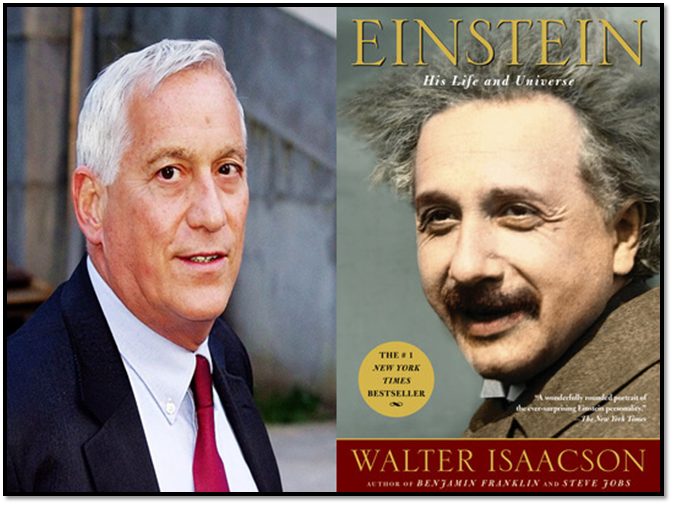
Einstein: His Life and Universe by Walter Isaacson is a masterfully crafted biography that presents a rich, multidimensional portrait of one of history’s most iconic scientific minds. Drawing from newly released personal letters and a wide array of historical sources, Isaacson weaves a compelling narrative that not only illuminates Albert Einstein’s groundbreaking scientific achievements but also explores the complexities of his personal relationships, political convictions, and philosophical beliefs.
Walter Isaacson (born May 20, 1952) is a celebrated American biographer, journalist, historian, and public intellectual whose work has illuminated the lives of some of the most transformative figures in science, technology, and the arts. Renowned for his ability to translate complex ideas into compelling, accessible narratives, Isaacson has become one of the most respected voices in contemporary nonfiction.
Born in New Orleans, Louisiana, Isaacson studied history and literature at Harvard University, followed by postgraduate studies at Oxford University as a Rhodes Scholar, where he earned honors in philosophy, politics, and economics. This strong academic foundation in both the humanities and social sciences shaped his interdisciplinary approach to biography and storytelling.
Isaacson began his journalism career at The Sunday Times of London before joining Time magazine, where he rose to become editor-in-chief in 1996. His leadership at Time was marked by a commitment to thoughtful, in-depth reporting, with a particular focus on global affairs, science, and culture. He later served as CEO of CNN from 2001 to 2003, guiding the network through a pivotal era in media and international news. Following his tenure at CNN, Isaacson became president and CEO of the Aspen Institute, a nonpartisan think tank dedicated to leadership, policy innovation, and civic dialogue.
Currently, Isaacson is a professor of history at Tulane University, where he continues to mentor students and contribute to public scholarship. He is best known for his bestselling biographies, which explore the lives of visionary individuals who have shaped the modern world — Einstein: His Life and Universe (2007) – A deeply researched and accessible portrait of Albert Einstein, blending scientific insight with personal depth. Steve Jobs (2011) – Based on exclusive interviews, this biography offers an unflinching look at the Apple co-founder’s genius, complexity, and contradictions. Leonardo da Vinci (2017) – A vivid exploration of the Renaissance polymath’s artistic brilliance, scientific curiosity, and boundless imagination. The Code Breaker (2021) – Chronicles the life of Jennifer Doudna and the revolutionary development of CRISPR gene-editing technology. Elon Musk (2023) – A revealing account of the controversial tech entrepreneur’s ambitions, innovations, and impact across industries from space travel to artificial intelligence.
Each of these works reflects Isaacson’s unique ability to connect the dots between creativity, science, and society, positioning him as a bridge between disciplines and generations. Isaacson’s biographies do more than recount lives—they explore the dynamic interplay between personal character and historical context, showing how visionaries think, struggle, and ultimately reshape the world. His writing continues to inspire readers to embrace curiosity, challenge convention, and pursue knowledge across boundaries.
One of the most striking strengths of “Einstein — His Life and Universe” is its ability to humanize Einstein. Often depicted as a solitary genius, he emerges here as a man full of contradictions—playful yet serious, rebellious yet principled, intellectually brilliant yet emotionally distant. Isaacson does not shy away from Einstein’s flaws. His strained relationships, particularly with his first wife Mileva Marić and his children, are portrayed with honesty and nuance. These personal challenges are thoughtfully juxtaposed with his intellectual triumphs, offering a balanced and deeply human portrayal of a man who was both extraordinary and imperfect.
Isaacson traces Einstein’s intellectual journey from his formative years in Germany and Switzerland, through his time at the Swiss Patent Office, to his rise as a global scientific icon. The book vividly recounts the period around 1905—Einstein’s “miracle year”—when he published four revolutionary papers that reshaped the landscape of physics. Isaacson explains complex scientific concepts such as the theory of relativity, the photoelectric effect, and Brownian motion with remarkable clarity, making them accessible even to readers without a scientific background.
What sets this biography apart is Isaacson’s ability to place Einstein’s scientific work within the broader context of his worldview. Einstein’s belief in imagination as a driving force, his skepticism of authority, and his philosophical commitment to determinism and simplicity are shown to be deeply intertwined with his scientific pursuits. Isaacson convincingly argues that Einstein’s intellectual independence and moral courage were essential to his revolutionary thinking.
Beyond science, the biography explores Einstein’s engagement with political and social issues. His Jewish identity, escape from Nazi Germany, and advocacy for civil rights in America are thoughtfully examined. Isaacson portrays Einstein as a committed pacifist who later supported the Allied war effort against Hitler, and as a Zionist who opposed nationalism and championed peaceful coexistence.
Einstein’s political activism in the United States is a significant part of the narrative. He was outspoken against racism, supported the NAACP, and was even offered the presidency of Israel—a role he respectfully declined. These episodes are not treated as mere footnotes but as integral to understanding Einstein’s moral compass and his belief in universal human dignity.
Finally, the book reflects Einstein’s enduring legacy—both scientific and cultural. Isaacson discusses how Einstein’s theories laid the groundwork for modern physics, including quantum mechanics and cosmology, even as Einstein himself remained skeptical of some of these developments. His iconic image—wild-haired and contemplative—has become a symbol of genius, and Isaacson explores how this public persona was shaped, celebrated, and sometimes misunderstood.
Commenting on Einstein’s extraordinary imagination and creativity, the author writes: “Therein lies the key, I think, to Einstein's brilliance and the lessons of his life. As a young student, he struggled with rote learning. Later, as a theorist, his success stemmed not from sheer mental processing power, but from his imagination and creativity. He could construct complex equations, but more importantly, he understood that mathematics is the language nature uses to express her wonders. He could visualize how equations translated into physical realities—how, for instance, the electromagnetic field equations discovered by James Clerk Maxwell would appear to a boy riding alongside a beam of light. As he once declared, ‘Imagination is more important than knowledge.’ That mindset required him to embrace nonconformity. ‘Long live impudence!’ he exclaimed to the woman who would later become his wife. ‘It is my guardian angel in this world.’ Years later, when critics claimed his resistance to quantum mechanics showed he had lost his edge, he lamented, ‘To punish me for my contempt for authority, fate made me an authority myself.’”
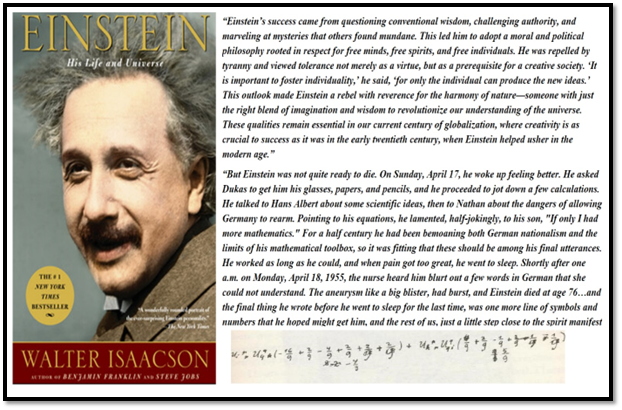
The author further observes: “Einstein’s success came from questioning conventional wisdom, challenging authority, and marveling at mysteries that others found mundane. This led him to adopt a moral and political philosophy rooted in respect for free minds, free spirits, and free individuals. He was repelled by tyranny and viewed tolerance not merely as a virtue, but as a prerequisite for a creative society. ‘It is important to foster individuality,’ he said, ‘for only the individual can produce the new ideas.’ This outlook made Einstein a rebel with reverence for the harmony of nature — someone with just the right blend of imagination and wisdom to revolutionize our understanding of the universe. These qualities remain essential in our current century of globalization, where creativity is as crucial to success as it was in the early twentieth century, when Einstein helped usher in the modern age.”
Einstein's disagreement with Bohr centered on a fundamental question: Does quantum mechanics describe an objective reality that exists independently of observation, or is it merely a statistical framework for predicting the outcomes of measurements? On this point, the author observes: "Einstein's fundamental dispute with the Bohr-Heisenberg crowd over quantum mechanics was not merely about whether God rolled dice or left cats half dead. Nor was it just about causality, locality or even completeness. It was about reality." Does it exist? More specifically , is it meaningful to speak about physical reality that exists independently of whatever observations we can make? ‘At the heart of the problem,’ Einstein said of quantum mechanics, ‘is not so much the question of causality but the question of realism.’ Bohr and his adherents scoffed at the idea that it made sense to talk about what might be beneath the veil of what we can observe. All we Can know are the results of our experiments and observations, not some ultimate reality that lies beyond our perceptions. Einstein had displayed some elements of this attitude in 1905, back when he was reading Hume and Mach while rejecting such unobservable concepts of absolute space and time. ‘At that time my mode of thinking was much nearer positivism than it was later on,’ he recalled. ‘My departure from positivism came only when I worked out the general theory of relativity.’”
Reflecting on 1921 Nobel prize, the author notes: “It seemed obvious that Einstein would someday win the Nobel Prize for Physics. He had, in fact, already agreed to transfer the money to his first wife, Mileva Marić, when that occurred. The Questions were: When would it happen?, For what? Once it was announced — in November 1922, awarding him the prize for 1921 — the questions were: What took so long? and, Why ‘especially for his discovery of the law of the photoelectric effect?’”
The major strengths of the book are — 1. Humanistic Portrait of Einstein: Isaacson presents Einstein not just as a scientific genius, but as a complex, relatable human being. The biography explores his personal relationships, emotional struggles, and moral convictions, offering a well-rounded view of the man behind the theories. 2. Simple Explanation of Complex Science: the author explains Einstein’s scientific contributions—like relativity and quantum theory—in a way that is accessible to non-scientific readers. Isaacson uses analogies and historical context to make difficult concepts understandable,.3. Use of Primary Sources: Isaacson draws extensively from Einstein’s personal letters, many of which were newly released at the time of writing. These sources add authenticity and intimacy, allowing readers to hear Einstein’s voice directly. 4. Juxtaposition of Science, Philosophy and Politics: the book skillfully weaves Einstein’s scientific work with his philosophical beliefs and political activism. It shows how his ideas about determinism, pacifism, and human rights were interconnected with his scientific worldview. 5. Engaging Narrative: the author’s writing is fluid, engaging, and well-paced. He brings historical events and scientific breakthroughs to life with vivid storytelling, making the biography enjoyable for a wide audience. 6. Balanced Perspective: the book does not shy away from Einstein’s flaws—his distant parenting, failed marriages, and stubbornness in scientific debates. This balanced portrayal adds depth and credibility to the narrative, and 7. Cultural and Historical Context: the author places Einstein’s life within the broader context — of 20th-century history, including World War I, World War II, the rise of Nazism, and the Cold War — helping readers understand the impact of Einstein’s work and beliefs on a global canvas.
Overall, Walter Isaacson’s explanations of relativity and quantum theory in Einstein: His Life and Universe are clear and often enhanced by analogies that illuminate rather than oversimplify. His ability to make complex scientific ideas accessible to general readers is one of the book’s strengths. However, some readers—particularly those without a background in physics—may still find certain scientific sections challenging. Despite its many strengths, the book is not without its limitations. Several key criticisms have been raised — 1. Limited Depth in Scientific Analysis: While Isaacson excels at simplifying Einstein’s theories for a broad audience, some critics argue that the scientific content lacks depth. Readers with a strong background in physics may find the treatment of complex topics—such as general relativity and quantum mechanics—too superficial or overly simplified. 2. Overemphasis on Personal Life: The biography devotes significant attention to Einstein’s personal relationships, particularly his troubled marriages and distant parenting. While this humanizes Einstein and adds emotional depth, some readers feel it comes at the expense of a deeper exploration of his scientific collaborations and intellectual development. 3. Underrepresentation of Collaborators: Isaacson tends to portray Einstein as a solitary genius, occasionally underplaying the contributions of key collaborators such as Hermann Minkowski, Marcel Grossmann, and Niels Bohr. This emphasis can obscure the inherently collaborative nature of scientific progress. 4. Philosophical Bias: At times, the narrative leans heavily into Einstein’s philosophical views — especially his resistance to quantum mechanics — with a tone that may appear overly sympathetic. Some critics argue this downplays the significance of quantum theory and the contributions of its leading proponents. 5. Lack of Technical Detail for Scholarly Readers: For academic readers or those seeking a rigorous scientific biography, the book may feel lacking in technical analysis. It avoids detailed equations and theoretical discussions, favoring a narrative-driven approach over a more analytical one. 6. Narrative Gaps in Later Life: The coverage of Einstein’s later years—particularly his work on unified field theory and his time at Princeton—feels less detailed and more rushed compared to the richly developed earlier chapters, and 7. Occasional Repetition: Due to the book’s thematic structure, certain ideas and anecdotes are revisited multiple times. While this can reinforce key themes, it may also feel repetitive to some readers. Despite these shortcomings, Einstein: His Life and Universe remains one of the most accessible and engaging biographies of Einstein available. Isaacson’s ability to blend science, history, and human drama makes the book a compelling read for both general audiences and those newly exploring the life of one of history’s greatest minds.
In the last paragraph of the book, the author offers a poignant and deeply human portrayal of Einstein’s final moments. Isaacson writes with reverence and insight, capturing the essence of Einstein’s lifelong dedication to science and his philosophical reflections on life: “But Einstein was not quite ready to die. On Sunday, April 17, he woke up feeling better. He asked Dukas to get him his glasses, papers, and pencils, and he proceeded to jot down a few calculations. He talked to Hans Albert about some scientific ideas, then to Nathan about the dangers of allowing Germany to rearm. Pointing to his equations, he lamented, half-jokingly, to his son, "If only I had more mathematics." For a half century he had been bemoaning both German nationalism and the limits of his mathematical toolbox, so it was fitting that these should be among his final utterances. He worked as long as he could, and when pain got too great, he went to sleep. Shortly after one a.m. on Monday, April 18, 1955, the nurse heard him blurt out a few words in German that she could not understand. The aneurysm like a big blister, had burst, and Einstein died at age 76…and the final thing he wrote before he went to sleep for the last time, was one more line of symbols and numbers that he hoped might get him, and the rest of us, just a little step close to the spirit manifest in the laws of the universe.”
These lines reflect Einstein’s unwavering commitment to understanding the universe, even as he faced death. His request for glasses, papers, and pencils symbolizes his desire to continue working, to keep probing the mysteries of nature. The quote, "If only I had more mathematics," reflects both humility and a sense of unfinished business—a recognition that even after a lifetime of groundbreaking discoveries, there was still more to uncover. The final image—Einstein scribbling one last line of equations before succumbing to the ruptured aneurysm—is profoundly moving. It suggests that his pursuit of truth and understanding was not just a profession, but a spiritual journey.
Einstein: His Life and Universe is a remarkable biography that succeeds on multiple levels. It serves as a scientific chronicle, a philosophical exploration, and a deeply personal account of a man who transformed our understanding of the universe. Walter Isaacson masterfully crafts a narrative that is both informative and inspiring, allowing readers to see Einstein not only as a towering intellect but also as a human being navigating the complexities of life, thought, and legacy.
Isaacson’s portrayal goes beyond the image of Einstein as a solitary genius. He presents a nuanced figure shaped by curiosity, conviction, and imagination. The biography invites readers to explore the interplay between Einstein’s scientific breakthroughs and his personal experiences, offering insight into how his worldview influenced his work.
This book is a must-read for students of science and history, as well as for curious minds eager to discover the life and ideas of one of the 20th century’s most fascinating figures. It reminds us that behind every great discovery lies a mind shaped by struggle, wonder, and relentless inquiry—and that the universe, as Einstein saw it, is as much about awe as it is about understanding.
(Dr Ahmed S. Khan — dr.a.s.khan@ieee.org — is a Fulbright Specialist Scholar.)