Book & Author
Matthew Ovortrup: Angela Merkel — Europe’s Most Influential Leader
By Dr Ahmed S. Khan
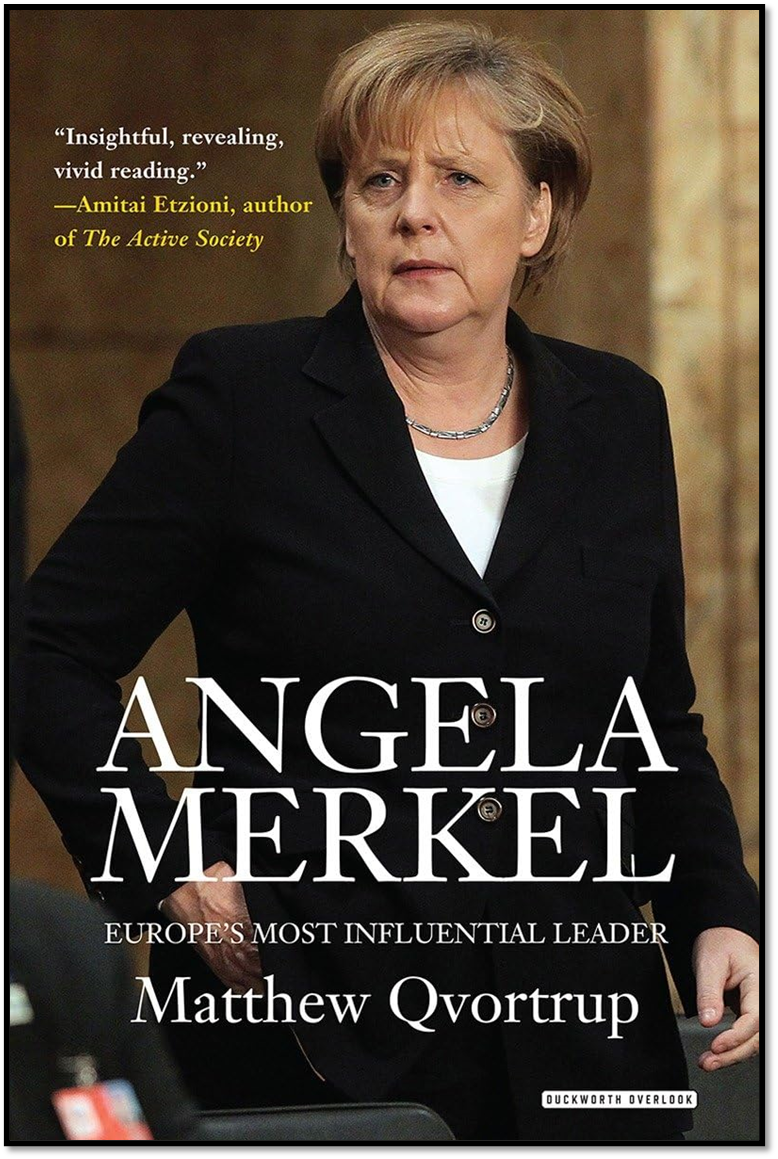
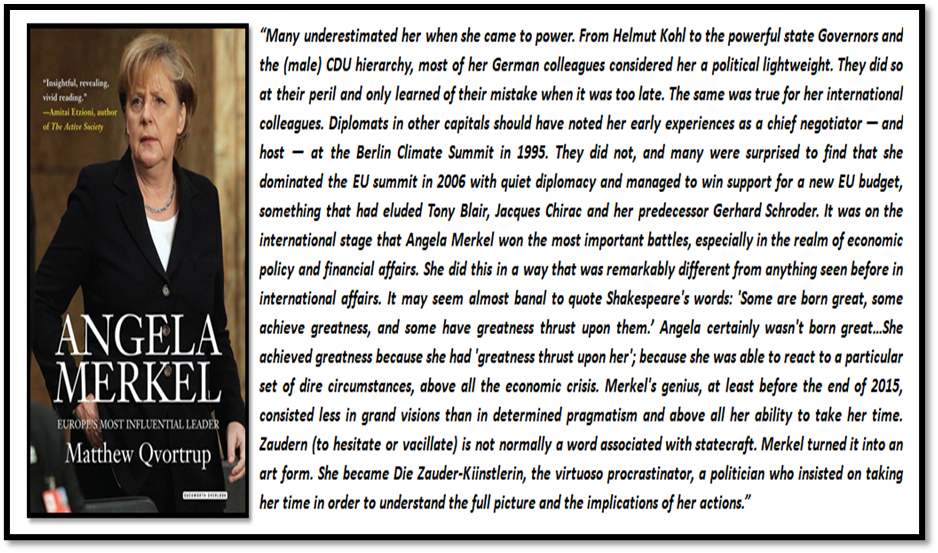
Matthew Qvortrup’s Angela Merkel: Europe’s Most Influential Leader is a compelling and meticulously researched biography that offers readers a deep dive into the life and legacy of one of the most consequential political figures of the 21st century. Drawing on over a decade of research and exclusive German sources, Qvortrup paints a portrait of Merkel that is both intimate and expansive — capturing her journey from a quiet East German scientist to the de facto leader of Europe.
Qvortrup is an award-winning author, political scientist, and broadcaster renowned for his expertise in referendums, European politics, and leadership studies. He earned his doctorate in political science from the University of Oxford and was appointed to his first professorial chair at the age of 36. He currently serves as Professor of Political Science and International Relations at Coventry University and is an adjunct professor at the Australian National University.
Qvortrup’s interdisciplinary work spans philosophy, politics, and social neuroscience. He has authored over 15 books. His recent titles include I Want to Break Free, Death by a Thousand Cuts, and The Political Brain. He is a frequent contributor to BBC Radio 4’s Analysis program and writes regularly for Philosophy Now. His op-eds have appeared in The Guardian, Newsweek, El País, and The LA Times. He has also served as a diplomat in Africa under Barack Obama’s Envoy for Africa team and as a UN mediator in Papua New Guinea.
The book has fourteen chapters in addition to an index, a notes section, eight-pages of color photographs, and a glossary. The book was published in 2017, so it does not cover contemporary US-German relations. It opens with Merkel’s early life in the German Democratic Republic, where she was raised in a politically cautious household under the watchful eye of the Stasi. Qvortrup paints a vivid picture of Merkel’s formative years, emphasizing how her upbringing in a divided Germany shaped her worldview and leadership style. Her background in quantum chemistry is not just a biographical detail— it becomes a metaphor for her analytical, methodical approach to politics.
Qvortrup’s portrayal of Merkel’s leadership is both admiring and insightful. He highlights her pragmatism, strategic patience, and ability to outmaneuver rivals through quiet resilience rather than overt charisma. The book delves into key moments of her chancellorship, including the Eurozone crisis, the refugee influx of 2015, and her handling of Brexit. In each case, Merkel is shown as a stabilizing force, often acting as the glue holding the European Union together during times of unprecedented strain.
The author also explores Merkel’s unique leadership style, which has been described as “Merkiavellian”—a blend of Machiavellian strategy and Merkel’s own brand of understated authority. She is portrayed as a leader who eschews ideological grandstanding in favor of consensus-building and incremental progress. This approach, while sometimes criticized for its lack of bold vision, is presented by Qvortrup as a source of her enduring political success.
Reflecting on how her values —Love thy neighbor as yourself…God loves everybody — shaped her policies, the author notes: “Merkel had rediscovered why politics was important; why it was necessary to show commitment to causes that are greater than ourselves Whether she herself would survive or not was immaterial; her action ‘made sense’. That was also the message when she addressed her party during the middle of the refugee crisis in December 2015. She was clew and direct, she spoke of her party as one that 'finds its basis in Christianity, in the God-given dignity of every individual. This means that it is no masses that arrive but individuals. For every human being has the dignity which is given to him by God.' She received a nine-minute standing ovation. Only one of the delegates, Wolfgang Schauble, seemed unimpressed Whether he was plotting his revenge could not be determined. But Merkel had at long last presented her credo, revealing to the world her deepest beliefs.”
Discussing Merkel’s background and achievements, the author states: “Can she take credit for rescuing the Eurozone? Can she be blamed for the refugee crisis? Historians are divided over the role of the individual. History is not just shaped by great men and women: 'Men make their own history, but they do not make it as they please; they do not make it tinder self-selected circumstances.' Angela Merkel has probably read this remark by the German philosopher and Communist Karl Marx, though it is unlikely that it made much of an impression on her — she barely achieved a pass-mark in the compulsory Marxist-Leninist module as an undergraduate at Karl Marx University in Leipzig. Merkel too was a victim of fate and fortune. But chance and luck alone do not determine our lives. Statesmen and stateswomen are individuals who seize the opportunity when given the chance. 'Destiny and character are the names of one single notion,' wrote the romantic German poet Novalis, who was fascinated by the grand sweep of history. Merkel's deeds shaped the future, creating a new set of political circumstances in politics and economics that everybody had to accept whether they lived in Berlin, Brussels, Moscow, Athens or the refugee camps scattered across Europe and the Middle East.”
The major strengths of the book are: (a) Extensive Research and Depth: It is based on over 14 years of research; the book draws from exclusive German sources and archives not previously available in English, (b) Balanced Blend of Biography and History: the author skillfully juxtaposes Merkel’s personal journey with the history of post-WWII Germany and Europe, providing context for her political decisions, (c) Insight into Merkel’s Leadership Style: It explores how Merkel’s analytical mindset, patience, and strategic thinking helped her outmaneuver rivals and navigate crises dealing with the Eurozone meltdown and the refugees. It also highlights her non-charismatic but highly effective leadership, often described as “Merkiavellian”—a mix of pragmatism and quiet power, and (d) Focus on Gender and Power: Qvortrup emphasizes Merkel’s role as a female leader in a male-dominated political landscape, showing how she built a team of mostly female advisors and challenged traditional power structures.
There are notable shortcomings and limitations in the approach and content of the book, which include: (a) Limited Psychological Insight: It provides plenty of factual detail about Merkel’s life and career, but offers little insight into her inner worldview, personal motivations, or emotional depth. Readers may come away with a clear timeline of events but not a deeper understanding of what drives Merkel as a person or leader, (b) Overly Sympathetic Tone: some readers may find the author’s portrayal of Merkel as too admiring, bordering on hagiographic, (c) Narrative Gaps: the book does not fully explore Merkel’s role in shaping EU institutional reforms, nor does it delve deeply into her foreign policy complexities, especially with Russia and China. Some chapters appear to be underdeveloped, particularly those dealing with her final years in office, and (d) Lack of Diverse Perspectives: The book relies heavily on German sources and Qvortrup’s own analysis, but does not incorporate a wide range of international viewpoints, especially from Merkel’s critics or political opponents, thus limiting readers’ ability to evaluate her legacy from a wider geopolitical lens. Despite these limitations, the book remains a valuable resource for understanding Merkel’s rise and influence.
Angela Merkel’s leadership of Germany and her influence on the European Union are widely recognized as exemplary. Her calm, pragmatic, and consensus-driven approach earned her respect both domestically and internationally. The key strengths and traits that defined her leadership include: (a) Pragmatism and Rational Decision-Making: With a background in quantum chemistry, Merkel brought an analytical and evidence-based mindset to governance. She consistently prioritized data over ideology, particularly during crises such as the Eurozone financial meltdown and the COVID-19 pandemic, (b) Calm and Steady Leadership: Dubbed the ‘steady hand of Europe,’ Merkel maintained composure during turbulent times, instilling public confidence. Her calm demeanor helped Germany navigate complex challenges without resorting to populism or emotional rhetoric, (c) Consensus Building: Merkel was a master of forging agreements among diverse stakeholders—within her party and across the political spectrum. She valued dialogue and compromise, which led to sustainable policies and long-term political stability, (d) Strategic Adaptability: She demonstrated flexibility by adjusting her positions when necessary, such as on nuclear energy and refugee policy. This adaptability enhanced her credibility and allowed her to respond effectively to changing circumstances, and (e) Trust and Integrity: Merkel consistently ranked high in public trust. She was seen as competent, caring, and honest. Her minimalist, fact-based communication style resonated with German voters who valued substance over charisma.
In context of her EU leadership, she strived for: (a) European Unity: Merkel played a pivotal role in maintaining EU cohesion during major challenges such as Brexit, the Eurozone crisis, and the refugee influx. She promoted multilateralism and diplomacy, reinforcing Germany’s role as a stabilizing force in Europe, (b) Humanitarian Leadership: Her bold and controversial decision to welcome over a million refugees in 2015 reflected a deep commitment to humanitarian values and moral responsibility, (c)Economic Stewardship: Her fiscal discipline helped Germany remain the EU’s economic anchor. She skillfully balanced support for struggling economies with the need for financial stability, contributing to the resilience of the Eurozone, and (d) Strong Diplomatic Relationships: She maintained strong relationships with global powers while consistently advocating for EU interests. Her leadership emphasized cooperation over confrontation, earning her widespread respect in international diplomacy.
Angela Merkel’s legacy offers invaluable lessons for leaders navigating complex and polarized environments. Her leadership style—grounded in integrity, reason, and resilience—should serve as a model for emerging leaders around the world. Many political analysts believe that if Angela Merkel had been Germany’s Chancellor in 2022, the war in Ukraine might have been prevented.
Angela Merkel’s leadership is widely praised for its stability, pragmatism, and consensus-building. However, her long tenure also revealed several limitations and shortcomings—both for Germany and the European Union, which include: (a)Lack of Depth in Strategic Vision: Merkel was often seen more as a manager than a visionary. Her leadership style focused on incremental change and crisis management, which sometimes led to missed opportunities for long-term reform in areas like digital infrastructure, education, and energy policy, (b) Energy Policy Missteps: Her abrupt decision to phase out nuclear energy after the Fukushima disaster lacked a comprehensive transition strategy. Germany became more dependent on coal and Russian gas, undermining climate goals and energy security, (c) Digital and Infrastructure Lag: Despite Germany’s economic strength, her government failed to modernize key sectors. Broadband expansion, digital transformation, and tech innovation lagged behind other advanced economies, (d) Indecisiveness and Delay: Her cautious approach often led to delayed decision-making. Her tendency to ‘kick the can down the road’ became so well-known that Germans coined the verb merkeln—meaning to hesitate or avoid taking a stance, and (e) Refugee Crisis Management: While her humanitarian stance in 2015 was praised, the refugee policy lacked preparation and coordination. There was little consultation with coalition partners or the EU, and integration strategies were underdeveloped.
Furthermore, some of shortcomings of her leadership for EU include: (a) Ambivalence on Strategic Autonomy: She often avoided taking a clear stance on EU strategic autonomy, trying to appease both sides of the debate, (b) Overreliance on Economic Interests: Her foreign policy was often guided by economic pragmatism rather than values. Her critics labeled this approach ‘Merkantilism’—prioritizing German commercial interests over EU solidarity and democratic principles, especially in dealings with Russia and China. (c) Nord Stream 2 Controversy: Her support for the Nord Stream 2 pipeline strained relations with Eastern European countries and increased Germany’s dependence on Russian energy, despite EU sanctions on Russia, and (d) Limited EU Reform Initiatives: While Merkel helped preserve EU unity during crises, she was reluctant to push bold reforms—such as deeper fiscal integration or institutional restructuring—leaving many systemic issues unresolved.
Angela Merkel’s legacy is complex: she was a stabilizing force in turbulent times, but her cautious and centrist approach sometimes came at the cost of bold leadership and transformative change.
In the epilogue, as he reflects on the influences that shaped Angela Merkel and the vision of Germany she pursued, the author observes: “In some ways she was the personification of her country in the post-war era. The Germany she represented was one very different from the 'blood and soil' nationalism so many associated with that country. That she chose to stand up for refugees even in the face of opposition from more or less xenophobic parts of her political hinterland was significant but perhaps not surprising. Some in the CDU espoused the muscular patriotism of Ernst Junger, the German author of a memoir of the First World War published in 1920, Storm of Steel, which glorified war, violence and masculinity. The CDU politicians (and one-time Merkel rivals) Roland Koch and Friedrich Merz harked back to an age where Germany was, if not a great power, then at least one that cherished Jiinger's ideals. Merkel was a patriot too, but of a different kind. She too believed in a strong Germany, but one that used its powers in a different way; a country that was a beacon to the world; a model for other countries, not a strong, militaristic and imperial power. It was because of this belief in, and commitment to, cosmopolitanism and the Christian values of her parents that Merkel welcomed the refugees.”
The author further notes: “In many ways she was, paradoxically, the personification of an older Germany, the embodiment of the country as it was before it became absorbed by perverted ideas of greatness and national chauvinism. Her values and ideals were those of the protestant eighteenth-century philosopher Immanuel Kant, the educationalist Wilhelm von Humboldt who inspired English liberal John Stuart Mill and the theories of Ordoliberalism.”
Angela Merkel: Europe’s Most Influential Leader stands as a valuable contribution to political biography. It offers a detailed and respectful account of a leader who defied expectations and reshaped the political landscape of Europe. It’s a study in leadership, resilience, and transformation. It offers lessons on how quiet strength and strategic patience can shape global politics. While not without its flaws, the biography is a fitting tribute to a woman who quietly changed the course of history. The book is well researched and written. It is absorbing, wide-ranging, and informative, making it accessible to both general readers and academic scholars interested in history, politics and leadership.
(Dr Ahmed S. Khan — dr.a.s.khan@ieee.org — is a Fulbright Specialist Scholar.)