America’s Identity Crisis
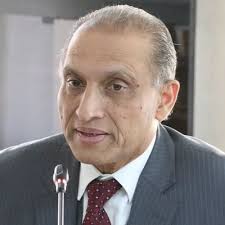
By Aizaz Ahmad Chaudhry
Pakistan
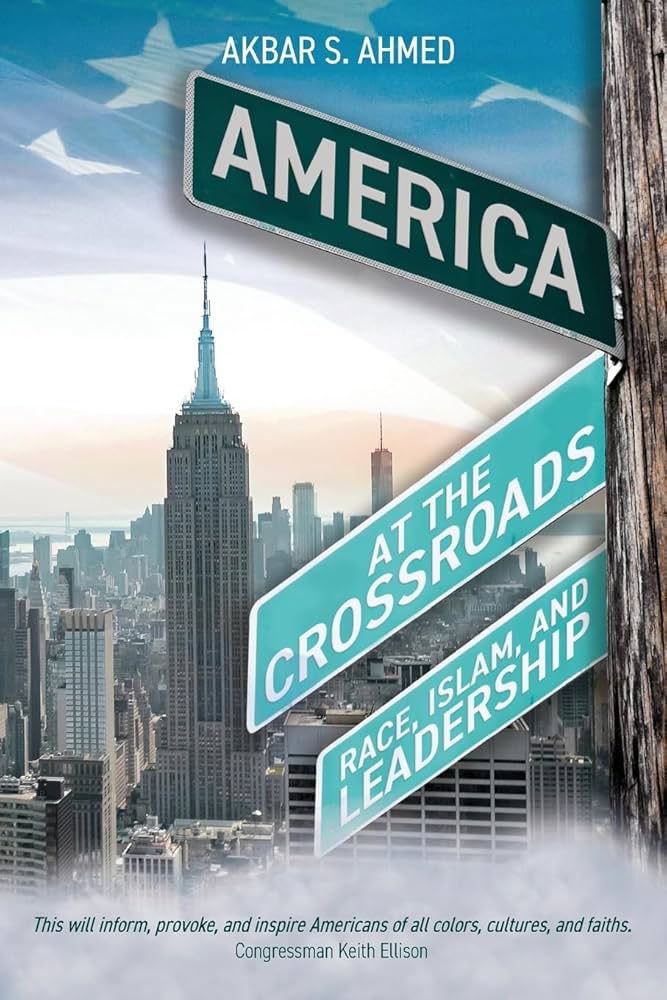
America at the Crossroads: Race, Islam and Leadership
By Akbar S. Ahmed
Beacon Books
ISBN: 978-1-916955-61-5
174pp.
Academic and former diplomat Akbar S. Ahmed’s latest book, America at the Crossroads: Race, Islam, and Leadership, dwells upon an identity crisis that is permeating into the American polity. Serving as the Distinguished Professor and Ibn Khaldun Chair of Islamic Studies at the American University in Washington DC, Ahmed discusses how American identity has changed over time, and how American-Muslims relate to it.
According to Ahmed, the primordial identity of America was shaped by the earliest settlers from Europe: white in color, English in language, and Protestant in faith. Over time, emerged a pluralist identity of America that embraced tolerance for diversity of race and religion, with respect for fundamental human rights. For much of modern American history, it is the pluralist identity that has come to define America. However, of late, a predator identity is taking roots.
Ahmed argues that the only enduring identity of America is the pluralist identity, which is resilient and deeply rooted. He recalls that American founding fathers, particularly George Washington and Thomas Jeffersen, did envisage enough space in America for Muslims and other religious minorities. They believed in a culture of tolerance, decent behavior, and mutual respect.
While recognizing the winds of change sweeping the American polity, Ahmed is cautiously hopeful that Americans would not give up their pluralist identity, which was evolved out of the broader vision, common sense and wisdom of America’s founding fathers.
The book explores the impact of several factors on contemporary American identity. Firstly, a negative sentiment against Muslims and other non-White minorities is germinating, the brunt of which is being borne by Muslim immigrants endeavoring to make America home. Secondly, the coronavirus pandemic brought in economic pressures that disrupted harmony between various segments of American society. Thirdly, racial tensions have grown, boosted mostly by those who believe in white supremacy.

Ahmed’s concluding thought in this book is that American Muslims must find a place within American pluralism by proactively engaging in politics, cultural expressions and interfaith dialogue. They must also integrate well into their adopted homeland, to preserve their dignity, representation and recognition
He cites the assault on Capitol Hill on January 6, 2021, as a direct challenge to America’s core values of democracy and tolerance. He also finds the growing trend in America of using violence to register protest or support one’s identity based on race, culture or religion troubling.
The book builds a strong case for protecting the rights of those Muslims who have made America their homeland or those who aspire to do so. He recalls that Thomas Jeffersen had bought a copy of the Qur’an with a view to understanding it. George Washington and Benjamin Franklin also envisioned Muslims as possible citizens of America in the future.
Over time, the number of Muslims in the US has grown and now form an important and growing constituency. For more than 200 years, Muslims in America did not face a serious challenge. However, the terrorist attacks of 9/11 changed the way Muslims were viewed in America. Even Islam as a faith came under a sharper scrutiny in the West.
Yet, the US leadership of the time did not opt for the populist course of naming and shaming Muslims. Ahmed commends President George W. Bush for using his influence to calm down the inflamed sentiment at that time by drawing a clear distinction between terrorism and the faith of Islam.
In 2010, Ahmed and his team engaged in extensive anthropologic and ethnographic fieldwork, culminating in the publication of Journey into America. The book enabled Ahmed to help understand who he was as an American and where it was all headed. However, suspicions about Muslims have continued to linger in the US. Ahmed is particularly concerned that, sometimes, Muslims are treated as the ‘other’. In his words “the issues of race, ethnicity and religion remain at the heart of the polarized state that America finds itself today.”
It is in this charged environment that Akbar S. Ahmed decided to project the true and sublime face of Islam, which stands for peace for all of humanity and shuns terrorism. For nearly two decades, he has consistently engaged in efforts to promote inter-faith dialogue. In doing so, he was pursuing two objectives: to develop a better understanding of Islam in the West, mainly the US and Europe, and to create harmony between the West and Muslims living in the West.
Under his leadership, a team of young scholars carried out a quartet of studies to better explain the relationship between Islam and the West after 9/11. These studies led to four publications: Journey Into Islam (2007); The Thistle and the Drone (2013); Journey Into Europe (2018) and America at the Crossroads – Race, Islam, and Leadership (2025). The objective of this project was to explain the esteem that Islam and Muslim scholars and philosophers had enjoyed in European history, culture and civilization.
A perusal of the book under review America at the Crossroads, in conjunction with the other three studies, explains how the issues of fear, identity and leadership have suddenly become phenomenally relevant to contemporary America, which is struggling to reconcile primordial, pluralistic and predator identities.
Ahmed’s concluding thought in this book is that American Muslims must find a place within American pluralism by proactively engaging in politics, cultural expressions and interfaith dialogue. They must also integrate well into their adopted homeland, to preserve their dignity, representation and recognition.
By his writings and actions, Akbar S. Ahmed and many like him are showing the way to join in efforts to save a pluralist America.
(The reviewer is a former Ambassador of Pakistan to the United States, and presently Chairman of Sanober Institute Islamabad. Dawn)