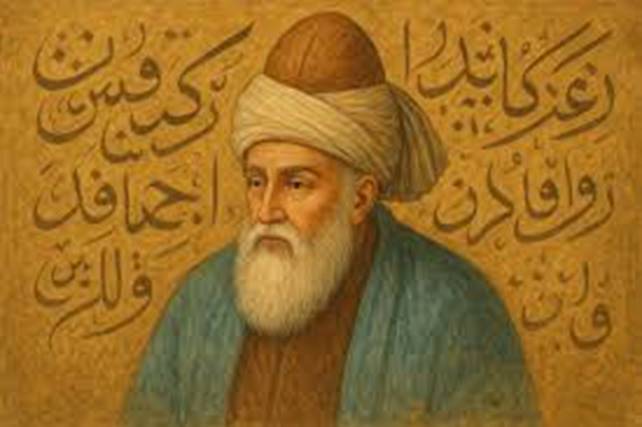
Pakistan Link will publish 19 short biographical essays on some of the greatest spiritual luminaries in Islamic history, from Rābiʿa al-ʿAdawiyya to Jalāl al-Dīn Rūmī and Khwāja Muʿīn al-Dīn Chishtī. Together, these essays would form a coherent spiritual journey—from renunciation and detachment, to ecstatic divine love, and ultimately to the human calling to know, love, and serve God. These essays are condensed from a chapter in Professor Nazeer Ahmed’s recently completed book, Faith, Love and Reason in Islamic History.
Tasawwuf has been one of the great sustaining forces in Islamic history. In times of upheaval and decline, it preserved not only faith, but the inner life of faith, the longing, remembrance, and resilience that kept the lamp of Islam burning. Yet this luminous inheritance is increasingly lost to today’s youth amid modernity, secularism, materialism, war, and the relentless distractions of the digital age. It is our hope that this series will help rekindle that lost flame and inspire a new generation to rediscover the spiritual depths of their tradition. According to the eminent author of ‘Faith, Love and Reason in Islamic History’, Professor Nazeer Ahmed, “no lasting renewal of Muslim civilization can come without spiritual renewal. A civilization must awaken from within before it can rise again.”
Reclaiming our Spiritual Heritage…
19.Ahmed Sirhindi of the Punjab
By Prof Nazeer Ahmed
Concord, CA

Ahmad Sirhindi (1564–1624 CE), widely honored as Mujaddid Alf-i Thani 9the (Renewer of the Second Millennium), remains one of the most influential figures in Islamic intellectual and spiritual history. Born in Sirhind, Punjab, during the height of the Mughal Empire, Sirhindi’s life coincided with an era of political consolidation, cultural flourishing, and religious pluralism. It was a period that encouraged philosophical exploration, syncretism, and debates over orthodoxy, and it is within this complex social and religious landscape that Sirhindi emerged as both a scholar and a spiritual reformer. Through his writings, letters, and personal example, he strengthened the connection between Shariah (Islamic law) and Sufi practice, laying the foundations for a spiritual movement with enduring influence across South Asia and beyond.
Historical and Social Context
Sirhindi was born into a distinguished scholarly family associated with the Hanafi jurisprudential tradition and the Naqshbandi Sufi order. His formative years were marked by intensive study of the Qur’an, Hadith, jurisprudence, logic, and rational sciences, reflecting the classical curriculum of Islamic scholarship. At the same time, he pursued rigorous Sufi training under Khwaja Muhammad Baqi Billah, a direct disciple of the Central Asian Naqshbandi silsila. This dual grounding in law and spirituality would define his lifelong approach: an integration of mystical experience with doctrinal fidelity and social responsibility.
The political context of Sirhindi’s lifetime was particularly influential in shaping his thought. Emperor Akbar’s policies of religious syncretism, including the promotion of the Din-i Ilahi and patronage of heterodox ideas, prompted concern among orthodox scholars. While Akbar’s reign encouraged intellectual diversity and experimentation, Sirhindi saw the need for spiritual and religious reform that reaffirmed the centrality of Islamic orthodoxy without undermining the ethical and contemplative dimensions of Sufism.
Spiritual Contributions
Sirhindi’s most significant contribution is the deepening and systematization of the Naqshbandi path in the Indian subcontinent. Building on the teachings of Bahauddin Naqshband, he emphasized the integration of Shariah and Tariqa, ensuring that mystical experience is always rooted in Islamic law and ethical practice. He famously critiqued forms of Sufism that disregarded legal obligations or indulged in excessive ecstatic expressions, arguing that true spiritual life must harmonize inward transformation with outward responsibility.
A cornerstone of Sirhindi’s thought is his doctrine of “wahdat al-shuhud” (unity of witness). While earlier Sufi thinkers, notably Ibn ʿArabī, articulated the idea of wahdat al-wujud (unity of existence), in which God and creation are seen as intimately connected, Sirhindi offered a corrective perspective emphasizing God’s transcendence. In his view, mystical experience must always affirm the distinction between Creator and creation; the perception of unity occurs in the consciousness of the observer witnessing God’s signs in the world, rather than collapsing the two into ontological equivalence. This nuanced interpretation safeguarded orthodoxy while preserving the transformative potential of spiritual practice.
Central to his spiritual methodology was silent dhikr, the inward remembrance of God, which he taught as a discipline that cultivates continuous awareness without ostentation. This practice aligns with the classical Naqshbandi ideal of “solitude in the crowd,” enabling the practitioner to maintain inner focus while actively participating in worldly responsibilities. Sirhindi also emphasized spiritual mentorship, asserting that genuine progress requires guidance from a realized sheikh who can provide instruction tailored to the disciple’s capacity, ethical orientation, and spiritual temperament.
The Maktubat: Letters of Spiritual Guidance
Sirhindi’s vast corpus of Maktubat (letters) stands as one of his most enduring contributions to Islamic spirituality. Composed over decades, these letters addressed disciples, contemporaneous scholars, and even political leaders, offering guidance on personal ethics, mystical discipline, and societal responsibility. The Maktubat articulate the principles of inner purification, ethical rectitude, and continuous remembrance, serving as both a manual for spiritual life and a practical guide to navigating complex social and political realities. Through these letters, Sirhindi codified a systematic approach to Sufism that was intellectually rigorous, spiritually profound, and socially relevant.
In addition to personal guidance, the Maktubat provide reflections on governance, social ethics, and the moral responsibilities of rulers. By communicating directly with Mughal elites, Sirhindi positioned spiritual insight as a resource for moral and administrative reform, exemplifying the Sufi ideal that inner transformation and social engagement are inseparable.
Influence on Mughal Governance
Sirhindi’s impact extended into the political realm, particularly during the reigns of Jahangir (r. 1605–1627) and Shah Jahan (r. 1628–1658). While maintaining the independence and spiritual authority of his order, he engaged with the imperial court, advocating policies consistent with Islamic law and ethical governance. His counsel emphasized justice, accountability, and the moral obligations of rulers, contributing to a climate in which orthodoxy, ethical conduct, and spiritual awareness were seen as mutually reinforcing.
Though his influence was primarily intellectual and moral rather than coercive, it shaped the way the Mughal court approached religious authority, legal reform, and engagement with Sufi institutions. In doing so, Sirhindi’s legacy bridges the domains of spirituality, scholarship, and governance, offering a model for the ethical exercise of political power informed by spiritual principles.
Spiritual Legacy and Universal Impact
The universal significance of Sirhindi’s legacy lies in the enduring vitality of the Naqshbandi-Mujaddidi order, which spread across India, Pakistan, Afghanistan, Central Asia, the Ottoman Empire, and Southeast Asia. By codifying spiritual practices, ethical precepts, and guidance on social conduct, Sirhindi created a framework adaptable to diverse cultural and political contexts while maintaining doctrinal coherence. His emphasis on silent dhikr, continuous moral vigilance, and the integration of inner and outer life provided a replicable model for spiritual training that transcended regional and temporal boundaries.
Sirhindi’s teachings also contributed to the intellectual revival of Islam in South Asia, influencing subsequent generations of scholars, reformers, and mystics. By emphasizing ethical rigor, doctrinal fidelity, and spiritual discipline, he strengthened the moral and spiritual fabric of the communities in which the Naqshbandi-Mujaddidi order took root. His ideas continue to resonate in contemporary discourse on Sufism, Islamic revival, and the role of spirituality in personal and social life.
Broader Historical Influence
Beyond the subcontinent, Sirhindi’s thought influenced Islamic reform movements across the Islamic world. The Mujaddidi branch of the Naqshbandi order, grounded in his teachings, contributed to both spiritual renewal and social reform in regions as varied as the Ottoman domains and Central Asia. His insistence on balancing mystical depth with ethical and social responsibility provided a model that could be applied in diverse historical circumstances, reinforcing the universal relevance of his spiritual vision.
Conclusion
Ahmad Sirhindi represents a pivotal figure in the history of Islamic thought, combining spiritual depth, intellectual rigor, and social engagement. Through his refinement of the Naqshbandi path, the articulation of wahdat al-shuhud, and the guidance offered in his Maktubat, he established a vision of Sufism that harmonizes the inner life of the soul with the demands of Shariah and social responsibility. His influence on Mughal governance, educational institutions, and subsequent generations of Sufi practitioners underscores the breadth of his legacy.
Sirhindi’s enduring contribution lies in demonstrating that spiritual realization is not isolated from ethical action, social responsibility, or intellectual engagement. By integrating contemplative practice with law, morality, and mentorship, he created a model of spirituality capable of guiding individuals and communities across centuries and continents. The Naqshbandi-Mujaddidi order remains a living testament to his vision, continuing to shape the inner and outer lives of countless adherents, while his Maktubat provide timeless guidance for the ethical, spiritual, and social challenges of every era.