Book & Author
Zafar Masud: Seat 1C — A Survivor’s Tale of Hope, Resilience and Renewal
By Dr Ahmed S. Khan
Over the last decade, global civil aviation experienced its safest era in history. Driven by technological advancements—such as fly-by-wire automation and enhanced ground proximity warning systems—alongside strict oversight from international regulators like ICAO and EASA, the global fatal accident rate fell to roughly one per 5.6 million commercial flights despite a massive expansion in air traffic. Today, global aviation hazards are mostly restricted to non-fatal operational issues like severe turbulence, tail strikes, and runway excursions, making Loss of Control In-Flight (LOC-I) exceedingly rare.
In sharp contrast, Pakistan’s aviation sector over the same period has been marred by a series of fatal airliner disasters that claimed hundreds of lives. Major incidents include the crashes of PIA Flight 661 in 2016 and PIA Flight 8303 in 2020, as well as the July 7, 2026, crash of a K2 Airways Boeing 737-400 cargo plane into the Arabian Sea. In that recent incident, the crew reported a severe navigation failure before the aircraft suffered rapid altitude fluctuations and plunged into the sea, killing all five crew members.
This sharp divergence stems from deep-seated institutional vulnerabilities in Pakistan's civil aviation sector. While global standards require strict adherence to Standard Operating Procedures (SOPs) and non-hierarchical Crew Resource Management, domestic crashes in Pakistan have been repeatedly traced to cockpit hubris, overconfidence, and a direct disregard for air traffic control warnings. These cockpit failures were compounded by ground-level lapses, including understaffed control towers during critical descent phases. Furthermore, safety oversight was severely eroded by organizational issues—such as deferred maintenance, unreplaced aging parts, administrative negligence, and the Pakistan Civil Aviation Authority’s conflicting dual role as both regulator and operator. This systemic crisis ultimately triggered an international regulatory backlash following revelations of fraudulent pilot licensing practices.
Ultimately, the corrupt ruling elite abandoned the rigorous benchmarks once established by visionary aviation leaders like Air Marshal Asghar Khan and Air Marshal Nur Khan. Driven by cronyism, corruption, and institutional neglect, these failures dismantled Pakistan International Airlines (PIA)—once an industry trendsetter and a global pioneer in commercial aviation.
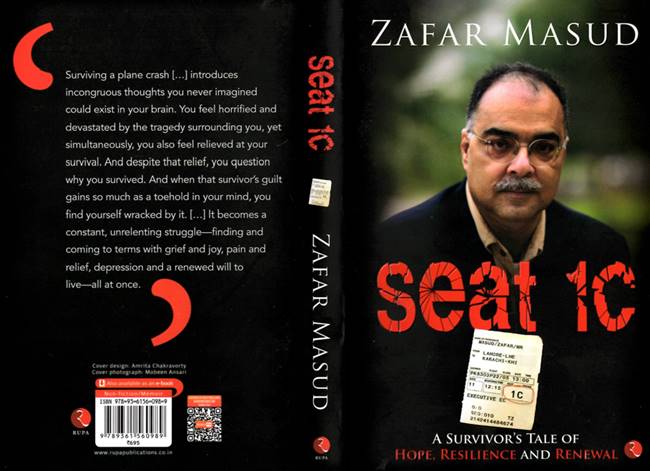
Seat 1C: A Survivor's Tale of Hope, Resilience, and Renewal by Zafar Masud is a deeply reflective memoir and essay collection exploring the author’s survival of the May 22, 2020, Pakistan International Airlines (PIA) Flight 8303 crash, which killed 98 people and left only two survivors.
As the newly appointed President and CEO of the Bank of Punjab, Zafar Masud was traveling from Lahore to Karachi when the Airbus crashed just 1,340 meters short of the runway after both engines failed following an aborted belly landing. Rather than presenting a simple survival story, the author uses his near-death experience to examine existential questions, survivor’s guilt, human psychology, and leadership.
Framed by an introduction and an afterword, the book comprises ten chapters: "Miracles," "Arrogance," "Rituals," "Dues," "Willpower," "Bold Steps," "Goodness," "Sincerity," "Communication," and "Legacy." Central to the narrative is a critique of systemic arrogance, which the author identifies as the primary driver of institutional decay across corporations, historical empires, national sports, and aviation safety — no one follows the rules! He outlines how Flight 8303 was the sixth plane crash in Pakistani airspace within a decade, attributing the disaster to a chronic pattern of pilot overconfidence, disregarded warnings, poor safety protocols, and administrative negligence. He also highlights how understaffing occurred during the critical descent because ground control personnel left their posts for Ramadan prayers without shift coverage.
The book begins with a passionate call to action, encouraging people of all ages and experience levels to reconnect with the grand ambitions of their youth, consider the legacy they wish to leave behind, and actively work toward building it. Reflecting on their own journey after surviving a major crash, the author discusses the practical and emotional difficulties of practicing compassionate leadership when confronted with senseless tragedy.
In one organization led by the author, a young female employee was murdered by a male colleague, allegedly for refusing his marriage proposal. This horrific act exposed deep-seated societal issues regarding gender rights and consent, while simultaneously revealing the stark limitations of traditional business school theories, which fail to prepare leaders for such extreme real-world crises. In response, the author and their leadership team took immediate action by addressing employees directly to dismantle victim-blaming rumors, providing financial and emotional support to the victim’s family, fully cooperating with law enforcement, implementing organization-wide psychometric testing, offering therapy, and heightening workplace security. Despite the shock of the incident, the author consciously refused to let a single heinous act define their view of humanity or turn into a generalized vilification of their workforce, choosing instead to recommit to believing in the best of every individual.
Building on this experience, the author asserts that empathy is a learnable, actionable skill, yet modern corporate structures systematically suppress it. By prioritizing shareholder value and short-term profit metrics over the needs of employees and customers, large organizations drive empathy out of leadership conversations.
To build sustainable, ethical businesses, the author argues that "soft" skills like empathy and effective communication must be restored and actively rewarded. This systematic loss of emotional connection extends beyond corporate boardrooms into other professional disciplines, such as science and journalism. In climate science, historical accounts reveal that early glaciologists wrote passionately about their sense of wonder when exploring nature, but over time, scientific writing adopted a clinical, emotionless tone to project objectivity, stripping narratives of their ability to inspire the public.
Similarly, standard journalistic ethics demand strict neutrality, but when carried to extremes, this posture can erase basic human empathy. The author illustrates this through photojournalist Kevin Carter, who won a Pulitzer Prize for his iconic photograph of an emaciated Sudanese child near a vulture during a severe famine. Because Carter simply shooed the vulture away and left without helping the child, intense public debate erupted over journalistic ethics and the appropriation of suffering, culminating in Carter's suicide four months later. The author contends that professional neutrality should never justify a lack of basic human empathy.
Ultimately, the author redefines survivor’s guilt, proposing that it should not be carried as a passive burden. Instead, individuals should view their privileges, positions, or wealth as evidence of survival in an uneven, unjust world, using that underlying guilt as a constructive catalyst to drive societal change and foster equity. Grounding their outlook in the realization that life is finite, the author advocates adopting a core philosophy of "no regrets"—ensuring that every decision and action contributes toward treating others better and building a more compassionate, equitable world.
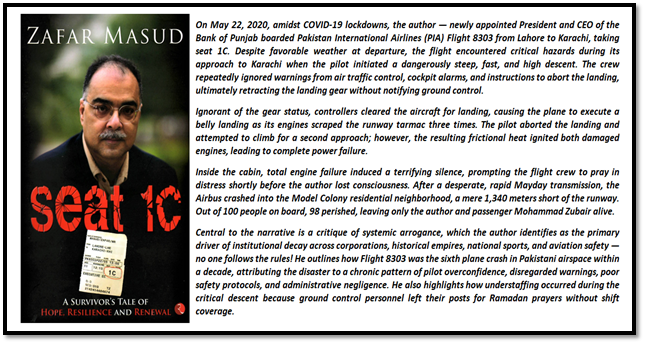
On May 22, 2020, amidst COVID-19 lockdowns, the author — newly appointed President and CEO of the Bank of Punjab boarded Pakistan International Airlines (PIA) Flight 8303 from Lahore to Karachi, taking seat 1C. Despite favorable weather at departure, the flight encountered critical hazards during its approach to Karachi when the pilot initiated a dangerously steep, fast, and high descent. The crew repeatedly ignored warnings from air traffic control, cockpit alarms, and instructions to abort the landing, ultimately retracting the landing gear without notifying ground control.
Ignorant of the gear status, controllers cleared the aircraft for landing, causing the plane to execute a belly landing as its engines scraped the runway tarmac three times. The pilot aborted the landing and attempted to climb for a second approach; however, the resulting frictional heat ignited both damaged engines, leading to complete power failure.
Inside the cabin, total engine failure induced a terrifying silence, prompting the flight crew to pray in distress shortly before the author lost consciousness. After a desperate, rapid Mayday transmission, the Airbus crashed into the Model Colony residential neighborhood, a mere 1,340 meters short of the runway. Out of 100 people on board, 98 perished, leaving only the author and passenger Mohammad Zubair alive.
In chapter titled “Arrogance”, the author describes how systemic hubris and arrogance transform organizational control into catastrophe, taking the crash of Pakistan International Airlines (PIA) Flight 8303—which the author survived—as its focal point. The author frames this tragedy not as an isolated incident, but as part of a chronic pattern of decay within Pakistan's aviation sector. Flight 8303 marked the country’s sixth major air disaster in a decade, alongside catastrophic crashes involving Air blue Flight 202, Bhoja Air Flight 213, and PIA Flight 661. These repeated failures were driven by pilot overconfidence, disregarded warnings, lax maintenance, and administrative incompetence, and conflict of interest exhibited by CAA.
Beyond aviation, the author explains how unchecked arrogance destroys sports and empires alike. Local thappad kabaddi and world-class Pakistani field hockey both collapsed due to an arrogant refusal to adapt to modern international standards. Historically, similar overconfidence led to Napoleon’s disastrous Russian campaign, the unraveling of the Mughal Empire, and the tragic myth of Icarus. Ultimately, the author urges an overhaul of institutional culture, replacing blind ego with strict safety protocols, accountability, and humility.
The author notes that psychologically, this destructive behavior stems from the "better-than-average effect", a universal human delusion where individuals overestimate their skills relative to others. This overconfidence spreads contagiously and leads to fatal missteps across aviation, law, medicine, and history.
Quoting poet Rais Amrohvi, the author warns that forgetting one's vulnerability brings about self-destruction. Reflecting on a personal career misstep at Barclays, where pride led the author to isolate themselves rather than engage with new leadership, the text stresses that leaders must actively counter egotism. True leadership requires cultivating humility, seeking feedback, listening to junior staff, and acknowledging mistakes to prevent disaster.
The primary strength of Seat 1C lies in its profound emotional and intellectual honesty. The author avoids the trap of self-glorification. Instead, he frames his survival as an act of grace rather than personal heroism, contrasting his passive escape with the proactive quick thinking of his fellow survivor, Muhammad Zubair.
Another major triumph is the book’s thematic breadth. The author seamlessly connects the micro-level trauma of the crash to macro-level institutional issues. Drawing from his background as an executive, he delivers an incisive critique of systemic arrogance, workplace culture, and institutional decay. He dissects how overconfidence, procedural non-compliance, and the "better-than-average effect" plague not only aviation, but governance and corporate environments at large. Interweaving personal trauma with references to literature, poetry (such as Rais Amrohvi), and historical collapses, the author grounds his ordeal in a timeless philosophical framework.
Furthermore, his celebration of the ordinary citizens who pulled him from the wreckage offers an uplifting counterweight to his critique of elite cynicism, celebrating the inherent goodness and resilience of everyday people.
Despite its compelling narrative, the book is not without flaws. Its non-linear structure—which weaves between raw recollections of the crash, hospital recovery, and historical or managerial essays—can feel disjointed. Readers looking for a straightforward chronological memoir may find the abrupt shifts in focus jarring.
Additionally, the author’s prose occasionally suffers from a stylistic disconnect. While his personal reflections and philosophical musings are vivid and moving, his tone sometimes shifts toward the overly formal or corporate when analyzing aviation safety and administrative failure. These analytical segments, though informative, read at times like policy reports rather than creative non-fiction, momentarily stalling the book’s narrative momentum.
Seat 1C is a powerful, thought-provoking contribution to survivor literature. While its structural leaps and occasional corporate diction slightly impede its narrative flow, the book’s vulnerabilities, intellectual rigor, and message of renewal far outweigh its limitations. It serves as both a touching memoir of recovery and an urgent call for humility, open communication, and institutional accountability.
(Dr Ahmed S. Khan — dr.a.s.khan@ieee.org— is a Fulbright Specialist Scholar)