
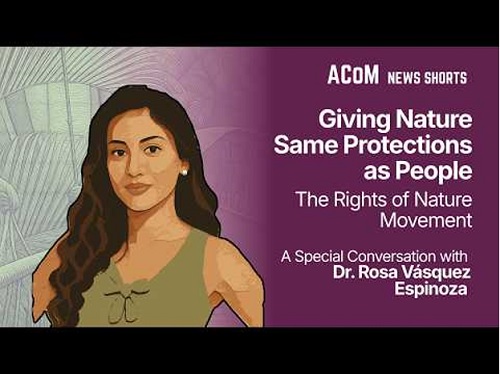
“The future is ancestral too. There is so much that we can learn from our roots,” she added. “We can regain a sense of a connection to humanity, which I think the world is in desperate need of.”
Indigenous Knowledge Holds Answers to Climate Crisis, Amazon Biologist Says
By Selen Ozturk
CA
Indigenous knowledge systems can address climate change, biodiversity loss and food insecurity in the Amazon, but only if they are protected with the communities that created them over thousands of years, says Rosa Vásquez Espinoza.
For the Peruvian chemical biologist, author and founder of Amazon Research Internacional , who has spent more than a decade working alongside Indigenous communities in Peru’s Amazon, the mining and deforestation devastating the rainforest is coupled with the rapid loss of traditional knowledge as younger generations become increasingly disconnected from their elders.
Currently, over 30 million people live in the Amazon, with Indigenous people — including 350 ethnic groups — comprising 9% of the overall population. Over 60 of these groups remain un-contacted.
A generational knowledge gap
“The people are deeply scared that the youth are not acquiring their knowledge,” said Vásquez Espinoza at a July 31 American Community Media briefing. “This became more obvious to the youth themselves during the pandemic, because they were seeing a lot of the elders die and didn’t know how to help them, so there was almost a cry for help that emerged from that.”
She traced part of the knowledge transmission gap to smartphone access reaching even remote areas, where youth “know what heel to stand on to get a little bit of internet access, and will know the latest trends, music, movies, and want to imitate what is in there in a way that leads to a rejection of wanting to wear your traditional clothes, to speak your traditional language and to acquire the traditional knowledge of your elders.”
Vásquez Espinoza’s response has been to formalize the knowledge that elders once passed down only orally: She is building “the first intercultural encyclopedia in Indigenous languages,” paired with workshops that bring youth into direct contact with that knowledge.
“The way we acquire information is changing everywhere, so we need to find creative ways to engage with the youth … we need to make it cool that the traditional knowledge stays alive,” she said, arguing for an Amazonian cultural-influencer strategy modeled on others emerging from Quechuan and Andean communities.
That culture is now being extracted by another force entirely: “The knowledge is being fed to AI, whether we want it or not,” continued Vásquez Espinoza, adding that current data regulations offer Indigenous people little say over how a medicinal recipe, for instance, is used once documented, and no guaranteed mechanism for compensation or decision-making power if it’s commercialized.
“The question is: What kind of sovereignty can we ensure in giving people the choice to select how their knowledge can be used?” she added.
Lessons from the rainforest
As an example of what can be lost when traditional knowledge is overlooked, Vásquez Espinoza’s pointed to her own research on the stingless bee — the oldest bee on the planet, dating to the age of the dinosaurs, and a pollinator of coffee, cacao, avocados and blueberries.
During the pandemic, Indigenous communities in unconnected regions of Peru independently identified the bee’s honey as a treatment for COVID-19 symptoms, which spurred her team to run the first chemical analysis of it.
That work led to the stingless bee becoming the first insect in the world granted legal rights — a model now drawing interest from groups in California, Holland, the United Kingdom, India, Ecuador, Colombia and Bolivia seeking similar protections for their own pollinators.
As the world’s biggest single tropical rainforest, the Amazon contains 20% of the world’s liquid freshwater and roughly one in 10 known species on Earth across 2.7 million square miles.
LiDAR mapping of these ecosystems has overturned assumptions about how much ancient knowledge was already known and lost.
Three-dimensional laser scans of earthworks and plant coverage show pre-Columbian cities sustaining one to two million people once existed in the Brazilian and Bolivian Amazon, “in areas where the soils are not fertile and we don’t even have access to water,” thriving instead through advanced landscape engineering, explained Vásquez Espinoza.
Meanwhile, studies of domestic settlements richer in dark earths now indicate that farming on these sites could have supported an estimated population of at least 8 million people in the Amazon basin by 1492.
“It tells us that our management of and our cohabiting with the Amazon forest was a lot more intertwined and balanced than we ever gave it credit for,” she said.
‘The future is ancestral’
The consequences of losing this balance extend well past the Amazon’s borders.
During the last 50 years, the Amazon has lost up to 20% of its forest cover.
Deforestation not only disrupts rainfall patterns and ocean temperatures worldwide, Vásquez Espinoza said, but also global access to everyday goods that trace back to the region like soybeans, corn, coffee, cacao and FDA-approved drugs derived from Amazonian plants: “Every aspect of our life is impacted by what happens in the Amazon forests.”
Economic pressure and poverty remain the biggest driver pulling Indigenous youth toward further extraction.
Vásquez Espinoza pointed to agroforestry as a working alternative: “Coffee and cacao, when done well, are a great generator of rainforest protection,” she said, describing models in central and southern Peru that combine steady income with forest regeneration and compensation funds for bad harvest years. Without that option, youth are often left with mining jobs paying “$2 a day.”
Despite generations of displacement, she said, “I meet communities that may have only just recently gained title to their lands, and yet are so open to rebuild trust, to welcome people … because they’re worried about not necessarily just their lives, they’re worried about the generation of their great-grandkids, even if they’re not born today … in a spirit of resilience showing up as kindness in a way that I think is extremely rare to see in an individualistic Western world.”
“The future is ancestral too. There is so much that we can learn from our roots,” she added. “We can regain a sense of a connection to humanity, which I think the world is in desperate need of.”
Watch the full conversation with Dr Vásquez Espinoza here . American Community Media
