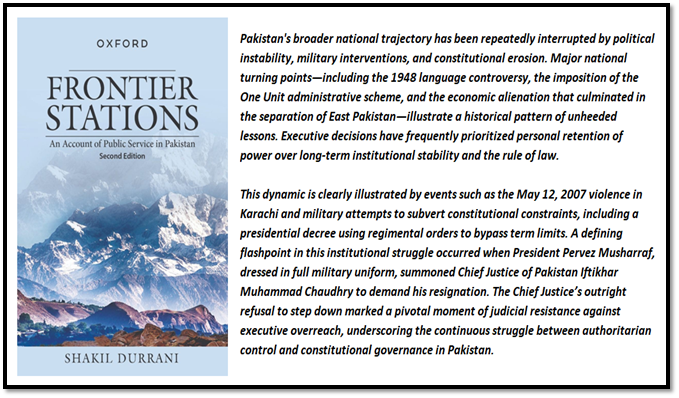
Book & Author
Shakil Durrani: Frontier Stations — An Account of Public Service in Pakistan
By Dr Ahmed S. Khan

In Frontier Stations — An Account of Public Service in Pakistan, veteran civil servant Shakil Durrani delivers an insightful insider’s perspective on the mechanics, structural dilemmas, and personal realities of state administration in Pakistan. Spanning over four decades of service—culminating in top-tier postings as Chief Secretary of Khyber Pakhtunkhwa (KP), Sindh, Azad Jammu & Kashmir, and Gilgit-Baltistan, alongside the chairmanship of WAPDA—Durrani's memoir offers a balanced examination of Pakistan’s complex governance landscape.
Shakil Durrani passed the Civil Service of Pakistan (CSP) competitive examinations in 1971, securing top marks in written exams and interviews after preparing while studying political science. His civil service career spanned several decades, culminating in senior executive roles including Chief Secretary in various provinces (such as Gilgit-Baltistan, Azad Jammu and Kashmir, Khyber Pakhtunkhwa, and Sindh) as well as head of major public sector entities. Presently, Shakil Durrani is the Executive Director of SOPREST (Society for the Promotion of Engineering Sciences and Technology), the governing body of the Ghulam Ishaq Khan Institute of Engineering Sciences and Technology (GIKI). In this role, he serves as an ex-officio member of GIKI’s Board of Governors and Executive Committee.
The author wrote the book in retirement; it combines personal memoirs, anecdotes, and administrative reflections on governance, tribal areas, political leadership, and national development in Pakistan.
The author narrates his account in four parts. Part One — A Frontiersman Recalls:- focuses on early memories, education, notable individuals, civil service experiences, and his administrative tenures as Chief Secretary in various regions. Part Two — Romance of the Frontier - details experiences in former princely states (Chitral, Swat, Dir), the former Tribal Areas (FATA/Frontier Crimes Regulation), the Frontier Corps, and the aftermath of 9/11 leading to the eventual merger of tribal districts. Part Three — Falling Standards - examines systemic failures in governance, police and dispute resolution systems (jirga vs. courts), corruption, leadership blights, and falling standards across public institutions. Part Four —Critical Issues - addresses environmental degradation, land-use planning, wildlife protection, railway decline, water/power crises (e.g., CPEC, WAPDA, Diamer Basha Dam, Neelum-Jhelum), and broader national politics.
In the preface, the author recalls the summer of 1970 when he was studying for the exam of civil service of Pakistan: “One night after completing my studies, I experienced the Ziarat-e-Mustafa, a truly amazing experience and one every Muslim dreams of literally. I dreamt of meeting Holy Prophet, Hazrat Muhammad (PBUH), on the marble platform in front of the Taj Mahal in Agra. Even in my dream, I was aware that this was a very special occasion for me. Furthermore, the Holy Prophet (PBUH) addressed me, asking me to give Rs 14 in Allah’s name to the poor. Immediately, I woke up and waited for daybreak to inform my parents about my good luck. My mother, Halima Zaib, named after Bibi Halima, who cared for the Holy Prophet (PBUH) during his early days, told me I was very fortunate and that I should say two rakat nafil prayers in gratitude. I did and gave the money to the poor. How fortuitous was it for me to be visited by the Holy Prophet (PBUH) in my dream! This experience was a life changer and further strengthened my faith in Providence. It resulted in a new confidence which gave me a direction in my life. I tried to walk the correct path with a conviction that Allah [SWT] would always guide me. In a sense the impact of this event on my life was immediate.”
Reflecting on Personal Foundations, Lineage, and Family Values, the author attributes his core ethical foundations to lessons learned early in life from his family, particularly his mother, Halima Zaib Durrani. He recounts parables she shared regarding integrity, the necessity of hard work, avoiding wastefulness, and maintaining compassion for the less fortunate.
His lineage features prominent military and administrative figures, including his grandfather Khan Abrader Abdul Hakim Khan, who served as Superintendent of Police in the 1930s and received a prized shotgun for solving a high-profile case. His father served in the military and was an active supporter of Abdul Ghaffar Khan's Indian National Congress before leaning toward the Muslim League.
Commenting on the Institutional Integrity, Governance, and Accountability, the author emphasizes character, courage, and objective decision-making over mere technical competence. He argues that top officials must eliminate the traditional "master-servant" dynamic in favor of genuine public accountability.
To prevent political harassment, arbitrary transfers, and corruption, he advocates for empowering oversight institutions such as Parliamentary Select Committees, the Public Accounts Committee, the Auditor General, and the Ombudsman. Decisions made by bodies like the National Economic Council must prioritize national public interest over partisan considerations.
The author critiques past judicial decisions—such as the historical Maulvi Tamizuddincase—that provided legal cover to authoritarian or military regimes. He recommends reforming the judicial appointment process by utilizing a broader advisory body comprising senior judges, bar leaders, civil servants, and parliamentarians to ensure merit and independence.
Discussing the National Security, Counter-Militancy, and Regional Dynamics, the author notes that maintaining nuclear deterrence and a strong defense capability absorbs significant national resources. He argues that sustained economic growth and efficient administrative governance are required to support the military's budgetary needs.
The author observes that security challenges, particularly in the former Tribal Areas, Khyber Pakhtunkhwa, and Balochistan, have required extensive operations by the military and intelligence services. While acknowledging tactical progress against insurgencies, he emphasizes that long-term stability requires comprehensive economic development, job creation, and grand regional strategies.
Addressing external relations, the author warns of external attempts to exploit Pakistan's internal vulnerabilities. He stresses the imperative of protecting Pakistan's rights under the 1960 Indus Waters Treaty against upstream water manipulation, framing water security as a vital national interest.
Contemplating on Leadership Deficits and Socio-Economic Development, the author notes that a primary structural flaw is the prevalence of dynastic politics and hereditary party leadership. He argues that true democratic progress is hindered when political parties function as family enterprises rather than merit-based institutions. He calls for equitable resource distribution through strategic infrastructure programs such as the China-Pakistan Economic Corridor (CPEC), the Public Sector Development Program, and targeted social safety nets like the Benazir Income Support Program (Ehsaas).
Despite long-standing structural challenges, the author maintains an optimistic outlook based on the resilience of ordinary citizens, dedicated public officials, and grassroots leaders. He underscores that sustainable progress ultimately depends on fostering inclusive governance, protecting human rights, and enforcing the rule of law across all regions of the country.
Reflecting on Reform Recommendations & Vision for the Future, the author proposes balancing power between the President and the Prime Minister, potentially electing the President directly to foster national unity. He recommends proportional representation to make legislatures more representative. For administrative redistribution, the author suggests subdividing oversized provinces (e.g., creating a Saraiki province from Punjab) and rotating key administrative positions (such as Chief Minister) across regional districts to reduce provincial hegemony and parochialism. For development priorities, the author stresses the urgent need for consensus on water sharing (1991 Water Apportionment Award), expansion of infrastructure (railways to Gwadar/Peshawar), energy projects, family planning, universal literacy, and environmental protection.
The author has also reflects on key political and historical aspects. Referring to Flaws of Partition & Kashmir, the author critiques British decision-making during the 1947 Partition, pointing out the flawed boundary decisions by Cyril Radcliffe and Lord Mountbatten that exacerbated conflicts, particularly over Jammu and Kashmir.
Discussing Political Instability & Governance, the author charts Pakistan's political trajectory across successive regimes—from Ayub Khan, Zulfikar Ali Bhutto, and Zia-ul-Haq to Benazir Bhutto, Nawaz Sharif, Pervez Musharraf, and Imran Khan. He highlights recurring issues such as military interventions, political polarization, corruption cases (e.g., Panama Papers), and the lack of strong, selfless national leadership.
The book also contains some details about military figures. Discussing the interaction of Field Marshal Sam Manekshaw and General Yahya Khan, the author details a 1995 meeting in New Delhi with Field Marshal Sam Manekshaw. Manekshaw fondly recalled his pre-Partition service in the Frontier and shared an anecdote about General Yahya Khan. Before Partition, Yahya Khan purchased Manekshaw’s motorbike for 1,000 rupees but left for Pakistan without paying. Manekshaw joked that 24 years later, Yahya paid for the bike by surrendering half of Pakistan in 1971. The author also notes that following the 1971 war, former President Yahya Khan was placed under house arrest in a rest house in Abbottabad, where he spent his days gardening. The author attributes the failure of the 1971 East Pakistan war to a lack of strategic clarity, subjective planning, and "Dutch courage" among top military commanders.
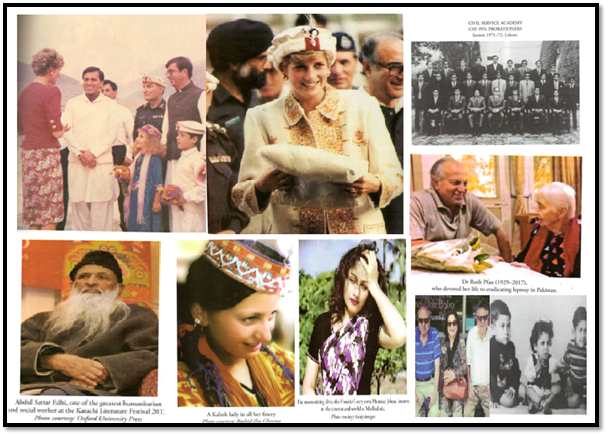
The key strength of Frontier Stations lies in its geographical and administrative breadth. While much of Pakistan’s political literature focuses heavily on the federal capital or core urban centers, the author shifts the lens toward the periphery. He provides crucial historical and operational detail on the former Princely States (Swat, Dir, and Chitral), the erstwhile Federally Administered Tribal Areas (FATA), and the northern territories.
The book candidly outlines how political expediency and bureaucratic submission systematically undermine the rule of law. The author narrates the continuous struggle between adherence to administrative procedure and demands of both military dictators and civilian politicians. He explores key historic turning points, notably contrasting the traditional bureaucratic discretion exercised in peripheral stations with the high-stakes political interference in urban hubs, such as during the violent May 12, 2007, incidents in Karachi where administrative warnings were bypassed by political interests.
Rather than presenting a dry policy summary, the author grounds his account in rich regional history and cultural nuances. A notable highlights section, Tales from the Frontier, blends administrative duties with captivating historical vignettes. These include stories such as two Afridi brothers who earned opposing military honors (the Victoria Cross and the Iron Cross) during World War I, and engaging encounters with prominent historical and political figures.
Furthermore, the author reflects on Pashtunwali (the Pashtun ethical code) and the administrative traditions of the borderlands, offering practical context on how state authority interacts with deeply entrenched local customs. His analysis of FATA’s long-standing governance structures and its eventual merger into Khyber Pakhtunkhwa provides valuable historical context for researchers evaluating modern integration efforts.
Beyond public administration, the author addresses critical technical and developmental challenges, drawing heavily from his tenure as Chairman of the Water and Power Development Authority (WAPDA). He highlights Pakistan’s growing water security crisis, chronic energy management failures, and infrastructure bottlenecks, attributing many of these setbacks to political paralysis, delayed decision-making, and institutional inertia.
The book moves beyond diagnosing institutional flaws by outlining practical administrative solutions. The author advocates for local authority empowerment, political non-interference, strict adherence to merit, and targeted investments in underdeveloped border regions as essential steps toward state stability.
However, the book carries minor structural drawbacks. Spanning over 400 pages, it occasionally suffers from loose editing and a wide thematic spread that causes the focus to drift from high-level institutional analysis to light anecdotes. Scholars seeking rigorous academic citations will note the absence of formal footnotes, though an extensive list of acknowledgments and detailed personal records support the author's claims.
To enhance academic rigor in future editions, the author should incorporate formal footnotes, citations, and primary document analysis rather than relying almost entirely on personal memory and subjective accounts.
Frontier Stations — An Account of Public Service in Pakistan is a significant contribution to the literature on Pakistani governance, state-building, and civil service administration. By capturing the distinct administrative reality of Pakistan’s borderlands and peripheral regions, Shakil Durrani delivers a vital historical record. It serves as an essential read for political analysts, historians, public administrators, and readers seeking a clearer understanding of the internal mechanics of Pakistan's state apparatus.
(Dr Ahmed S. Khan —dr.a.s.khan@ieee.org — is a Fulbright Specialist Scholar)