Book & Author
James A. Bill: The Eagle and the Lion — The Tragedy of American‑Iranian Relations
By Dr Ahmed S. Khan
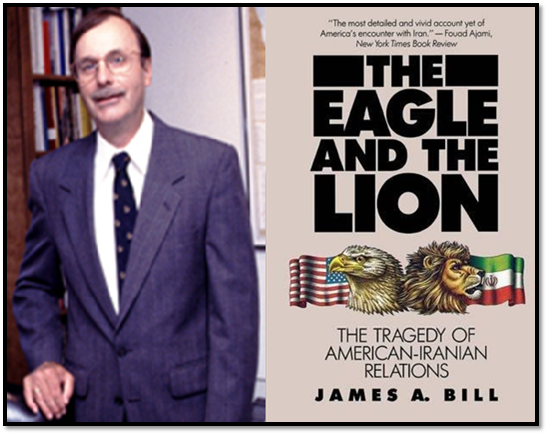
James A. Bill is an American political scientist and one of the most respected scholars of Middle Eastern politics and US–Iranian relations. His book, The Eagle and the Lion: The Tragedy of American‑Iranian Relations, is widely regarded as a foundational study of the political, historical, and cultural forces shaping relations between the United States and Iran
A substantial body of scholarship has examined the evolution of US–Iran relations. Among the most influential works are the following:
- James A. Bill, The Eagle and the Lion: The Tragedy of American‑Iranian Relations (Yale University Press, 1988). A classic “grand narrative” of US–Iran relations from World War II through the Iran‑Contra era, based on extensive interviews and archival research. The book remains frequently assigned in international relations and Middle East politics courses.
- Stephen Kinzer, All the Shah’s Men: An American Coup and the Roots of Middle East Terror (Wiley, 2003). The most widely read single‑volume account of the 1953 coup (Operation Ajax) and its enduring impact on Iranian perceptions of the United States. Its narrative style makes it a common entry point for students.
- David Crist, The Twilight War: The Secret History of America’s Thirty‑Year Conflict with Iran (Penguin Press, 2012). A major study of the post‑1979 strategic confrontation between the United States and Iran, covering military, intelligence, and proxy conflicts through extensive reporting and interviews.
- Roham Alvandi, Nixon, Kissinger, and the Shah: The United States and Iran in the Cold War (Oxford University Press, 2014). A leading archival analysis of the US–Iran partnership in the 1970s under the Nixon Doctrine, emphasizing Iranian agency and Iran’s evolution from client to strategic partner.
- Mark J. Gasiorowski and Malcolm Byrne (eds.), Mohammad Mosaddeq and the 1953 Coup in Iran (Syracuse University Press, 2017). A heavily documented scholarly collection synthesizing multi‑archival research on the coup and its long‑term implications; widely regarded as a core academic reference.
Among these works, “James A. Bill’s The Eagle and the Lion” stands out as one of the most thorough, influential, and enduring studies of US–Iran relations. First published in 1988 and grounded in decades of research, interviews, archival investigation, and personal experience, the book remains essential reading for scholars and policymakers seeking to understand how two nations—once allies—became strategic adversaries. Reviewers in Foreign Affairs, The Washington Post, and The New York Times praised the work for its analytical depth and narrative balance, describing it as “essential reading,” “the most searching study,” and “the most detailed and vivid account yet” of America’s encounter with Iran.
James A. Bill is an American political scientist and one of the most respected scholars of Middle Eastern politics and US–Iranian relations. His book, The Eagle and the Lion: The Tragedy of American‑Iranian Relations, is widely regarded as a foundational study of the political, historical, and cultural forces shaping relations between the United States and Iran.
Bill earned his bachelor’s degree from Assumption College, his master’s degree from Pennsylvania State University in 1965, and his doctorate from Princeton University in 1968. He began his academic career shortly thereafter at the University of Texas, where he taught comparative politics and Middle Eastern studies and developed a reputation for combining rigorous scholarship with deep regional expertise.
In 1987, Bill joined the Government Department at the College of William & Mary, where he also served as director of the Wendy and Emery Reves Center for International Studies. He held that leadership position until 1998 and continued teaching until his retirement in 2004. Throughout his career, he was widely admired as a dedicated mentor, engaging lecturer, and influential public intellectual.
Published by Yale University Press in 1988, The Eagle and the Lion draws on extensive archival research, interviews with American and Iranian officials, and Bill’s firsthand experience living in Iran. The book offers a penetrating critique of US foreign policy making while emphasizing the human and cultural dimensions often overlooked in diplomatic analysis. It was selected as one of Library Journal’s Best Books of 1988 and received widespread praise for its depth and originality. In addition to this seminal work, James A. Bill authored numerous books and articles on Middle Eastern politics, nationalism, religion, and US foreign policy.
The author identifies systemic flaws in American foreign policy making as central contributors to the eventual breakdown of US–Iran relations. He explicitly seeks both to deepen public understanding of Iran and to scrutinize the US foreign policy establishment, particularly its misjudgments during the Pahlavi era and the critical period leading up to—and immediately following—the 1979 Islamic Revolution.
The book examines events from the 1940s through the Iran‑Contra affair, offering detailed analyses of the political, diplomatic, and personal factors that shaped policy on both sides. The author structures his narrative in two parts. Part I, which comprises roughly two thirds of the book, presents a chronological account of bilateral relations from early engagement through the Iranian Revolution. Part II offers a structural and institutional critique of US foreign‑policy mechanisms that failed to grasp Iran’s political and social realities. This organization reinforces the author’s central thesis: the tragedy of US–Iran relations lies not only in conflicting national interests, but also in preventable failures of analysis and decision‑making.
Prior to this study, no single volume attempted such a comprehensive synthesis of the US–Iran relationship. His work filled a major gap in literature by offering three significant contributions.
First, a comprehensive historical arc: The author traces key turning points, including US wartime engagement with Iran, the 1953 CIA‑backed coup, the consolidation of the Shah’s power, Iran’s uneven path toward modernization and repression, the 1979 Revolution, the hostage crisis, the early years of the Islamic Republic, and the Iran‑Contra affair.
Second, the integration of political, social, and cultural factors: Rather than portraying Iran as a mere geopolitical chess piece, the author examines the internal evolution of Iranian society, nationalism, clerical opposition movements, and the Shah’s modernization programs. He shows how US policymakers repeatedly misread these dynamics due to overreliance on elite interlocutors and narrow information channels.
Third, extensive use of interviews and archival sources: The author conducted in depth interviews with policymakers in Washington and Tehran and drew on embassy files, Persian language sources, and declassified materials. This evidentiary foundation enabled him to produce what Yale University Press described as a definitive analysis of the US–Iran relationship.
The author covers the following themes and arguments.
1. The Role of Misperception: One of the author’s most important themes is the vast gulf of mutual misunderstanding between US and Iranian officials. He argues that American policymakers frequently misread Iranian public sentiment, internal political currents, and the depth of resentment toward foreign intervention.
2. The Dangers of Elite Centered Diplomacy: The author criticizes Washington’s overdependence on the Shah and a narrow circle of elites—what reviewers called the “Pahlavi lobby,” including powerful figures such as the Rockefellers and Henry Kissinger. This dependency blinded American policymakers to the growing legitimacy crisis facing the monarchy.
3. Structural Flaws in US Foreign Policy Institutions: The author uses Iran as a case study of deeper weaknesses in the US foreign policy system — Over centralization of decision making, Bureaucratic infighting, Insufficient field intelligence, Overreliance on personal relationships, and Ideological biases and Cold War framings. These flaws, the author contends, contributed significantly to the rupture with Iran.
4. Iranian Nationalism and Identity: Unlike many Western analyses that focus overwhelmingly on geopolitics, the author emphasizes the strength of Iranian nationalism, religious sentiment, and anti-imperialist identity. His portraits of Iranian intellectuals, clergy, and activists underscore how deeply these forces shaped the revolution and subsequent US–Iran tensions.
The book has the following strengths.
1. Balanced and Humanized Presentation: While the author sympathizes with Iranian aspirations for sovereignty and dignity, he does not romanticize the revolutionary movement. Nor does he demonize American actors, though he is critical of their errors. This balanced perspective is one reason scholars continue to praise the book.
2. Vivid Narrative and Accessible Writing: The author excels at portraying the personalities behind policy decisions, weaving together their ambitions, fears, miscalculations, and blind spots.
3. Detailed, Rich, and Multidimensional: The book is incredibly detailed (over 500 pages) but never feels overloaded. It blends archival rigor with storytelling, making it both academically robust and highly readable.
4. Strong Moral and Political Insights: The work is not merely descriptive; it is prescriptive in its warnings — policymakers must avoid over personalization. They must cultivate diverse information channels, they must understand partner nations’ internal politics. These lessons remain profoundly relevant today.
The book has the following limitations.
1. Underdeveloped Treatment of Certain Key Figures: While the author offers deep portraits of some actors, others, such as figures important in Iranian administrative history (e.g., W. Morgan Shuster), are omitted or given insufficient contextualization.
2. Limited Post‑Revolution Perspective: Because the book was published in the late 1980s, it does not cover later Iran‑US confrontations such as: Iran’s role in the post‑2003 Iraq War, nuclear negotiations, the rise of Hezbollah, and regional competitions with Saudi Arabia. This is not a flaw of the book itself, but it limits its contemporary applicability.
Commenting on the flawed US policy, the author observes: “Thus, the interaction of interests and ideology produced a climate of ignorance that gave rise to the Pahlavi premise, which in turn explained the foreign-policy outcome of unconditional support for the regime of Muhammad Reza Shah Pahlavi. American decision makers formulated policies designed to provide firm, constant support for an authoritarian political system up to the collapse and disintegration of that system. This traumatic collapse not only destroyed the Pahlavi government but also deeply damaged the power and credibility of the United States in this critical part of the world.”
The author further notes: “ Iran is in many ways very special. A Shi'i Muslim society ruled by an absolute monarch, Iran had a long history of foreign intervention into its internal affairs. The manner in which American leaders entangled themselves with the Pahlavi elite approached a degree seldom seen elsewhere. Early blatant interventionary successes (the Musaddiq episode), which set the stage for later failure, were also relatively rare in American diplomatic history. Finally, the system of US foreign policy-making seemed particularly inept and flawed in Iran.”
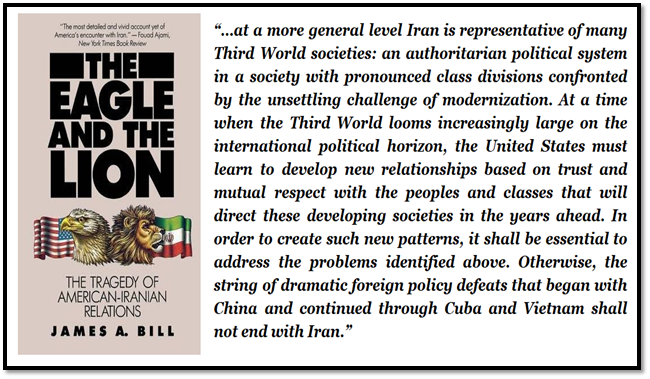
The author concludes the book by advising policy makers to pursue policies based on trust and mutual respect: “…at a more general level Iran is representative of many Third World societies: an authoritarian political system in a society with pronounced class divisions confronted by the unsettling challenge of modernization. At a time when the Third World looms increasingly large on the international political horizon, the United States must learn to develop new relationships based on trust and mutual respect with the peoples and classes that will direct these developing societies in the years ahead. In order to create such new patterns, it shall be essential to address the problems identified above. Otherwise, the string of dramatic foreign policy defeats that began with China and continued through Cuba and Vietnam shall not end with Iran.”
The Eagle and the Lion remains one of the most influential works on the history of US–Iran relations. Its enduring significance lies in its unparalleled archival depth, vivid narrative style, and penetrating analysis of policy failure. Author’s study continues to shape scholarly discourse because it combines a sweeping historical narrative with incisive institutional critique, balanced portrayals of key actors, and sustained engagement with Iranian society and politics.
While some sections show bias toward Iranian revolutionary actors, and certain historical details suffer from impressionistic treatment, the book’s overall contribution is monumental. It is not merely a history—it is a cautionary tale about the dangers of misperception, the costs of flawed diplomacy, and the enduring consequences of policy errors. That is why reviewers have repeatedly labeled it “powerful,” “essential,” and “the most detailed and vivid account yet” of America’s tragic entanglement with Iran.
In sum, The Eagle and the Lion offers a rich, authoritative, and deeply compelling analysis of how the United States and Iran moved from cooperation and mutual respect to profound estrangement. Its synthesis of narrative sensitivity, empirical rigor, and structural analysis ensures its continued status as a foundational text in Middle Eastern studies and international relations. It remains essential reading for serious students of history and foreign policy alike.
(Dr Ahmed S. Khan is a Fulbright Specialist Scholar )