Business Standard
Aamir Khan Productions to Release Lahore 1947 on Aug 13 — a Partition Film We’re Not Sure We Trust
By Images Staff
Aamir Khan Productions has confirmed that its upcoming period drama Lahore 1947 will hit Indian cinemas on August 13. A Partition-era film arriving during India’s Independence Day week is never a neutral proposition, especially at a time when mainstream Indian cinema has repeatedly leaned into hyper-nationalist spectacle.
Yet, Lahore 1947 appears, at least on paper, to be positioning itself differently.
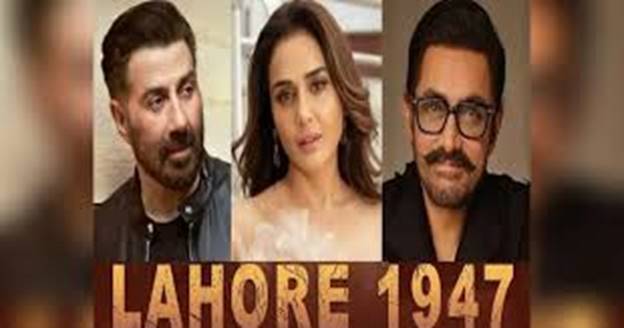
Directed by Rajkumar Santoshi and produced by Aamir Khan, the film brings together Sunny Deol, Shabana Azmi, Ali Fazal, Karan Deol and Preity G Zinta, whose return to acting is one of the project’s most talked-about elements.
According to the announcement, A R Rahman will be composing the music, Javed Akhtar will write lyrics, and Santosh Sivan will be leading cinematography.
Lahore 1947 is based on Asghar Wajahat’s celebrated play Jis Lahore Nai Dekhya, O Jamyai Ni.
Set in 1947, the story will reportedly follow a Muslim family that migrates from Lucknow to Lahore and is allotted a haveli vacated by a Hindu family fleeing the city. Tensions unfold when the family discovers that the Hindu residents are still living there — unwilling, or unable, to leave.
In recent years, Partition-adjacent narratives in Indian cinema have often been flattened into nationalist allegories. Pakistani audiences have grown accustomed to projects that frame them, or Muslims, as convenient antagonists.
In a statement accompanying the announcement, Khan said Lahore 1947 was one of Dharmendra’s favorite scripts, and that the veteran actor had seen the film before his death.
But the source material alone or Dharmendra’s appreciation doesn’t exactly guarantee that Lahore 1947 will avoid the pitfalls that have plagued recent Indian blockbusters. Release timing, star power and political climate all exert pressure on how stories are ultimately told — and marketed.
Sunny Deol, veteran actor and Dharmendra’s son, speaking about the film’s long gestation period, noted that the project had been in development for years until Gadar 2 accelerated the process. He told Hindustan Times , “We have been working on Lahore 1947 for so many years. Several actors heard the story, and many of them were supposed to do it as well, but it didn’t happen. But Gadar 2 made everything happen.”
His screen persona is deeply associated with muscular nationalism, which inevitably shapes expectations, even when the material itself suggests restraint. The latest examples of that are Gadar 2 and Border 2 .
But unlike many recent films that have arrived pre-loaded with ideological certainty, Lahore 1947 appears, at least so far, to be drawing from a tradition that privileges shared trauma over triumphalism.
For Pakistani audiences, the instinct to approach such a film with caution is understandable — perhaps even necessary. Yet, based on what is currently known, Lahore 1947 does not announce itself as an exercise in anti-Muslim rhetoric or cross-border provocation.
Whether it stays true to that promise will only be clear once the film is actually seen. - Images