Book & Author
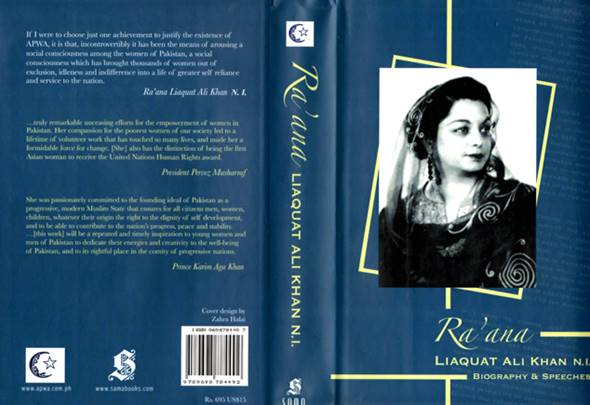
Kay Miles & F.D. Douglas:Ra’ana Liaquat Ali Khan N.I. — Biography & Speeches
By Dr Ahmed S. Khan
“Dynamo in Silk is how a writer has described the revered founder, President of APWA, Begum Ra’ana Liaquat Ali Khan. Might we not thus characterize the entire organization?” - UNICEF
Begum Ra’ana Liaquat Ali Khan (1905–1990) stands as one of the most influential figures in Pakistan’s history—a visionary leader who championed women’s empowerment and national progress. Revered for her pioneering role in shaping Pakistan’s social and diplomatic landscape, she combined intellect, courage, and compassion to drive transformative change.
As the wife of Pakistan’s first Prime Minister, Nawabzada Liaquat Ali Khan, Ra’ana was more than a political partner; she emerged as a dynamic activist, reformer, and diplomat in her own right. From mobilizing women during the independence movement to founding institutions that uplifted communities, and later representing Pakistan on the global stage, her legacy reflects an unwavering commitment to equality, education, and social justice.
Born on February 13, 1905, in Almora, British India, Ra’ana grew up in a progressive family that valued education. She earned a master’s degree in economics from the University of Lucknow and later taught at the same institution, marking the start of her academic career.
In 1933, Ra’ana married Nawabzada Liaquat Ali Khan, who would become Pakistan’s first Prime Minister. United by a vision of independence and social reform, she played an active role in the freedom movement, mobilizing women and promoting their participation. Her organizational skills and dedication made her a respected figure even before 1947.
Begum Ra’ana Liaquat Ali Khan founded the All Pakistan Women’s Association(APWA) in February 1949, just two years after Pakistan’s independence. Her initiative was driven by the urgent need to respond to the refugee crisis following the 1947 partition, which left thousands of women displaced, traumatized, and vulnerable. Ra’ana envisioned APWA as a voluntary, non-political, and non-profit organization committed to improving the social, economic, and legal status of women in Pakistan.
Under her leadership, APWA mobilized educated women and volunteers to work in refugee camps, establish family health centers, and set up schools and industrial homes for women. Ra’ana’s philosophy was unequivocal: women’s participation in nation-building was as vital as men’s. She famously declared that APWA would continue its struggle “until one day, the Pakistani woman shall emerge free from all her shackles—economic, social, and political.”
Begum Ra’ana’s contributions extended beyond social work. Following the assassination of her husband prime minister Nawabzada Liaquat Ali Khan in 1951, she continued her public service with resilience and dignity. She represented the country as ambassador to the Netherlands, Italy, and Tunisia, and later as Governor of Sindh, projecting Pakistan as a progressive nation and strengthening its global ties.
Throughout her life, Ra’ana championed women’s education and empowerment, believing that national progress depended on women’s active participation. Her speeches and writings reflected a deep commitment to equality and social justice. For her services, she received numerous honors, including the UNESCO Adult Literacy Prize and Pakistan’s Nishan-i-Imtiaz (NI).
Begum Ra’ana Liaquat Ali Khan passed away on June 13, 1990, leaving behind a legacy of courage, vision, and service. Today, she is remembered as a trailblazer who transformed women’s roles in Pakistan.
The book Ra’ana Liaquat Ali Khan: Biography & Speeches serves as both a tribute and a historical record, offering readers a window into her personal journey and her public role in shaping Pakistan’s identity. This review explores the book’s structure, themes, and significance, while critically analyzing its strengths and limitations.
The work is not merely a chronological account of events; it is a narrative of ideals, struggles, and aspirations. Through biographical sketches and a curated selection of speeches, the book attempts to capture Ra’ana’s vision for Pakistan—a vision rooted in social justice, gender equality, and national progress. For scholars of South Asian history, gender studies, and political science, this book is an invaluable resource. For general readers, it is an inspiring story of resilience and leadership.
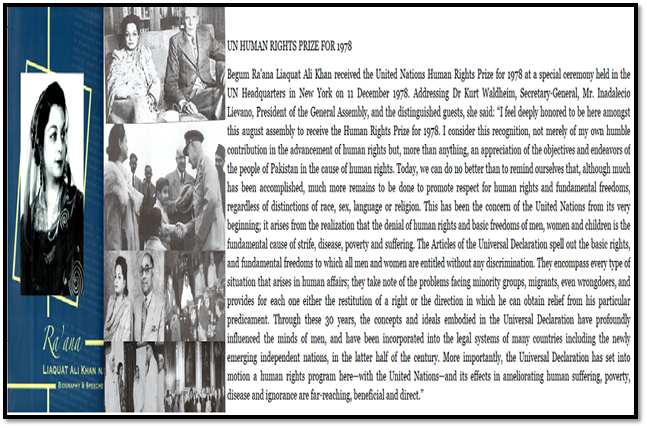
The book offers an in-depth look at the life and work of Begum Ra’ana Liaquat Ali Khan. It features “Dynamo in Silk”, a biography by Kay Miles that captures her remarkable journey, alongside a curated collection of more than 150 speeches and statements edited by F.D. Douglas. The book also includes the full text of ten significant speeches delivered at various international conferences, providing insight into her vision and advocacy. Enriched with a striking selection of photographs, the volume concludes with three valuable appendices: the Citation for the International Gimbel Award, a detailed biographical note, and the UNICEF-supported article “Woman of Pakistan: Great Progress in Small Steps”, highlighting APWA’s contributions. Together, these elements create a vivid portrait of a trailblazing leader whose influence shaped Pakistan’s social and diplomatic landscape.
The book goes far beyond personal anecdotes, exploring critical themes such as women’s empowerment, education reform, and diplomatic engagement. It offers detailed accounts of Ra’ana’s tenure as Pakistan’s ambassador to the Netherlands and her leadership in women’s organizations, showcasing her multifaceted contributions to society.
To fully appreciate the book, readers must situate Begum Ra’ana Liaquat Ali Khan within the broader historical context of post-independence Pakistan. The partition of 1947 was not merely a political event—it was a profound social upheaval that demanded visionary leadership. In this challenging environment, Ra’ana emerged as a symbol of modernity and progress. Her advocacy for women’s rights was groundbreaking in a society struggling with traditional norms and the trauma of displacement.
The biography underscores her pivotal role in founding the All Pakistan Women’s Association (APWA) in 1949, an organization that became a cornerstone for women’s welfare and education. APWA addressed issues ranging from vocational training to legal aid, and Ra’ana’s speeches during this period reveal her deep understanding of socio-economic challenges and her pragmatic approach to overcoming them.
Her diplomatic assignments in Europe during the 1950s and 1960s further positioned her as an ambassador of Pakistan’s cultural and political identity. Through her speeches at international forums, Ra’ana worked tirelessly to present Pakistan as a progressive nation, countering stereotypes and fostering goodwill abroad.
The biographical section of the book is meticulously researched, drawing on archival material, personal letters, and interviews. Organized chronologically, it begins with Ra’ana’s childhood in Almora, her academic achievements in economics, and her marriage to Nawabzada Liaquat Ali Khan. The portrayal of their partnership is nuanced, emphasizing mutual respect and shared ideals rather than relegating her to a secondary role.
The second half of the book, devoted to Begum Ra’ana Liaquat Ali Khan’s speeches, elevates this work from a conventional biography to a significant historical resource. Organized thematically, these speeches provide a rare glimpse into the ideological foundations of Pakistan’s early years, offering scholars, historians, and political analysts a nuanced understanding of the country’s formative policy debates and social priorities.
A dominant theme in Begum Ra’ana’s addresses is nation-building — a concept she frames as both a moral and practical imperative. Her speeches emphasize unity, discipline, and economic self-reliance as the pillars of national strength. This rhetoric, imbued with optimism, reflects the aspirations of a state emerging from the trauma of partition. Particularly noteworthy are her appeals to women’s organizations, where she describes women as “architects of the nation,” urging their active participation in education and employment. This framing was revolutionary for its time, positioning women not as passive beneficiaries but as active agents of national progress.
Begum Ra’ana’s advocacy for gender equality is arguably the most compelling aspect of her discourse. She challenges entrenched stereotypes, calls for legislative reforms, and promotes vocational training for women—initiatives that were radical in a society negotiating between tradition and modernity. Her vision was inclusive, extending beyond urban elites to rural women, whom she recognized as critical to social transformation. These ideas resonate powerfully today, as Pakistan continues to grapple with systemic gender disparities, underscoring the enduring relevance of her thought.
Education emerges as a leitmotif throughout her speeches. Begum Ra’ana viewed education not merely as a tool for personal advancement but as a catalyst for national development. Her proposals—scholarships, teacher training programs, and curriculum reform—reflect a pragmatic approach to systemic change. By linking education to economic empowerment and social stability, she articulated a holistic vision of progress that remains pertinent in contemporary policy discourse.
Her speeches as an ambassador add another dimension to her legacy. Delivered at international forums, these addresses project Pakistan as a peace-loving nation committed to global cooperation. Begum Ra’ana deftly balances national interests with universal values, advocating for disarmament and economic collaboration. Her diplomatic rhetoric counters stereotypes and positions Pakistan as a progressive actor on the world stage — a narrative that was crucial during the Cold War era.
What makes these speeches particularly valuable is their dual relevance: they capture the optimism and urgency of Pakistan’s early years while offering insights that remain pertinent today. Issues of gender equality, education reform, and social welfare continue to dominate national discourse, and Begum Ra’ana’s vision provides a framework for addressing them. For historians, these speeches are a treasure trove of primary material; for policymakers, they offer lessons in inclusive development and principled diplomacy.
While the thematic organization of the speeches enhances accessibility, the book could benefit from more editorial commentary to contextualize Begum Ra’ana’s ideas within global feminist movements and South Asian political thought. Nevertheless, the inclusion of over 150 speeches, supplemented by archival material and photographs, makes this volume an indispensable resource for understanding the intellectual and moral foundations of Pakistan’s early decades.
The book succeeds in portraying Begum Ra’ana Liaquat Ali Khan as a visionary leader and a trailblazer for women’s rights. Its greatest strength lies in the authenticity of the speeches, which allow readers to engage directly with Ra’ana’s ideas in her own words. The biographical narrative complements these speeches effectively, providing context and continuity.
However, the book is not without limitations. It could have benefited from a comparative perspective—placing Begum Ra’ana alongside contemporaries such as Mohtarma Fatima Jinnah would have highlighted the diversity of women’s leadership in Pakistan. Similarly, incorporating secondary literature on gender and development would have enhanced its scholarly depth and analytical rigor.
Ra’ana Liaquat Ali Khan: Biography & Speeches is a valuable contribution to Pakistan’s historiography, preserving the legacy of a woman who defied convention and championed progressive ideals. For students of history, it offers rich primary source material through her speeches; for general readers, it provides inspiration in the story of a life devoted to public service.
Begum Ra’ana’s relevance transcends time. Her advocacy for women’s empowerment, education, and social justice remains strikingly pertinent in contemporary Pakistan. As the nation grapples with challenges of governance and gender equality, revisiting her vision offers lessons in resilience and reform.
In essence, this book is more than a biography—it is a manifesto for inclusive development and democratic values. While it could have been more critical and comparative, its role in preserving Begum Ra’ana Liaquat Ali Khan’s legacy is undeniable. For anyone interested in Pakistan’s history, women’s rights, or leadership studies, this book is a must-read.
( Dr Ahmed S. Khan - dr.a.s.khan@ieee.org - is a Fulbright Specialist Scholar. Professor Khan has more than 40 years of experience in Higher Education as professor of Electrical Engineering, Chair and Dean of the College of Engineering and Information Sciences. He is the author of many academic papers, technical and non-technical books, and a series of books on Science, Technology & Society (STS) — used globally in the academic programs of more than 200 universities. His most recent books are Mashriq-o-Mugrib Ki Mumtaz Shaksiaat (Prominent Personalities of the East and the West), and Nanotechnology: Ethical and Social Implications ) .