APWA in East Pakistan: A Legacy of Empowerment and Social Reform (1949–1971)
By Dr Ahmed S. Khan
Chicago, IL
When Begum Ra’ana Liaquat Ali Khan founded the All Pakistan Women’s Association (APWA) in 1949, Pakistan was a young nation struggling to recover from the upheaval of partition. Millions of refugees had crossed borders, and among them were thousands of women—displaced, vulnerable, and in urgent need of support. Begum Ra’ana Liaquat Ali Khan recognized that rebuilding the country required more than political stability; it demanded social reform and women’s active participation in nation-building. APWA became her answer—a voluntary, non-political, and non-profit organization dedicated to improving the social, economic, and legal status of women.
Initially focused on emergency relief, APWA quickly evolved into Pakistan’s first and largest women’s welfare NGO. Under Begum Ra’ana’s visionary leadership, the organization mobilized educated women and volunteers to work in refugee camps, establish family health centers, and set up schools and industrial homes. These efforts were not charity, they were empowerment. Ra’ana famously declared that APWA would continue its struggle “until one day, the Pakistani woman shall emerge free from all her shackles—economic, social, and political.”
According to information provided by Dr Tanvir Kamal (President, APWA) and Mrs Yasmin Dastur (Senior Vice President, APWA), the East Pakistan branch was established in Dhaka in 1949 with the support of prominent women leaders, including Mohtarma Viquarunnesa Noon, Mohtarma Shamsunnahar Mahmud, and Mohtarma Hamida Khanum. Earlier that year, APWA was founded by Begum Ra’ana Liaquat Ali Khan with the help of leaders such as Mohtarma Zaib-un-Nissa Hamidullah and Zubeida Habib Rahimtoola.
Between 1949 and 1971, APWA built a robust welfare network across East Pakistan, addressing critical areas such as women’s education, vocational and cottage-industry training, maternal and child healthcare, legal awareness, disaster relief, and cultural as well as inter-provincial exchanges. These initiatives laid the foundation for women’s social development infrastructure in East Pakistan.
Timeline of APWA’s Expansion and Impact 1949–1951
APWA founded (1949)
First APWA volunteer visits Dhaka to assess women’s welfare needs and establish contacts (1950)
Formal establishment of APWA Dhaka branch
1952–1955: Foundation of Welfare Services
First Mother and Child Health (MCH) Clinic opened in Dhaka (1952)
Literacy programs launched in Dhaka and Chittagong (1953)
Vocational training centers for sewing, embroidery, and home economics established (1954)
APWA Women’s Handicraft Unit created to promote Bengali crafts through exhibitions (1955)
1956–1958: Organizational Growth
Branches opened in Chittagong and Khulna (1956)
East Pakistan delegation participates in APWA National Convention in Karachi (1957)
Provincial authorities recognize APWA health clinics for serving low-income women (1958)
1959–1962: Legal Advocacy and Social Outreach
Training programs for women volunteers in hygiene and first aid (1959)
Second MCH clinic established in Chittagong (1960)
Awareness campaigns on women’s rights under Muslim Family Laws Ordinance 1961 (1961)
Women’s legal aid desk set up at Dhaka branch (1962)
1963–1965: Inter-Provincial Exchanges
National exhibition of Bengali handicrafts in Karachi and Lahore (1963)
Joint APWA training workshops on family planning and home economics (1964)
Relief drives during floods in Dhaka and Khulna districts (1965)
1966–1968: Rural Outreach and Disaster Relief
Village-level cottage industry training centers near Comilla (1966)
Literacy campaigns for adolescent girls launched with UNESCO support (1967)
Emergency relief work following cyclones in coastal East Pakistan (1968)
1969–1970: Cultural and Humanitarian Response
Women’s cooperatives for handicrafts established in Rajshahi and Chittagong (1969)
Inter-provincial cultural programs staged to bridge East-West differences (early 1970)
APWA plays a major role in Bhola Cyclone relief operations, distributing clothing, food, medical supplies, and coordinating volunteer teams (November 1970)
1971: Final Year
Activities severely restricted due to political turmoil and war (March–December 1971)
APWA’s East Pakistan branches cease operations as Bangladesh becomes independent (December 1971)
After Bangladesh’s independence, the East Pakistan branch became Bangladesh Mahila Samiti. A government notification dated February 28, 1972, announced Begum Noorjahan Murshed as its first ad hoc president. Later, on June 12, 1972, a new committee was formed with Dr Neelima as founding president. Today, the Mahila Samiti continues its work, details of which are available on its official website: https://bangladeshmohilasamity.com .
APWA’s work in East Pakistan was more than a series of welfare projects—it was a movement that empowered women and reshaped social norms. From education and health to legal advocacy and disaster relief, APWA laid the foundation for women’s development in a region undergoing profound change. Its legacy lives on through the Bangladesh Mahila Samiti and through countless women whose lives were transformed by its initiatives. More than seven decades later, APWA remains a testament to Begum Ra’ana Liaquat Ali Khan’s vision of a progressive, inclusive society—one where women are not just beneficiaries of development but architects of the nation’s future. The legacy of APWA (Mahila Samiti) endures.
Profile of an Avid APWA Leader and Activist:
Mrs Zohara Karim (1919-1988)—A Pioneer of Women’s Empowerment
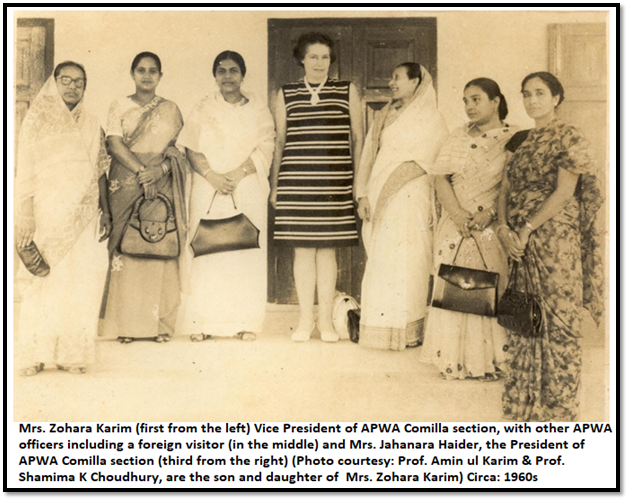
Mrs Zohara Karim (1919–1988) was the wife of Fazlul Karim, a professor and Vice Principal at Comilla Victoria Government College in Comilla, Bangladesh (formerly East Pakistan), and the mother of seven children. Although intellectually gifted, she chose to be a homemaker and did not pursue formal education beyond high school. Yet, she was a natural leader, dedicating her life to voluntary work for the welfare of her less fortunate relatives and the wider community.
To channel her efforts, Mrs Karim joined the All Pakistan Women’s Association (APWA) in the 1950s, finding its mission aligned with her own vision for social upliftment. In the late 1950s, she established an evening adult school in her neighborhood to teach literacy and social education. She recruited a friend to assist in teaching mostly illiterate women and domestic workers, and she remained available outside class hours to offer guidance and support.
In 1963, Mrs Karim spearheaded fundraising efforts to establish the first women’s college in Comilla. The college began operating in 1965, with her youngest daughter among its first students. After Bangladesh’s liberation, the college became part of the government education system in the 1980s. Throughout this period, Mrs Karim continued to advance APWA’s goals with unwavering commitment.
As Vice President of APWA’s Comilla branch, she broke social barriers by traveling alone—twice—to West Pakistan (Karachi and Islamabad) to attend national conferences and collaborate with APWA leaders. At a time when it was uncommon for Muslim women to travel without male family members, her husband supported her noble work and encouraged her independence for the greater good of the country.
Mrs Zohara Karim —What an accomplished mother! Lived true to her name – Zohara – the guiding star – Venus! Guiding family, society and the country! An embodiment of an APWA leader! A true role model mother! Indeed, mothers are unique! A mother is like an oak tree that provides shade in all seasons. When the tree suddenly vanishes, only then, one realizes the value of its being there! A mother is a unique blessing in the entire cosmos; a mother provides limitless and unconditional love and never expects an iota of anything in return! Indeed, APWA mothers were unique! May Allah (SWT) grant Mrs Zohara Karim, and all mothers, the highest station in Janet-ul-Firdous. Ameen.
(The author gratefully acknowledges Prof Amin ul Karim, former National Dean of Technology at DeVry University, USA, and Prof Shamima K. Choudhury, Professor of Physics at Dhaka University, Bangladesh, for sharing valuable information about their mother, Mrs. Zohara Karim.)
Dr Ahmed S. Khan — dr.a.a.skhan@ieee.org — is a Fulbright Specialist Scholar.