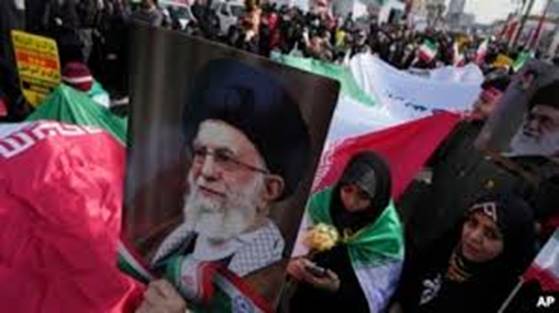
The Ayatollah Wobbles but Will He Topple?
By Nayyer Ali MD

Starting December 28 of last year Iran has been rocked by massive demonstrations. While the clerical regime in power since the revolution of 1979 has faced demonstrations before, they have never been on this scale and persisted this long. There is now intense speculation regarding whether the regime could be overthrown.
Iran has been ruled by its Shia clerics in a theocratic dictatorship for the last 47 years, and it has been a mixture of harsh repression and general incompetence. A large nation with massive oil reserves has failed to develop economically, instead there has been stasis or decline. This has been due to bad economic policies along with the effects of American and Western sanctions, and an overreliance on oil wealth but without real economic development. Iran has no serious exports, and has only a minimal internal industrial economy.
The Iranian people have long chafed at this situation, and have risen up in peaceful protests many times, for example in 2009 when a Presidential election was stolen from a reformist candidate, or a few years ago when women were outraged over the killing of a woman who was not wearing her Hijab correctly. National protests after that event resulted in millions of Iranian women defying the regime and removing their Hijab, with the regime giving up on enforcing that rule after decades.
Iranians also see that much of their misery is due to Iran’s foreign and defense policy. Iran has spent huge sums on trying to develop a nuclear weapon, including building centrifuges to enrich uranium deep inside fortified mountains. Iran has also used its oil wealth to try to build a pro-Iranian axis across the Middle East. This included support for Hamas in Gaza, Hezbollah in Lebanon, saving the Assad regime from rebels in Syria, and supporting pro-Iranian Shia militias in Iraq. But all these assets now lie in ruin. Israel decimated both Hamas and Hezbollah in the war since October 2023. The Assad regime collapsed last year and has been replaced by a Sunni government hostile to Iran. Iraq still has its Shia militias, but Iraqi politics is much more complicated, and Iraq retains close ties to the US and is not an Iranian proxy. Certainly, Iraqi Sunnis and Kurds have no desire to play that role.
Then just a few months ago Israel carried out a 12-day air campaign against Iran’s nuclear program that was joined in its final day by American B-2 bomber strikes on its centrifuge plants. All indications are that Iran’s nuclear program was dealt a massive setback.
The Iranian people see this record of foreign failure and are thoroughly turned off by it. They chant that Iran should spend its money on Iran and not on Hamas and Hezbollah. As sanctions bite and Iran’s oil exports are limited, the Iranian economy declined sharply last year. The value of the Rial went from 500,000 to the dollar in January 2024 to 1.5 million in December 2025. For perspective, the Rial was 70 to the dollar in the last year of the Shah. This catastrophic decline reflects massive inflation and gross mismanagement. The Rial at this point is next to worthless.
It was the economic crisis that has changed the nature of the current revolt. Iranians now perceive they have nothing to lose and so are more willing to challenge the regime. The merchant class, which has stayed on the sidelines in previous uprisings, has joined national strikes. There is even word that oil workers may join in a national strike. The Azeri minority, a key group living in northwestern Iran, have joined in the demonstrations. The credibility of the regime is now in tatters.
But is this enough to overthrow the clerics? The bottom line is that one side has guns and the other does not. And it seems that the clerics are more than willing to shoot their own people. Reporting from inside Iran is cut off as the regime has shut down both the internet and cell phone service for several days. But some information is getting out and points toward massacres in the street, with a death toll likely over 10,000 and perhaps as high as 20,000. If the clerics can keep the Revolutionary Guard and regular Army and Basiji militias on their side, they could clear the streets with enough lethal force. But if the men with the guns choose to stop shooting the demonstrators, then the regime could fall.
President Trump in all this has been a wild card. He has made a number of statements that if the clerics start hanging people and conduct a massacre the US may respond with force. This could mean airstrikes against regime power centers. Israel showed the Iranian generals how penetrated their systems were as many received cell phone calls directly from Israel during the recent air war. The US could target senior regime officials. But what is not clear is what good this would do. A revolution that occurred with the backing of the US would be tainted in the eyes of many, including Iranians themselves. But there are some Iranian voices that are asking for just that.
Even if the Ayatollah Khamenei and his entourage retain their grip on power in the next week or two, that will likely not be the final chapter. The Iranian revolution that overthrew the Shah took 14 months in 1977 to 1979. A discredited theocratic dictatorship that barely holds onto power by shooting tens of thousands of its own people may be living on borrowed time.
If Iran does throw off the clerics, it could reshape the Middle East. A new government would likely give up the nuclear program, establish friendly relations with the US, and stop its support of Hamas, Hezbollah, the Houthis in Yemen, and Putin’s war with Ukraine. If Iran were to become a liberal democracy that would be a huge change in the region and in world history. It would also mark the death knell of political clergy in the Muslim world.