Book & Author
Hal Brands: The Eurasian Century — Hot Wars, Cold Wars and the Making of the Modern World
By Dr Ahmed S. Khan
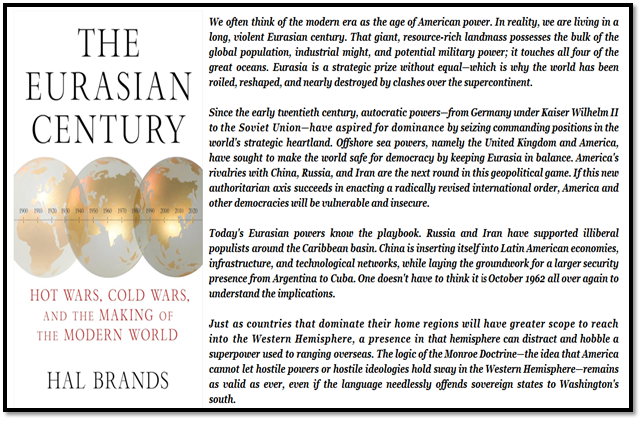
Eurasia, rich in resources and population, is the world’s ultimate strategic prize, shaping global conflicts for over a century. Autocratic powers have repeatedly sought dominance, while sea powers like Britain and America worked to maintain balance and protect democracy. Today’s rivalries with China, Russia, and Iran mark a new phase in this struggle, threatening democratic security if authoritarian ambitions succeed.
In “The Eurasian Century: Hot Wars, Cold Wars, and The Making of The Modern World,” Hal Brands argues that understanding Eurasia’s geography reveals patterns of rivalry and conflict that persist into the 21st century. Technological revolutions and aggressive ideologies have made Eurasia the epicenter of global geopolitics—with profound implications for the future.
The author argues that the 21st century is defined by competition between major powers, particularly the US, China, and Russia, centered on Eurasia and its strategic extensions. Venezuela, while geographically outside Eurasia, has been a critical outpost for China and Russia’s influence in the Western Hemisphere. Both countries invested heavily in Venezuela’s oil sector and provided diplomatic and military support to Maduro’s regime.
The recent US military operation in Venezuela, which resulted in the capture of President Nicolás Maduro, has sharply polarized American politics. Both major parties frame the intervention through contrasting lenses of legality, morality, and strategic interest. Democrats overwhelmingly criticize the intervention as unconstitutional and reckless. Party leaders argue that President Trump bypassed Congress, violating the War Powers Resolution and undermining democratic checks on executive authority. Both sides agree on one thing: the stakes for US foreign policy and domestic politics are enormous.
The US intervention undermines these Eurasian powers’ foothold in Latin America, signaling Washington’s intent to counter their global reach. China and Russia condemned the operation as a violation of international law, framing it as hegemonic aggression.
The author emphasizes that control over strategic resources and geography is central to global power struggles. Venezuela holds the world’s largest proven oil reserves (303 billion barrels), which China has relied on for discounted energy supplies.
By seizing President Maduro and signaling plans to “run” Venezuela and its oil industry, the US is effectively weaponizing energy access—a tactic the author identifies as critical in modern geopolitics. This move directly impacts China’s energy security and Russia’s economic interests, aligning with the author’s argument that resource competition is a key driver of conflict.
The Venezuela crisis validates the book’s thesis that global competition is not confined to Eurasia but radiates outward, with resource control, alliance politics, and norm erosion shaping a volatile international order. It underscores his warning that great-power rivalry will be multidimensional—spanning energy, ideology, and geography.
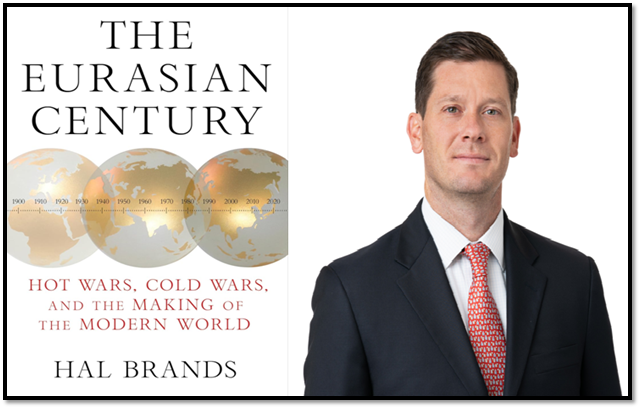
Hal Brands (b. 1983) is an American scholar, author, and commentator widely recognized for his expertise in US foreign policy and global strategy. He currently serves as the Henry A. Kissinger Distinguished Professor of Global Affairs at the Johns Hopkins School of Advanced International Studies (SAIS) and is a senior fellow at the American Enterprise Institute (AEI) . In addition to his academic roles, Brands is a columnist for Bloomberg Opinion and a senior advisor at Macro Advisory Partners, where he provides strategic insights on international affairs.
Brands earned his Bachelor of Arts in history and political science from Stanford University , followed by an MA, MPhil, and PhD in history from Yale University . His rigorous academic training laid the foundation for his deep engagement with historical and contemporary issues in international relations.
Hal Brands is a prolific author whose works explore grand strategy, geopolitics, and the evolution of US foreign policy. His major books include: From Berlin to Baghdad: America’s Search for Purpose in the Post-Cold War World (2008), Latin America’s Cold War (2010), What Good is Grand Strategy? (2014), Making the Unipolar Moment (2016), American Grand Strategy in the Age of Trump (2018), The Lessons of Tragedy (2019, with Charles Edel), The Twilight Struggle (2022), Danger Zone: The Coming Conflict with China (2022, with Michael Beckley), The New Makers of Modern Strategy (2023), and The Eurasian Century: Hot Wars, Cold Wars, and the Making of the Modern World (2025).
His writings have appeared in leading outlets such as Foreign Affairs , Foreign Policy , The Wall Street Journal , and The Washington Post . Brands is known for blending historical insight with policy relevance, making his work influential among scholars and practitioners alike.
At the heart of “The Eurasian Century” lies a simple but powerful idea: geography still matters. The author contends that Eurasia—the vast landmass stretching from Europe through Russia to East Asia—has historically been the fulcrum of global power. Today, as China rises and Russia seeks to reassert influence, this region is once again the epicenter of strategic rivalry.
The author frames the Eurasian challenge as multidimensional: 1. China’s ambition to become the dominant global power through economic, technological, and military means. 2. Russia’s revisionism, aimed at undermining Western influence and securing its sphere of control, and 3. The weakening of US primacy, as internal divisions and external pressures erode its ability to shape global norms.
The book argues that these dynamics are not isolated but interconnected; creating a complex web of competition that spans trade, technology, security, and ideology. The Key themes of the book are:
1. The Rise of China: The author examines Beijing’s Belt and Road Initiative (BRI), its military modernization, and its quest for technological supremacy. Unlike some alarmist narratives, the author offers a nuanced view — China is powerful but not omnipotent. Its demographic challenges, economic vulnerabilities, and political rigidity could constrain its ambitions. Yet, its sheer scale and strategic patience make it the most formidable challenge the US has faced since the Cold War.
2. Russia’s Role: While Russia lacks China’s economic heft, the author argues that Moscow remains a disruptive force. Its invasion of Ukraine, energy leverage, and cyber capabilities illustrate how a declining power can still destabilize the international system. The author presents Russia as a spoiler rather than a hegemon— an actor whose partnership with China amplifies Eurasian influence but whose long-term trajectory is uncertain.
3. The US Dilemma: The author is candid about America’s predicament. The US faces a two-front challenge — deterring Chinese expansion in the Indo-Pacific while containing Russian aggression in Europe. This dual contest strains resources and political will. The author warns against complacency, urging a strategy that blends military readiness with economic resilience and diplomatic agility.
4. Middle Powers and Regional Dynamics: The book discusses middle powers—India, Japan, Turkey, and others—that will shape Eurasia’s future. The author argues that these states are not passive spectators but active players whose choices could tip the balance of power. For instance, India’s alignment with the US could counterbalance China, while Turkey’s oscillation between NATO and Russia complicates Western strategy.
One of the book’s greatest strengths is its historical perspective. The author presents current events within a long arc of geopolitics, drawing parallels with the Great Game of the 19th century and the Cold War. This approach underscores the cyclical nature of power politics while highlighting what is unique about today’s contest— namely, the fusion of economic interdependence with strategic rivalry.
The author also excels in clarity. Complex concepts like “multipolarity” and “strategic autonomy” are explained without jargon, making the book accessible to non-specialists. His use of case studies— such as China’s infrastructure diplomacy in Africa or Russia’s energy politics in Europe— adds empirical weight to his arguments.
While The Eurasian Century is compelling, it is not without limitations. First, the book occasionally underplays the agency of non-Eurasian actors, such as Latin America and Africa, whose economic and political trajectories will influence global power distribution. Second, the author’s prescriptions for US strategy, though sensible, lean toward traditional hard-power solutions. A deeper exploration of soft power, petrodollars and de-dollarization, Middle East, South Asia, climate diplomacy, and technological governance would have enriched the analysis.
Eurasian powers are expanding influence in Latin America through economic, technological, and security footholds, challenging US dominance. To counter this, America may revive Cold War-style tactics while pairing strategic denial with regional cooperation for lasting effectiveness.
The author expounding on the renewed rivalry in the western Hemisphere observes: “Today's Eurasian powers know the playbook. Russia and Iran have supported illiberal populists around the Caribbean basin. China is inserting itself into Latin American economies, infrastructure, and technological networks, while laying the groundwork for a larger security presence from Argentina to Cuba... Just as countries that dominate their home regions will have greater scope to reach into the Western Hemisphere, a presence in that hemisphere can distract and hobble a superpower used to ranging overseas. The logic of the Monroe Doctrine—the idea that America cannot let hostile powers or hostile ideologies hold sway in the Western Hemisphere—remains as valid as ever, even if the language needlessly offends sovereign states to Washington's south. Another epoch of competition foretells another effort to keep US rivals from setting up shop there. Don't be shocked if America eventually uses some of the same sharp-edged tools, from economic coercion to covert intervention, that it deployed in the Cold War; even enlightened democracies resort to hard measures in hard times. Yet the more the United States can pursue a negative objective—strategic denial of the Western Hemisphere to its adversaries—with a positive program of regional cooperation, the more effective it will be.”
The author makes following policy recommendations:
1. Prioritize Eurasia as the Strategic Center: The US foreign policy must recognize Eurasia as the primary arena of global competition. This means focusing resources and attention on countering Chinese and Russian influence rather than dispersing efforts globally.
2. Strengthen Alliances and Partnerships: The US should deepen ties with NATO allies in Europe and security partners in the Indo-Pacific (Japan, South Korea, Australia, and India). These alliances are critical for balancing China and deterring Russian aggression.
3. Invest in Domestic Renewal: The US must invest in infrastructure, education, technological innovation, and economic competitiveness to sustain long-term strategic advantage.
4. Maintain Military Readiness: A credible deterrent requires modernizing US military capabilities, especially in the Indo-Pacific. Brands advocates for forward deployment, naval strength, and advanced technologies to counter Chinese military expansion.
5. Compete in Technology and Economics: There is the need for leadership in emerging technologies (AI, semiconductors, and cybersecurity) and resilient supply chains. Economic statecraft—trade agreements, investment screening—is essential to prevent dependency on adversaries.
6. Avoid Strategic Overstretch: The US should resist distractions in secondary theaters and avoid over-committing resources to conflicts that do not directly affect Eurasian balance. Strategic discipline is the most important factor.
7. Prepare for Long-Term Competition: The rivalry with China and Russia will be protracted. US policy must be patient, adaptive, and sustainable, avoiding short-term fixes in favor of enduring strategies.
The author, emphasizing that strategy outweighs geography in Eurasian rivalry, concludes the book with the observation: “If Washington and its friends can consistently stymie this set of Eurasian ambitions, if they can bolster the order their enemies aim to weaken, if they can show that rivalry brings more pain than profit for revisionist regimes, then perhaps policies or politics in Moscow, Tehran, and Beijing will eventually mellow. As the resolution of the Cold War reminds us, countries—even ideologically radical ones—do sometimes reconcile themselves to realities they cannot change. But don't take anything for granted. Outlasting the Soviet Union required a forty-year struggle pervaded by threats of Armageddon. Other aspiring hegemons did dreadful damage before they fell. Today's Eurasian powers will try to smash, subvert, or seduce the countries around them. They will hope an overseas superpower that has settled three prior confrontations stumbles in a fourth. History suggests the odds are against them. But history also shows that surprises happen and democratic dominance is not assured. Geog raphy shapes but strategy decides: that's the most crucial insight the Eurasian century offers.”
The Eurasian Century is a masterful blend of history, strategy, and foresight. The author does not indulge in sensationalism; his tone is sober, his analysis rigorous. Yet, the urgency of his message is unmistakable — the world is entering a period of intense competition, and the stakes could not be higher. The book is essential reading for anyone who wants to understand the forces reshaping our world—from students of international relations to business leaders navigating geopolitical risk.
(Dr Ahmed S. Khan is a Fulbright Specialist Scholar)