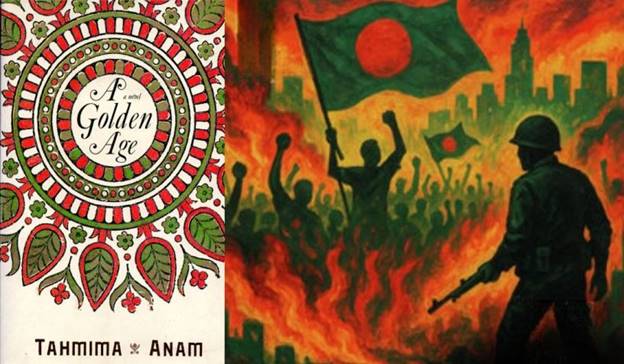
His curiosity aroused by ousted Bangladeshi premier Sheikh Hasina’s response to the youth protests last year and an Al Jazeera podcast series about those protests, a journalist in Kenya, reflects on his own country’s history and reads a novel that leaves him wanting to learn more about Bangladesh
Bangladesh: Looking back to the Small Actions of Ordinary People in 1971
By Tom Maliti
Kenya

As a Kenyan who has lived and worked in Pakistan, I still follow events in the region fairly closely. But I was unaware of how ousted Bangladeshi Prime Minister Sheikh used her country’s independence war of 1971 to define the tone of her premiership, and to identify her supporters and opponents particularly during her recent tenure.
I gained a better understanding of the issue after listening to the ‘Al Jazeera Investigates’ five-part podcast series ‘ 36 July: Uprising in Bangladesh ’, released in July 2025.
For me, Bangladesh’s top political leader identifying so closely with the 1971 war came as a revelation. I knew, of course, that the Awami League party led by her father, Sheikh Mujibur Rehman, had won Pakistan’s 1971 general election but was denied the opportunity to form the government, and that he was eventually killed.
I expected Hasina, as one of two of Mujib’s surviving children, to hold closely to this history. I was surprised how much this history drove government policy and thinking, as described in the Al Jazeera podcast.
In Kenya, those who fought for our independence formed the government after the British left on 12 December 1963. But post-independence, the issues that drove that struggle were not addressed in any meaningful way. This happened even though our first prime minister, and later first president, Jomo Kenyatta, was imprisoned for nine years by the colonialists between 1952 and 1961. And despite the fact that some members of the first post-independence Cabinet had fought the colonialists.
By the mid-1960s, the Kenyatta administration dealt ruthlessly with anyone who criticised it for not fulfilling the aspirations and promises of independence. These critics were detained without trial or sidelined, if they were still in government or Parliament. Two of Kenyatta’s vice-presidents resigned in frustration.
Since then, the fight for independence and the issues that drove it are only remembered on national days such as Jamhuri (Kiswahili for Freedom) Day on 12 December. As if to emphasise how Kenya’s successive political leaders have only paid lip service to our independence struggle, the Mau Mau Association, which the colonialists banned in 1952 for its role in the independence struggle, remained banned after independence. The ban was only lifted some 50 years later, in 2003.
The Al Jazeera podcast made me want to learn more about Bangladesh’s second independence war. Particularly because Hasina used a slur rooted in that independence war in response to the youth protests against her government’s policies.
So, while browsing through my favourite Nairobi bookstore, Prestige Bookshop, when I came across a novel that delved into how what was East Pakistan at the beginning of 1971 ended up becoming Bangladesh by the end of that year, I eagerly bought it — A Golden Age (John Murray, 2007) by the award-winning writer Tahmima Anam. When I got home, I read a few pages to check I had made the right choice. Before I knew it, I had finished the book within days.
I found it to be an easy-to-read, gripping story about ordinary people caught up in Bangladesh’s second independence war. This novel is not an imagining of what the top leaders did or thought during those tumultuous and bloody months between March and December 1971. The Mujibs and Khans provide a backdrop to the motivations, dilemmas, choices, trauma and tragedies faced by the main characters, Rehana Haque, her son Sohail and daughter Maya, together with their friends and neighbours.
Much of the novel is located in the middle-class neighbourhood of Dhanmondi, Road 5 in Dhaka. Once the conflict starts, Rehana, Sohail and Maya do not expect it to last long. But it does. And ordinary people become desperate as university students are massacred and neighbours are killed because of their religion. Girls and women are sexually assaulted, food becomes scarce and entire neighbourhoods are destroyed. Many flee East Pakistan to seek refuge in camps across the border in India. In some chapters, the novel moves to the camps in Salt Lake in India.
The top political and military leadership of then West and East Pakistan have cameo roles in A Golden Age but the impact of their decisions is explored through the lives of the characters in the novel.
This Tahmima Anam does well, allowing the reader to experience how the “big” decisions influence the “small” actions of Rehana and her family in Dhaka and Lahore, Rehana’s gin-rummy ladies, her neighbour Mrs Chowdhury and her daughter Silvi, among others.
Some questions
There’s the immediate splitting of families once the war begins. Rehana’s estranged married sisters live in Lahore. Rehana writes them letters that she never sends, perhaps taking for granted that she can always make plans to see them. The war upends any such possibility.
But the split is not just families being unable to visit each other whenever they wish. Families are now divided along political lines: Rehana, reluctantly and gradually, gets involved in the war for independence. As she becomes comfortable with her choices and more involved in the independence struggle, one of her brothers-in-law, Faiz, moves to Dhaka, from Lahore, to become a high-level enforcer of West Pakistan’s martial law regime.
Once West Pakistan’s army admits defeat in December 1971, power shifts: Faiz is imprisoned and Rehana is his only hope for reprieve.
So, what did I learn from A Golden Age? For one thing, I believe I got to see the full spectrum of individual histories of those who remained in Dhaka during Bangladesh’s second independence war. I also got to see what life was like in the refugee camps in India.
A Golden Age does raise some questions. What happened to family members in West Pakistan? Faiz, a big shot Lahore lawyer, and his wife Parveen in A Golden Age show how some Bengalis actively worked with the West Pakistan military.
Were there others who sent money, food and other things to their family members in East Pakistan and the refugee camps, if nothing else but on humanitarian grounds? Did they contribute to the war of independence, if only out of filial loyalty? Did they face questions about which side they were on? Or did they live in denial for the nine months of the war?
I guess that is a separate novel.
A Golden Age is worth reading. I am looking forward to completing Tahmima Anam’s ‘Bangla Desh’ trilogy – the other books, The Good Muslim (2011) and The Bones of Grace (2016), continue the Haque family’s story in Bangladesh and the diaspora into the 1980s and beyond.
(Tom Maliti is a journalist based in Nairobi, Kenya who reported on cases at the International Criminal Court for nearly a decade. He was a student at Government College, Lahore (now University) 1989-1992, when he contributed to The Frontier Post Lahore. He was also a member of the founding editorial team of The News on Sunday, Pakistan, where he worked until returning to Kenya in 1997.)
This is a Sapan News syndicated feature. http://www.sapannews.com