Book & Author
Afzal Ahmed: Pakistan Cricket Chronicle 1948–2024
By Dr Ahmed S. Khan
Cricket is the heartbeat of Pakistan—more than just a sport, it is a national passion and cultural phenomenon. As the country’s most popular sport, cricket is deeply woven into everyday life. From bustling city streets to remote villages, people play cricket everywhere, often with tennis balls, tape balls, and improvised bats. Street cricket has become a defining feature of Pakistani life.
Introduced during British colonial rule, cricket gained momentum after Pakistan’s independence in 1947. The nation achieved Test status in 1952, marking its entry into international cricket. Today, cricket serves as a powerful force for unity, bridging ethnic and social divides and inspiring national pride.
Pakistan’s global achievements include winning the ODI World Cup in 1992 under the leadership of Imran Khan—a historic milestone—followed by the T20 World Cup in 2009, two Asia Cup titles (2000 and 2012), and ICC Under-19 World Cups in 2004 and 2006. Other memorable victories include defeating England at Lord’s in 1982, winning a Test series in Australia in 1995, and beating India in Chennai in 1999. Cricket in Pakistan is more than a game—it is a symbol of resilience, unity, and national pride.
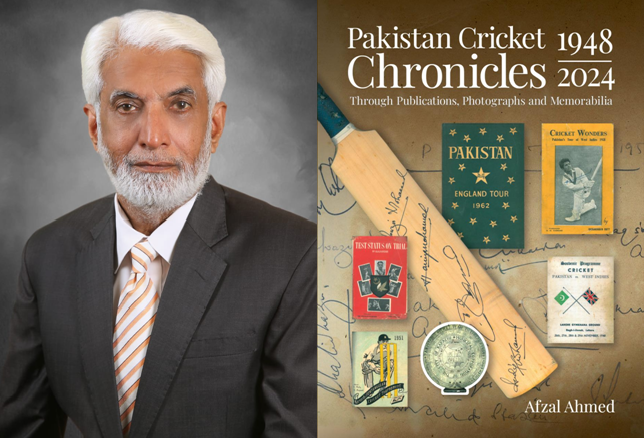
Afzal Ahmed’s “Pakistan Cricket Chronicle 1948–2024” is an ambitious and sweeping narrative that charts the evolution of Pakistan cricket from its formative years after independence to its contemporary challenges and triumphs. This work is far more than a compilation of matches and statistics; it serves as a cultural and historical document, illustrating how cricket became deeply intertwined with national identity, politics, and global recognition.
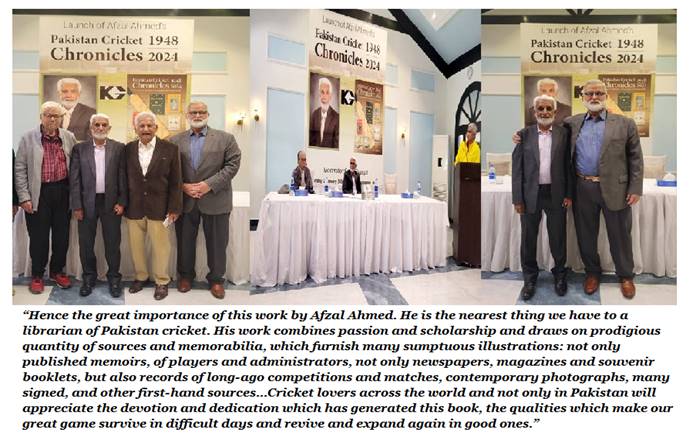
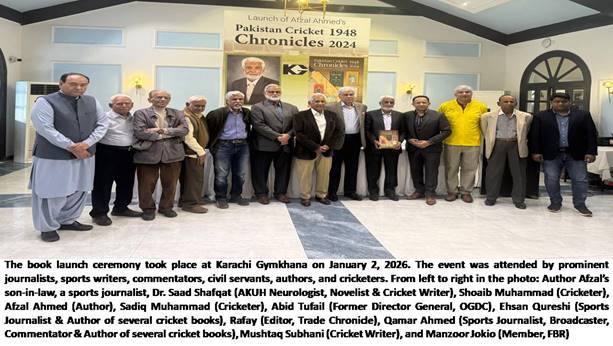
What sets Afzal Ahmed’s chronicle apart is its engaging storytelling and ability to contextualize the sport within Pakistan’s socio-political fabric. The book was officially launched on January 2, 2026, at the Karachi Gymkhana Club, in an event attended by a distinguished gathering of cricketers, sports writers, and senior civil servants.
Afzal Ahmed, a retired banker from Karachi, transformed his lifelong passion for cricket into this remarkable work. Over five decades, he collected an extensive range of cricket memorabilia and curated it into a unique visual chronicle of the game’s journey in Pakistan. Organized chronologically, the book begins with Pakistan’s inaugural season in 1948–49 and culminates in the modern era of 2023–24. Each season is presented as a distinct mini-chapter, enabling readers to trace the progression of the sport through visiting teams, foreign tours, and a rich collection of souvenirs, books, magazines, photographs, letters, first-day covers, and scorecards.
In the preface, the author explains the motivation behind writing the book: “One day, while sitting with veteran journalist Qamar Ahmed at his Clifton home and discussing the latest cricket book, it occurred to me: why not compile a work that not only traces the history of Pakistan cricket but also displays my lifelong collection of books and memorabilia? Qamar loved the concept and encouraged me to begin without delay. Fraz, too, shared his excitement and insisted I start right away. Another friend, Najum Latif — whose vast knowledge and dedication to preserving Pakistan cricket’s history is unparalleled — enthusiastically supported the idea. Dr Salaman Faridi, with a deep understanding of the game’s heritage, described it as ‘a unique book of its kind.’ And so, the seed for this book was planted.” The author also mentions his friendship with fellow collectors: “Over the decades. I ‘ve been fortunate to form enduring friendships with fellow collectors — Saifullah Khairi, Mohammed Taufique, Shahzad Ali Khan, Ahmed Ansari, and Abid Tufail. For more than 35 years we’ve not only shared a passion for cricket books and memorabilia but have also enriched one another’s collection with generosity and camaraderie. Our friendship has grown beyond the boundaries of the game.”
In the foreword, paying tribute to the author and the book — Peter Oborne (author of Wounded Tiger) and Richard Heller (co-author of White on Green) — authors of two landmark books on Pakistan cricket, note: “Hence the great importance of this work by Afzal Ahmed. He is the nearest thing we have to a librarian of Pakistan cricket. His work combines passion and scholarship and draws on prodigious quantity of sources and memorabilia, which furnish many sumptuous illustrations: not only published memoirs, of players and administrators, not only newspapers, magazines and souvenir booklets, but also records of long-ago competitions and matches, contemporary photographs, many signed, and other first-hand sources…Cricket lovers across the world and not only in Pakistan will appreciate the devotion and dedication which has generated this book, the qualities which make our great game survive in difficult days and revive and expand again in good ones.”
The author’s narrative is elegant yet accessible. He combines professional precision with narrative flair, weaving match descriptions with anecdotes and archival material. The inclusion of rare photographs, scorecards, and personal stories adds authenticity and texture. His ability to balance technical analysis with human drama ensures that the book appeals to all avid readers.
The book stands out as a significant contribution to cricket literature, offering readers a rich and nuanced perspective on the sport’s evolution in Pakistan. The major strengths of the book are: 1. Comprehensive Coverage: Few works attempt such an extensive temporal span with this level of detail, making it a valuable resource for enthusiasts and researchers alike, 2. Contextual Depth: The author skillfully situates cricket within Pakistan’s cultural and social fabric, transforming the narrative into a broader commentary on society as well as sport, and 3. Balanced Perspective: Triumphs are celebrated without exaggeration, and shortcomings are addressed with candor, lending credibility and honesty to the work.
There are some areas for improvement — 1. Table of Contents: The current structure lists seasons without any topical detail. Including summaries of each season and specifying related content—such as souvenirs, photographs, and referenced books—would enhance usability, 2. An Appendix on Books: A consolidated list of all books mentioned throughout the text would allow readers to access this information at a glance, improving the book’s utility as a reference. Despite minor shortcomings, this book is an authoritative and engaging account that blends sporting history with cultural insight.
Pakistan Cricket Chronicle 1948–2024 is far more than a sports book—it is a cultural chronicle that reflects Pakistan’s aspirations and anxieties. In an era when cricket is increasingly commercialized, Afzal Ahmed’s work reminds readers of the game’s deeper significance as a symbol of national pride and identity.
For young fans, the book offers valuable historical perspective; for scholars, it serves as a rich and authoritative resource. It is a must-read for cricket enthusiasts and anyone seeking to understand the intricate relationship between sport and society in Pakistan. Afzal Ahmed has produced a landmark work that stands as the definitive account of Pakistan cricket. With its seamless blend of history, narrative, and striking visual illustrations, this book is essential reading for anyone interested in how the game helped shape Pakistan into a leading cricketing nation.
The book is available at Liberty Books: https://www.libertybooks.com/pakistan-cricket-chronicles-1948-2024-9786279476104
Author’s Interview
Q: What inspired you to write a comprehensive chronicle of Pakistan cricket spanning over seven decades?
A: The inspiration to transform a lifelong passion for cricket into Pakistan Cricket Chronicle emerged gradually, shaped by encouragement from people who understood both my commitment to the game and my years of collecting its history. A decisive influence was Ahmed Fraz, a family friend of five decades. After every cricket anecdote I shared with him, he would insist, “Afzal bhai, you must write a book on cricket.” His constant encouragement and unwavering faith ultimately persuaded me that this passion deserved a permanent form. In many ways, this book exists because of his insistence and belief.
A second and equally important catalyst came during a conversation with the esteemed journalist and broadcaster Qamar Ahmed at his Clifton residence. While discussing recently published cricket books, the idea crystallized: why not bring my lifelong collection of memories, literature, and memorabilia together in a single volume as both a tribute to Pakistan’s cricketing heritage and a historical archive? Qamar Ahmed immediately endorsed the idea and urged me to begin without delay. His affirmation gave the project clarity, confidence, and momentum, turning an idea into a determined undertaking.
Q: How did you gather and verify historical data, especially for the early years of Pakistan cricket?
A: In addition to written sources, I was fortunate to have direct access to living history. The Mohammad brothers—most notably Hanif Mohammad—were not only central figures in Pakistan’s early cricketing narrative but also personal friends. Hanif Mohammad, who played 55 Test matches from Pakistan’s inaugural Test in 1952 until 1969 and later served the game in various capacities, shared with me first-hand accounts of the triumphs, setbacks, and inner workings of Pakistan cricket over nearly five decades. Combined with my extensive personal archive—comprising nearly 90 percent of Pakistan cricket literature and memorabilia published worldwide—and careful cross-verification of sources, these insights helped ensure both historical accuracy and depth, especially for the formative years of Pakistan cricket.
Q: What was the most challenging aspect of compiling such an extensive timeline of events and personalities?
A: The challenge was not research, as I approached the project with a clear vision and a vast personal archive of books, brochures, photographs, souvenirs, and memorabilia. The real difficulty lay in presenting this material in a coherent and visually compelling manner. I was fortunate to have the professional expertise of the brilliant designer Mannan Hatim, whose artistic sensibility shaped the book’s visual identity and transformed it into a true collector’s volume. Despite my limited computer skills, my nephew Abdul Rahim played a vital role by integrating over 1,200 illustrations, ensuring that the book achieved both richness and clarity in presentation.
Q: In your view, how has cricket shaped Pakistan’s national identity and culture since independence?
A: In a country that has faced social, economic, and political challenges since its inception, cricket has played a unifying and harmonious role in Pakistan’s national life. It has offered moments of collective pride, joy, and relief to a nation often in need of something to celebrate. Alongside hockey and squash—sports in which Pakistan also achieved global distinction—cricket helped shape a shared national identity, transcending class, language, and regional divides. Its successes provided not only sporting achievement but also a sense of confidence, belonging, and international recognition for an underprivileged and developing society.
Q: Which five players or leaders do you believe had the most transformative impact on Pakistan cricket, and why?
A: In the formative years of Pakistan cricket, three figures were collectively foundational: Abdul Hafeez Kardar, Fazal Mahmood, and Hanif Mohammad. Kardar provided the leadership and structure essential to a newly formed team. A deeply patriotic, educated, and authoritative captain from 1952 to 1958, Kardar shaped the team’s character and ensured that Pakistan established itself as a credible force in international cricket. His role was complemented—and made effective—by the extraordinary performances of Fazal Mahmood and Hanif Mohammad.
Fazal Mahmood, Pakistan’s first great fast bowler, delivered the country’s earliest historic victories and set benchmarks for pace bowling that inspired generations. Hanif Mohammad, a batsman of exceptional technique and endurance, became the backbone of Pakistan’s batting for nearly two decades and established standards of resilience and excellence that defined the team’s early identity.
In the later era, Imran Khan and Javed Miandad were transformative figures. Imran’s charisma and leadership elevated Pakistan cricket to its greatest heights, while Miandad’s intensity, consistency, and match-winning ability embodied Pakistan’s competitive spirit. Among captains, I rate Abdul Hafeez Kardar, Mushtaq Mohammad, and Imran Khan as the three finest leaders to have guided Pakistan cricket, each contributing uniquely to its journey.
Q: Among all the milestones covered in your book, which moment stands out as most defining for Pakistan cricket?
A: Among the many milestones covered in the book, the most defining moment for Pakistan cricket, in my view, was the historic victory at The Oval in 1954 against England. By achieving this remarkable feat, Pakistan became the first team in the history of the game to defeat England on their very first tour to the mother country—a triumph that announced Pakistan’s arrival as a serious force in international cricket.
Q: How did you approach sensitive topics like match-fixing scandals, politics, and governance of PCB?
A: This book takes a different approach, focusing solely on preserving the legacy and heritage of Pakistan cricket. Matters such as match-fixing, politics, and PCB governance lie outside its scope and have therefore been left untouched.
Q: How do you see the role of the Pakistan Super League (PSL) in reviving cricket culture and talent development?
A: I do not believe the Pakistan Super League has played any significant role in reviving cricket culture or in the systematic development of talent. In fact, in my view, it has not contributed meaningfully to the overall betterment of Pakistan cricket.
Q: Who are your favorite cricket writers and commentators of Pakistan? Please cite some of their works and memories.
A: Among Pakistani commentators, Iftikhar Ahmed remains my favorite. His vibrant and evocative commentary added excitement and color to the game and played a significant role in shaping how cricket was experienced by listeners.
Although Abid Ali Kazi does not strictly fall into the category of a conventional cricket writer, his contribution to Pakistan cricket literature is immense. His five-volume work on Pakistan cricket—containing complete scorecards and summaries of first-class matches played in Pakistan between 1947 and 1975—represents a monumental effort to document and preserve the game’s early history.
Q: If you could add more chapters to the book for its second edition, what themes would you focus on?
A: There are no plans for a second edition. This is the kind of book whose value lies in its originality and completeness; producing a second edition would, in my view, only diminish its significance rather than enhancing it.
(Dr Ahmed S. Khan — dr.a.s.khan@ieee.org — is a Fulbright Scholar)