O.P. Nayyar
O.P. Nayyar: Musician, Magician or Both?
By Siraj Khan
Atlanta
(Personal recollections from a Pakistani 'OPium' about a Lahore-born Bollywood musical icon whose stories are entwined with many legendary figures, and whose immortal melodies continue to inspire and shape popular music.)
While organising my thoughts last year to start writing my annual January piece on the celebrated composer O.P. Nayyar , I wondered how I would encapsulate the decades of his work into an article for 2026, his birth centenary.
Our relationship had developed into a strong bond since we first met in Dubai in June 1995 . I was there on assignment, and he was visiting for a show. We met whenever I visited India and I would call him for marathon phone conversations, considering myself his adopted son.
Since his death in January 2007, I have strived to keep his work and memory alive. Looking back, it is incredible to think that I, a Pakistani, started and am running the O.P. Trust in Mumbai, managing his official website, which his four children also watch over.
For me, January is "O.P. Nayyar Month" -- the month in which he was born and died, as he had predicted he would. My thoughts were interrupted by news of iconic Bollywood star Dharmendra's death on 24 November, after weeks of rumours.
My mind was flooded with dozens of names and characters, as if the past was embracing the present. I knew that my annual O.P. Nayyar article would be an extract of a chapter from his life, connecting him with Dharmendra -- both proud Punjabis.
Guru Dutt
I remembered Guru Dutt’s last production 'Baharein Phir Bhi Ayengi‘ (Spring Will Still Come), in which Dutt himself played the male lead. By now, Dutt had achieved a cult following, and Nayyar, doing the music score, was a hot commodity. He had earlier done the music for C.I.D., a crime thriller produced by Dutt in 1956.
In 1957, Nayyar became the first composer to be paid a lakh (100,000) rupees. His face was splashed on billboards instead of the film’s leading actors', something never seen before or since.
Eleven unedited reels of ’Baharein Phir Bhi Ayengi’ had been shot, and four of its songs recorded when Dutt, 39, was found dead on 10 October 1964. That day, he and Nayyar were to meet and discuss the picturization of the title song, which had already been recorded. Only Aapke ke Haseeen Rukh pe (On Your Beautiful Face), already picturized with Dutt and the two heroines, Mala Sinha and Tanuja.
Dutt’s sudden death brought things to a halt. Then the 1965 India-Pakistan war took place. It seemed that the film had died with Dutt.
Then something remarkable happened. If one single song ever changed the trajectory and destiny of an entire film, it was Aapke ke Haseeen Rukh pe, penned by Kaifi Azmi. Dutt’s brother, Atma Ram, happened to hear it and was inspired to revive the production. Interestingly, this is the only song that Azmi ever penned for Nayyar.
Badal jaye agar mali, chaman hota nahi khali
Baharein phir bhi aati hein, baharein phir bhi ayengi
(The garden does not become barren if the gardener changes
Spring has always come, spring will still come.)
The new maali (gardener) had arrived. Director Shahid Lateef and Dutt’s trusted writer, Abrar Alvi, jumped into action. Along with Nayyar, they started looking for an actor to take up Dutt’s role. Every top hero, including Dev Anand and Sunil Dutt, declined to step into Dutt’s shoes. Then young Dharmendra, who just went by one name, was signed on.
An interesting aspect of the film's music was that its six songs were written by five lyricists.
Koee kehde kehde kehde zamane se jaake (Somebody go and tell the world) – Aziz Kashmiri
Woh hans ke mile humse ham pyar samajh baithe (He met with a smile and I took it to be love) – S. H. Bihari
Aap ke haseen rukh pe aaj naya noor hai (On your pretty face, today I see a new radiance) – Anjaan
Dil to pehle hee se madhosh hai matwala hai (My heart is already intoxicated with a hangover) – Shevan Rizvi
Badal jaye agar mali chaman hota nahi khali (The garden doesn't become barren when the gardener changes) – Kaifi Azmi
Suno suno Miss Chatterjee, mere dilka matter jee (Do listen to me, Miss Chatterjee, this is a matter of my heart) – Aziz Kashmiri
Also interestingly, not one was in the voice of Geeta Dutt, Guru Dutt’s wife.
With the modified script, the songs were initially reduced to five. However, aware that lyricist Aziz Kashmiri was going through tough times, Nayyar wanted to assign at least two songs to him, and convinced the team that a comedy song picturised on Johnny Walker would enrich the film.
Parallel stories
Nayyar also managed to get a higher compensation for Kashmiri for his generous -- and judicious -- use of English words in a Hindi song. When Kashmiri received his compensation, he almost fainted with surprise, finding the amount unimaginable. That was Nayyar.
More twists and turns were to follow, with almost a parallel story running in real life. Until his meeting with Nayyar, Kashmiri was being cast as an extra, playing dead men, often seen in films being carried through the streets for the last rites. He had been playing this strange role well, but Nayyar made him promise that to stop.
Kashmiri developed a long list of hits with Nayyar in just a few months, starting in 1966, going into 1969. Huzoorewala jo ho ijazat (Your Permission, Sir) was a runaway success. Even established lyricists were taking notice of Kashmiri. Nayyar had created some sort of a miracle.
Dara Singh’s 1969 film The Killers had six songs, three each assigned to poets Kashmiri and S.H Bihari . Kashmiri wrote two. After that, nobody remembers meeting him. He did not even collect his dues. He just vanished and was presumed dead. He was just skin and bones when he was last seen. Nayyar used to say light-heartedly that Kashmiri had rehearsed well for his death. The mystery has never been solved.
S.H. Bihari penned the lyrics for Kashmiri's missing third song, Churate ho nazrein aji kis liye (Why do you steal your glances, tell me?). The singers of Kashmiri’s last song, Asha Bhosle and Usha Timothy, are still with us.
Back to ‘Baharein Phir Bhi Ayengi’, the film limped towards completion, with numerous glitches along the way, and was finally released in 1966. This would be director Shahid Lateef's last one. He died in April 1967, just a few months later.
Interestingly, the only time Nayyar, Azmi and Dharmendra ever worked together in their respective long careers was for Badal jaye agar mali, the title song.
Nayyar, who was born in Lahore, where he lived for the first 21 years of his life, continued to work wonders with Dharmendra. They always spoke in Punjabi, and whenever the legendary singer Mohammed Rafi joined them, there was no stopping them.
Mohabbat Zindagi Hai (Love is Life) was another Nayyar-Dharmendra starrer. Na jaane kyon hamare dil ko tumne dil nahi samjha (I don’t know why you never understood my heart as a heart), Tumhari mulaqaat se mujhko pata ye chala (Meeting you is when I finally learned this) and Ye Purnoor chehra (This radiant face), all sung by Rafi, fared well in the charts.
However, the writing was on the wall. The film Baharein Phir Bhi Ayengi and the year of its release signaled the tipping point, the beginning of the decline of Nayyar’s eventful career. After that peak, Nayyar’s career took a dip and never picked up.
Geeta Dutt's death in July 1972, followed by Nayyar's dramatic break-up with Asha Bhosle, finished the composer in Nayyar. He was never the same again.
In 2005, Nayyar called me, saying that his vertigo was getting worse. The end was near, he said, adding that he had predicted to the late iconic actor Madhubala that she would die in the same month as her birth, and that he knew that this would happen to him too. Then he read me a poem he had just penned.
Ik roz mein har aankh se chhup jaoonga lekin,
Dhadkan mein samaya har dil mein rahunga
Duniya mere geeton se mujhe yaad karay gi,
Uth jaunga phir bhi iss mehfil mein rahunga
(One day I’ll vanish from every eye, but still,
I’ll live on in every heart, woven into its beat.
The world will remember me through my songs,
Even if I rise and leave, I’ll remain in this gathering).
January 2006 came and went. Neither of us brought up his prediction. However, his health went on a downward spiral.
Here and forever
In December, I called to tell him that I had booked my Boston-Mumbai flight for 14 February 2007, Valentine’s Day. He asked if I could come earlier. I said I couldn’t, but promised that I would go to his place straight from the airport. I also gave him the good news about the launch of his official website www.opnayyar.org .
He left for his final journey on the morning of 28 January 2007. I flew to Mumbai as scheduled and, keeping my promise, went straight to his place from the airport. There I found the poem he had recited to me tucked under his pillow, written in Urdu.
On his birth centenary, 16 January, this year, the singer Sumaira Altaf gifted me a video that encapsulates our relationship -- I often have to pinch myself to remind me that this is all real and not a fairy tale.
WATCH VIDEO: : https://youtube.com/shorts/3EwukRw8Ips?si=beJyu2FdRUXLMz0-
Caption: Video by OPium Sumaira Altaf, who gifted this video to Siraj Khan on 16 January 2026.
‘OPiums’, as Nayyar's fans are known, are celebrating his centennial in various places and in various ways this year, including in Mumbai on 16 January, and in New Delhi, at the India Islamic Cultural Center on 17 January.
On 7 February, we will stage Jadugar (magician) in Atlanta, Georgia, where I moved last year from Boston. I am privileged to direct this show about how the maestro turned music into magic. As I have been doing annually for years , I will go on stage feeling his presence even more strongly as I wear attire from his wardrobe - shirt, trousers, shoes, black hat, red bowtie, blazer - to raise funds for the Trust. His adopted daughter, Rani Nakhwa , says that I even resemble him.
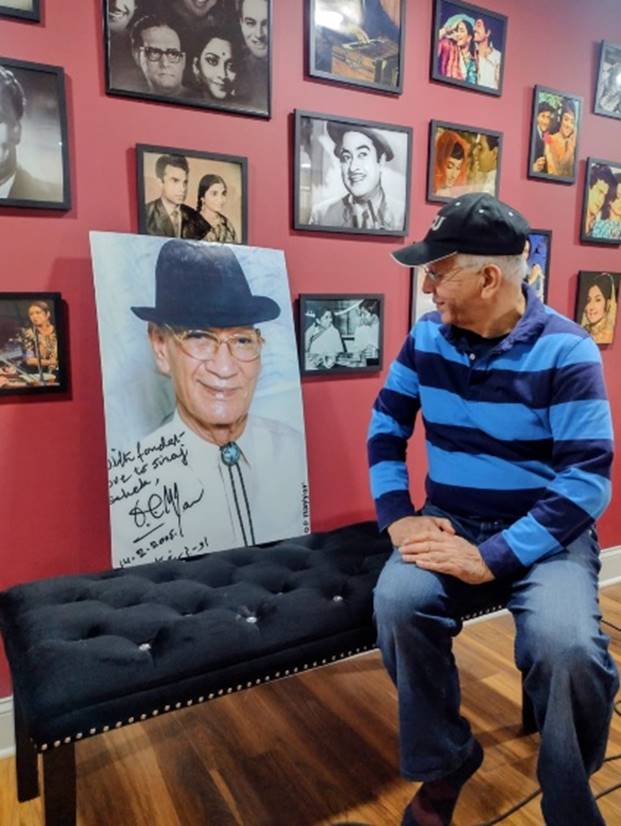
Siraj Khan, affectionately looking at Nayyar's photo - Photo by Karishma Virani
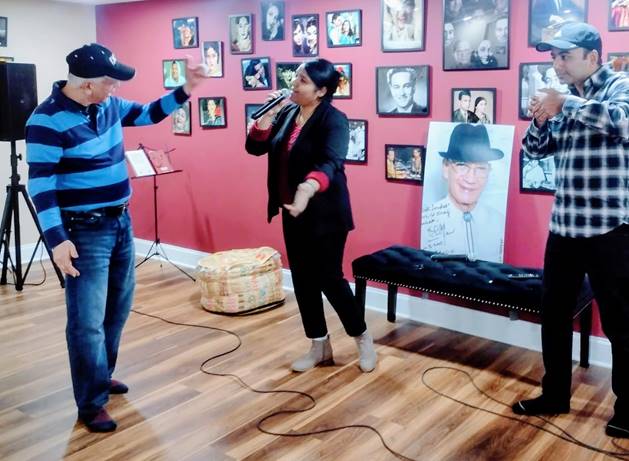
Rehearsals in full swing at the music room of Karishma Virani, the founder of ASK-V Productions and the producer of the show 'Jadugar' - Phoro by Karishma Virani
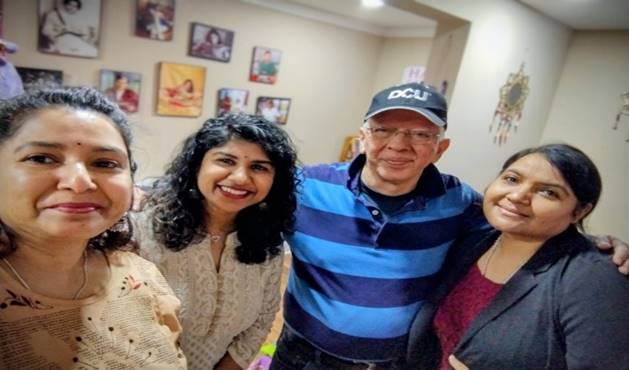
Siraj Khan, with three of the eight vocalists, Megha, Shilpa and Anita Sunny, performing in 'Jadugar' - Photo by Karishma Virani -
A hundred years after his birth, the musician-magician lives on in the hearts and minds of OPiums around the globe.
( Karachi-born Siraj Khan in Atlanta is a connoisseur of South Asian film music and former President of the Pakistani Association of Greater Boston. He heads the nonprofit O.P. Nayyar Memorial Trust. A global finance and audit specialist by profession, he has written scripts and directed concerts in the USA, Southasia and the UAE. He also works towards women's empowerment, children, and youth and is a founder member of the Southasia Peace Action Network , Sapan. - Sapan News)