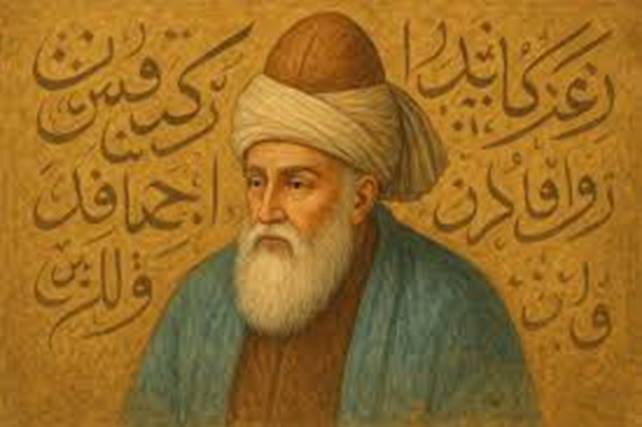
Pakistan Link will publish 19 short biographical essays on some of the greatest spiritual luminaries in Islamic history, from Rābiʿa al-ʿAdawiyya to Jalāl al-Dīn Rūmī and Khwāja Muʿīn al-Dīn Chishtī. Together, these essays would form a coherent spiritual journey—from renunciation and detachment, to ecstatic divine love, and ultimately to the human calling to know, love, and serve God. These essays are condensed from a chapter in Professor Nazeer Ahmed’s recently completed book, Faith, Love and Reason in Islamic History.
Tasawwuf has been one of the great sustaining forces in Islamic history. In times of upheaval and decline, it preserved not only faith, but the inner life of faith, the longing, remembrance, and resilience that kept the lamp of Islam burning. Yet this luminous inheritance is increasingly lost to today’s youth amid modernity, secularism, materialism, war, and the relentless distractions of the digital age. It is our hope that this series will help rekindle that lost flame and inspire a new generation to rediscover the spiritual depths of their tradition. According to the eminent author of ‘Faith, Love and Reason in Islamic History’, Professor Nazeer Ahmed, “no lasting renewal of Muslim civilization can come without spiritual renewal. A civilization must awaken from within before it can rise again.”
Reclaiming our Spiritual Heritage…
- Khwāja Muʿīn al-Dīn Chishtī
By Prof Nazeer Ahmed
Concord, CA
Among the great saints who carried the fragrance of Sufism into new lands and new civilizations, few are as beloved or as historically consequential as Khwāja Muʿīn al-Dīn Ḥasan Chishtī (c. 1141–1236), the revered founder of the Chishtī tradition in the Indian subcontinent. Known lovingly as Gharīb Nawāz, “Benefactor of the Poor,” he stands in the memory of the Muslim world not merely as a preacher or teacher, but as a luminous embodiment of compassion, humility, service, and universal spiritual hospitality. If ʿAbd al-Qādir al-Jīlānī represents the majestic integration of law and inward purification, Khwāja Muʿīn al-Dīn represents the expansive heart of Sufism in its civilizational form: a spirituality that transforms societies not through coercion or polemic, but through love, generosity, remembrance, and service to all who come near.
Khwāja Muʿīn al-Dīn was born in Sijistān or possibly in the region of Sanjar in the twelfth century, in the broader Persianate world that produced so many of Islam’s great sages and saints. He lived in a time of profound upheaval and transition. The Muslim world was experiencing both intellectual flowering and political fragmentation. The legacy of the great classical scholars and Sufis remained vibrant, but many regions were also marked by instability, dynastic conflict, and the ravages of the Mongol age. At the same time, the eastern Islamic lands were becoming fertile ground for the spread of Sufi networks, whose spiritual lineages often carried Islam across cultural frontiers more effectively than rulers or armies ever could.
Like many great Sufi saints, Muʿīn al-Dīn’s early life is remembered through a blend of history and sacred memory. Tradition recounts that he inherited an orchard and mill in his youth, but after a transformative encounter with a wandering dervish, his heart turned decisively away from worldly attachment. He sold his possessions, gave the proceeds to the poor, and entered the path of spiritual seeking. Whether understood as literal history or as a reverent sacred memory, the story conveys an essential truth about him: from the very beginning, his life was marked by detachment from worldly things, deep compassion, and an extraordinary openness to the call of God.
He traveled widely in search of knowledge and spiritual formation, moving through the great centers of the Islamic world in Bukhara, Samarkand, Baghdad, Khurasan, and beyond. He studied the outward sciences, law and fiqh, but more importantly, he entered the company of the saints. His decisive spiritual formation came under the guidance of Khwāja ʿUthmān Hārūnī, the great Chishtī master, from whom he received the mantle of initiation. Through this lineage, Muʿīn al-Dīn inherited a path already known for its sobriety, poverty, gentleness, and emphasis on inward sincerity. But it was he who would carry the Chishtī spirit into India and root it there so deeply that it would become one of the most influential spiritual traditions in South Asian history.
Eventually he settled in Ajmer, in present-day Rajasthan, a place that would become one of the great spiritual capitals of the subcontinent. His arrival in India is one of the defining moments in the history of Islamic spirituality there. Importantly, Khwāja Muʿīn al-Dīn did not establish his presence through political power, legal domination, or doctrinal aggression. He came as a faqīr, as a poor one before God. His authority was spiritual, not imperial. This fact is central to understanding both his historical significance and his enduring sanctity. In a land of immense religious diversity, deep philosophical traditions, and ancient sacred geographies, he embodied an Islam that was confident yet humble, rooted yet compassionate, principled yet hospitable.
The essence of Khwāja Muʿīn al-Dīn’s Sufi message can be expressed in three interwoven themes: love, service, and remembrance. His path was not one of abstraction, nor primarily of metaphysical system-building. Like ʿAbd al-Qādir al-Jīlānī, he emphasized moral and spiritual transformation, but his genius lay especially in the social radiance of sanctity. To draw near to God was, for him, to become a source of mercy for creation. The saint is not one who withdraws into spiritual privilege, but one whose heart has become so softened by divine remembrance that he becomes a refuge for others.
This is why the title Gharīb Nawāz is so revealing. He was remembered above all as a friend of the poor, the broken, the marginalized, and the spiritually hungry. Feeding others, welcoming strangers, consoling the afflicted, and serving humanity were not secondary expressions of the path; they were the path. The Chishtī ethos that emerged from him would later become famous for its langar (free kitchen), its open doors, and its refusal to distinguish too sharply between those worthy and unworthy of compassion. In Khwāja Muʿīn al-Dīn, Sufism becomes not only a discipline of inward purification but a civilization of mercy.
The Chisti generosity was not sentimental. It was rooted in deep spiritual discipline. Like the great sober Sufis before him, Khwaja Moeenuddin emphasized faqr (spiritual poverty), zuhd (detachment), ikhlāṣ (sincerity), tawakkul (trust in God), and dhikr (remembrance of God). The seeker must empty himself of pride, ambition, greed, and the desire for recognition. Only a heart emptied of the self can become a vessel of divine compassion. In this respect, Muʿīn al-Dīn stands in clear continuity with the earlier Sufi tradition: the outer gentleness of the saint is made possible by the inner severity of his struggle against the ego.
The Chishtī tradition associated with him also became known for its embrace of samāʿ, spiritual audition, especially devotional poetry and music, as a means of softening the heart and awakening longing for God. While always contested by some legalists, in the Chishtī milieu samāʿ was not entertainment, but a disciplined and sacred art, intended to stir remembrance and love. In later generations, this would blossom into one of the most culturally influential dimensions of South Asian Sufism, the Qawwali, helping shape traditions of devotional music, poetry, and public spirituality. Here again, Khwāja Muʿīn al-Dīn’s legacy is not merely doctrinal but civilizational: he helped create a form of Islamic presence in India that could speak deeply to the emotional, aesthetic, and communal life of the people.
Historically, his role in the spread and deep rooting of Islam in the subcontinent is difficult to overstate. It would be far too simplistic to suggest that the spread of Islam in India can be attributed to a single saint, or that so vast and intricate a civilizational transformation can be explained solely through pious legend and devotional memory. Yet it is equally mistaken to ignore the decisive role of the Sufi khānqāh and the moral authority of the saints. In many parts of South Asia, people encountered Islam first not through rulers or theologians, but through Sufi hospices, devotional gatherings, acts of charity, and the example of Sufi shaikhs whose character embodied the mercy of the Prophet. Khwāja Muʿīn al-Dīn Chishtī became one of the greatest archetypes of this phenomenon. Through him and those formed in his path, Sufism became one of the principal means by which Islam entered the spiritual and social fabric of the subcontinent.
His disciples and successors magnified this legacy immensely. Figures such as Qutb al-Dīn Bakhtiyār Kākī, Farīd al-Dīn Ganj-i Shakar (Bābā Farīd) and Niẓām al-Dīn Awliyāʾ, carried the Chishtī message into Delhi and beyond, helping shape not only Muslim spirituality but the broader culture of South Asia. Through them, the Chishtī path became synonymous with tenderness, renunciation of political entanglement, hospitality, and love-centered devotion. Unlike some Sufi orders that cultivated close relationships with rulers, the Chishtīs often preferred principled distance from political power, believing that proximity to courts endangered sincerity and spiritual freedom. This moral posture became one of their defining marks.
In modern times, Khwāja Muʿīn al-Dīn Chishtī remains one of the most beloved saints in the entire Muslim world, and certainly among the most venerated in South Asia. His shrine in Ajmer continues to draw millions, Muslims and non-Muslims alike, who come seeking blessing, solace, healing, and spiritual connection.
(The author is Director, World Organization for Resource Development and Education, Washington, DC; Director, American Institute of Islamic History and Culture, CA; Member, State Knowledge Commission, Bangalore; and Chairman, Delixus Group)