Book & Author
Shaista Saeed: Remembering Syed Mohammad Taqi — An Intellectual Par Excellence & Founding Editor of Daily Jang
By Dr Ahmed S. Khan
Syed Mohammad Taqi (May 3, 1917, Amroha, British India – June 26, 1999, Karachi, Pakistan) was a distinguished philosopher, intellectual, writer, and journalist. He holds a unique distinction among Eastern and Western thinkers for producing a comprehensive philosophical system encompassing history, epistemology, and cosmology. As the first modern Eastern philosopher to expound a fully consistent, internally coherent system of the universe, Taqi sahib dedicated his life to propagating the use of logic and reason.
Born to Shafiq Hasan Elia, a prominent scholar of Amroha, Taqi belonged to an illustrious literary family; his brothers included the celebrated poets and intellectuals Rais Amrohvi (1914–1988) and Jaun Elia (1931–2002).
Taqi was a philosopher par excellence and a gifted, versatile writer whose work spanned economics, politics, sociology, constitutional theory, and literary criticism. He achieved the rare feat of popularizing philosophy for the general public, notably becoming the first to do so in the Urdu language. His global impact is anchored by several well-received books rooted in his scholarly newspaper essays, including Rooh aur Falsafa, Mantiq, Falsafa aur Science, and Essays in Philosophy (published in English).
His 1974 book, History & the Universe - My View (Taarikh aur Qaainat - Mera Nazaria), is widely regarded as his magnum opus. It covered all facets of human philosophical quest, devising a sound system anchored in human rationality and societal evolution. Beyond philosophy, his cultural and literary contributions were widely recognized; his book Hindustan: Pas’manzar-o-pesh’manzar earned him the prestigious Adamjee Prize. An accomplished translator, he brought monumental Western works to Urdu readers, translating Karl Marx’s Das Kapital, Sir James Jeans’s Mysterious Universe, and Arthur Eddington’s Science and Philosophy.
Alongside his academic pursuits, Taqi was a titan of journalism, serving as the founding editor of the daily Urdu newspaper Jang, a position he held for over 20 years. Representing Pakistan on the global stage, he regularly participated in international philosophy conferences across Europe and North America, where he engaged with legendary minds and Nobel Laureates, including Bertrand Russell and Subrahmanyan Chandrasekhar. In the 1990s, he was invited to chair an international philosophy conference in Mexico, a journey during which he also visited his brother-in-law, Professor Naqi Akhter, in Chicago to participate in local academic activities.
In the following interview conducted by the scribe (ASK), his eldest daughter, Shaista Saeed (SS), reflects on her father's personal life and profound professional legacy.
ASK: When and where was Taqi Sahib born?
SS: Taqi Sahib was born on May 3, 1917, in Amroha, a town in India. Amroha is located just eighty (80) miles away from Delhi.
ASK: Who was his father? Did he also author any books?
SS: Syed Mohammad Taqi’s father was Allama Syed Shafiq Hasan Elia. He was a researcher and scholar who knew several languages, including Persian, Arabic, Sanskrit, Hebrew, and English. He was an expert in astronomy. Because of this expertise, he maintained regular correspondence with the Greenwich Observatory in London, UK. Additionally, he kept in touch with "Nisyan", the director of an observatory in Burma (South Asia), and was also in contact with the famous philosopher Bertrand Russell. He composed poetry in Urdu, Persian, Hindi, and English, and wrote in Arabic besides Urdu. One of his books written in Arabic was Sawata-ul-Azab. His books authored in Urdu included Haqeeqat-ul-Masih, Asl-o-Asool, and Ved aur Quran. Syed Mohammad Taqi’s mother was Syeda Narjis (Nargis in Persian). She took a keen interest in the education and upbringing of her children and would sometimes be strict with them, especially regarding their studies.
ASK: Where did Taqi Sahib receive his primary and higher education?
SS: Taqi Sahib received his primary education at a home-based madrasa (school). It was established by his grandfather in the Mardan Khana (men's quarters) of the house for all his grandsons: Syed Mohammad Mehdi (Rais Amrohvi), Kamal Amrohvi, Syed Zeeshan Haider, and Taqi Sahib. Two teachers, Maulvi Jafar Hussain and Syed Akhtar Hussain, were appointed to teach Urdu, Persian, and Arabic. Both teachers were boarded in the same men's quarters.
In 1930, Taqi Sahib passed the Munshi examination from Punjab University, which was considered equivalent to Matriculation. Thus, Syed Mohammad Taqi passed the Munshi exam at just thirteen years of age. Upon returning to Amroha, he developed a passion for learning Arabic and continued his studies independently. In 1933, he passed Allahabad's highest literary examination, Fazil-e-Adab, which included subjects like Urdu prose, poetry, rhetoric, and history. Following that, in 1934, he passed the Maulvi examination from "Syed-ul-Madaris", a school in Amroha affiliated with the Allahabad Board. In 1935, he cleared the Maulvi Alim examination from Punjab University, and in 1936, he cleared the Maulvi Fazil examination. The latter included challenging subjects such as philosophy, exegesis (Tafseer), Hadith, jurisprudence (Fiqh), logic, and history. The Maulvi Alim and Maulvi Fazil examinations were typically cleared over two years. Although there was no restriction from the Board forcing a candidate to take one or two years, these were exceedingly difficult exams to clear in a single year. Nevertheless, Syed Mohammad Taqi passed both exams within one year each. Later, he passed his Matriculation exam as well.
ASK: When did Taqi Sahib join the Daily Jang?
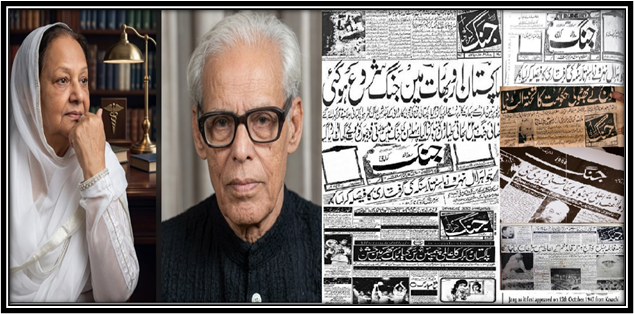
SS: Before the creation of Pakistan, Taqi Sahib was the editor of the newspaper Musalman. This publication belonged to his grandfather, Ali Ishrat Sahib. His grandfather held the declaration rights for another newspaper as well, which was Jang. Another young man named Mir Khalil-ur-Rahman worked with Ishrat Sahib. Ishrat Sahib handed over Jang to him free of cost so that the newspaper could be published regularly. Thus, Mir Khalil-ur-Rahman took charge of Jang alongside Syed Mohammad Taqi. Khalil-ur-Rahman managed administrative affairs, while Mohammad Taqi was entrusted with editorial and writing duties. These individuals were associated with journalism purely out of a voluntary spirit, working without any basic amenities. Consequently, Jang began publication in 1943. For as long as Jang was published from Delhi, it was edited solely by Syed Mohammad Taqi. Under his leadership, Jang built its reputation. The first regular issue of Jang featured two main articles, and Rais Amrohvi also joined them. After the creation of Pakistan, Khalil-ur-Rahman and Rais Amrohvi moved to Karachi with Jang, while Syed Mohammad Taqi went to Amroha.
Initially, Jang was published as an evening newspaper. The first issue of Jang Karachi was printed on September 10, 1947. Gradually, the newspaper progressed, and from February 10, 1948, Jang began publishing as a morning edition. Syed Mohammad Taqi reached Karachi in February 1948 and took over his responsibilities as editor. Thus, ever since Jang transitioned into a morning newspaper, Syed Mohammad Taqi managed its editorial duties, serving as its Editor-in-Chief throughout his tenure.
ASK: When did Taqi Sahib migrate to Pakistan?
SS: After the creation of Pakistan, Rais Amrohvi and Khalil-ur-Rahman went to Karachi. Taqi Sahib returned to Amroha and became highly active in the Pakistan Movement. He had pamphlets printed and distributed in support of Pakistan. Due to this, the CID began tracking him, which worried his father, who eventually asked him to leave for Pakistan. Taking his wife and children, he first went to Bombay, staying at the house of his brother, Kamal Amrohvi, for a few days. On January 31, 1948, they set sail from Bombay to Karachi by ship, arriving in Karachi during the first week of February.
ASK: How long did Syed Mohammad Taqi work for Jang?
SS: When grandfather Ali Ishrat gave the declaration rights of Jang to Khalil-ur-Rahman, Mir Khalil and Taqi Sahib published the first issue of Jang on September 10, 1947, with Taqi Sahib editing it. After Pakistan was established, Khalil-ur-Rahman relocated the Jang newspaper to Karachi, and Rais Amrohvi migrated with him. Syed Mohammad Taqi arrived in Pakistan in the first week of February 1948 and assumed the editorship of Jang. This continued seamlessly until March 10, 1969, when Taqi Sahib resigned from Jang. In total, Taqi Sahib served as the editor of the Jang newspaper for 26 years.
ASK: What was Taqi Sahib’s daily routine while working at the Jang newspaper?
SS: When Jang was first launched in Delhi, there were no set working hours, nor was there any staff. He worked from morning until night, almost seven days a week.
After moving to Karachi, during the initial few years, he would go to the office at 10:00 AM and return home around 1:30 or 2:00 AM. Later, when conditions at Jang improved, he would go to the office at 10:00 AM and return by 9:00 or 10:00 PM. A few years later, he began going at 1:00 PM but still returned at 9:00 or 10:00 PM.
In his final years, he would go at 10:00 AM, return around 1:00 or 1:30 PM, have lunch, rest for a while, and head back to the office at 5:00 PM, returning home around 9:00 or 9:30 PM. This remained his routine until the very end.
ASK: How were his relations with the owners of Jang?
SS: Mir Khalil-ur-Rahman was the sole owner of Jang. He and Taqi Sahib shared a friendly relationship. Taqi Sahib believed that Khalil Sahib was intelligent but possessed a purely practical and business-oriented mindset. He felt Khalil Sahib lacked ideological depth; understanding what makes a great newspaper or what serves national interests was not his primary concern.
Taqi Sahib’s close associates believed that the harmony in their relationship stemmed from Syed Mohammad Taqi’s highly peaceful and accommodating nature, which was exactly the kind of person Khalil Sahib needed.
In the early phases of the newspaper's publication, Taqi Sahib would prepare the newspaper himself; in fact, the entire paper was produced under his direct supervision. However, as circulation grew later on, Khalil Sahib began to interfere.
ASK: Did the owners ever pressure him to alter his writings?
SS: The initial period after the creation of Pakistan—specifically the first ten to fifteen years—was a time when the owner certainly did not interfere much in policy matters.
Later on, however, a dynamic developed where Mir Khalil-ur-Rahman would consult on the editorials written by Syed Mohammad Taqi. If Taqi Sahib felt an editorial might harm the newspaper’s reputation, affect business, or deeply offend the government, he would craft the editorial in a way that avoided those consequences. It was his genius that he could write strictly in accordance with the newspaper’s policy while remaining completely bulletproof to criticism. Despite any personal disagreements on perspective, he wrote so skillfully that Jang's policy remained uncompromised. He never wanted anything published that could damage the newspaper's standing.
On one occasion, Khalil-ur-Rahman even remarked, "I don't understand what Taqi Sahib writes in his editorials, but I stay quiet because perhaps Jang sells so well solely because of him."
ASK: How long did Taqi Sahib serve as an editor at Jang?
SS: Taqi Sahib was involved with Jang from its very inception. Grandfather Ali Ishrat gave the declaration of Jang to Khalil-ur-Rahman in 1943, and he, along with Taqi Sahib, started publishing it. Khalil Sahib handled the management, while Taqi Sahib handled the writing. For as long as Jang was published from Delhi, Taqi Sahib wrote its editorials. Due to the lack of teleprinter facilities, he would listen to Urdu and English news at a nearby shop where a radio played constantly. He would then return to the office, write down the important news suitable for the paper, and that is how Jang was published.
Initially, Jang was an evening paper. On February 10, 1948, it became a morning paper. Taqi Sahib arrived in Karachi in the second week of February and took charge of editing the paper. He resigned on March 10, 1969. He remained the Editor-in-Chief throughout his time at Jang.
ASK: Why did Taqi Sahib leave Jang? Was there pressure on him to resign? If so, from whom, and what was their demand?
SS: Syed Mohammad Taqi’s departure from Jang was a highly painful event. For a man who had been attached to Jang since its inception, poured every ounce of hard work into it at every turn, and whose 25 years of effort elevated Jang into Pakistan’s highest-circulating newspaper—it culminated abruptly. One evening, when Syed Mohammad Taqi reached his office at 5:00 PM, he saw a massive crowd outside the door shouting slogans. Upon entering, he discovered the slogans were targeted against him. The staff advised him to go upstairs to the APP (Associated Press of Pakistan) office. The office staff there set up a chair for him behind a cabinet, where he sat down. Some of the protestors made their way up there and asked the staff if Syed Mohammad Taqi was inside, but left after the staff denied his presence. Afterwards, Syed Mohammad Taqi returned to his office, wrote his resignation, and went home.
Even prior to this event, there had been protests against Syed Mohammad Taqi at the Jang office involving members of various political parties and student organizations. But this time, the crowd was not only chanting that the editor was an atheist and asking why he was heading such a large newspaper, but they were explicitly shouting, "We want the head of Syed Mohammad Taqi." The second underlying factor was internal factionalism within the Jang office itself. A group had formed against Syed Mohammad Taqi, which included certain members of the management. Syed Mohammad Taqi was well aware that there were several individuals affiliated with Jamaat-e-Islami within the office who were covertly working against him.
When Syed Mohammad Taqi submitted his resignation, those individuals intentionally withheld it from Mir Khalil-ur-Rahman for two days because they wanted to claim Taqi Sahib's position for themselves. Ultimately, disheartened by these protests and the toxic attitude of his colleagues, he resigned. Recalling the incident of his resignation, he once sighed deeply and said: "Well, they did a good deed. The work stopped in Urdu, which is for the best. What a pity, what an absolute pity, how unfortunate are these people who do not wish to see Urdu progress."
After receiving the resignation, Khalil-ur-Rahman came with his wife twice to convince Mohammad Taqi to return, but he did not agree. He never set foot in the Jang office again for the rest of his life, as his principles were far dearer to him than material gains.
ASK: Did the owners of Jang ever try to reinstate him as editor?
SS: No extensive efforts were made to reinstate Taqi Sahib as editor. Khalil Sahib, who for a long time knew very well that his paper's circulation and credibility were due to Taqi Sahib, had now begun to believe that Jang sold purely on its own name and brand. He felt it no longer needed the name of a veteran or prominent writer. During his own lifetime, Khalil Sahib had already handed over many of Jang's administrative responsibilities to his sons. Taqi Sahib also noted that internal elements from Jamaat-e-Islami within the office were constantly working against him.
Despite this, Khalil Sahib and his wife did visit Taqi Sahib twice to change his mind, but he refused. He did not attempt to write for any other newspaper either, choosing instead to immerse himself entirely in authoring and compiling his books.
ASK: What hobbies or pursuits did he adopt after leaving Jang?
SS: Even during his employment at Jang, Taqi Sahib remained engaged in scholarly endeavors. Out of personal passion, drive, and curiosity, he translated highly important books into Urdu and authored books on philosophy. Anticipating that he would have to separate from Jang at some point, he had established a small printing press named "Mashriq Press" shortly before his resignation. He had envisioned publishing his works through this press. However, after leaving Jang, he spent the vast majority of his time writing his books.
ASK: How many books did Taqi Sahib write, and what are their titles?
SS: The books authored by Taqi Sahib are:
- Rooh aur Falsafa (Soul and Philosophy) — First published in 1962
- Hindustan: Pas-Manzar o Pesh-Manzar (India: Background and Foreground) — First published in 1968
- Mantiq, Falsafa aur Science (Logic, Philosophy, and Science) — First published in 1970
- History and the Universe: My View (Taarikh aur Qaainat: Mera Nazaria) — First published in 1973
- Nahj-ul-Balagha ka Tasawwur-e-Uloohiyat (The Concept of Divinity in Nahj-ul-Balagha) — First published in 1977
- Essays in Philosophy (In English) — First published in 1981
- Karbala... Tehzeeb ka Mustaqbil (Karbala... The Future of Civilization) — First published in 2017
- A New Concept of the Universe — Left incomplete; the angel of death did not grant him time.
Taqi Sahib’s book Karbala... Tehzeeb ka Mustaqbil could not be published during his lifetime. When the Iranian Consul General learned that Taqi Sahib had completed this book, he visited him and requested the manuscript so they could publish it. Taqi Sahib handed over the completed manuscript. However, they failed to publish the book. Taqi Sahib followed up by calling the consulate regularly and sent his son multiple times, but received the same reply that it would be printed soon, until he passed away. Following his demise, his daughters tried to retrieve a copy of the manuscript to print it themselves. However, being a typical philosopher, Taqi Sahib had never systematically maintained his papers. Taqi Sahib’s wife was also searching for it. She suddenly remembered a large bag where she used to collect all the papers her husband intended to discard. She retrieved the bag and handed it to her daughters, saying, "Look through this now." His daughters spent nearly a year piecing the documents together to reconstruct a copy, which revealed that the manuscript was indeed complete. This manuscript was then given to prominent scholars to verify if it was fit for publication. Following their final endorsement, the book was published.
Later, Taqi Sahib’s granddaughter, Sumaira Naqvi, translated this book into English, which was published in 2025 under the title The Future of Civilization.
In addition to authoring books, Taqi Sahib translated several monumental texts, listed below:
- Mysterious Universe (Pur-Asrar Kainaat) by Sir James Jeans — First published in 1958
- Democracy & Education (Jamhooriyat aur Taleem - Volumes I & II) by John Dewey — First published in 1958
- Das Kapital (Das Capital - Volumes I & II) by Karl Marx — First published in 1961
- Aims of Education (Maqasid-e-Taleem) by Alfred North Whitehead
ASK: How many children did Taqi Sahib have? What were their names and professions?
SS: Taqi Sahib had four children: two daughters and two sons. The daughters were older, and the sons were younger.
- Eldest Daughter: Shaista Saeed, an author who has written two books: 1. Do Naslon ki Maaien (Mothers of Two Generations); 2. Pakistani Khandan aur Aurat (The Pakistani Family and Woman).
- Second Daughter: Shahnaz Saeed, who actively assists in publishing Taqi Sahib's books.
- Eldest Son: Haidar Taqi, who joined his father's printing press after completing his education. Following his father’s passing and the subsequent closure of the press, he took a job at the Jang newspaper, where he served as the manager of Jang's editorial page. He was diagnosed with cancer a few years later and passed away in 2024.
- Younger Son: Hammurabi Taqi, who also worked at his father's press after finishing his studies. After the press closed following his father's death, he ventured into the business of exporting printing machinery, a field in which he operates very successfully.
ASK: How many countries did Taqi Sahib visit for conferences or professional engagements?
SS: Aside from being a journalist, Taqi Sahib was a philosopher of international stature. Consequently, he was invited to state-level professional journalism events as well as global philosophy conferences.
As a journalist, he visited the following countries:
- Egypt (1955)
- Saudi Arabia (1955)
- Iraq (1956)
- Italy (1958)
- United Kingdom and France (1959)
- India (1961)
As an international philosopher, he attended several international conferences:
- Austria (Vienna) — 1958
- Mexico — 1981 (Where he also chaired a seminar discussion)
ASK: How did Taqi Sahib’s wife support him in his domestic and professional life?
SS: Syed Mohammad Taqi Sahib was 25 years old when he married. His wife's name was Zahina Khatoon. She was a homemaker but an exceptionally sensible, intelligent, and hardworking woman. Right after marriage, she realized that her husband was highly educated, deeply caring, and possessed an immense passion for reading. For as long as he was home, he would constantly read books, often late into the night. Taqi Sahib’s wife took over every single domestic responsibility. Raising the children, managing their education, arranging their marriages, and handling all post-marriage responsibilities were managed entirely by her. She fulfilled every domestic duty flawlessly. Taqi Sahib lived in a joint family system; Rais Amrohvi, Syed Mohammad Abbas, and Jaun Elia lived in the same household, and Zahina Khatoon took great care of all of them as well.
Beyond domestic duties, Zahina Sahiba managed several responsibilities in Taqi Sahib's business ventures. Even before Taqi Sahib resigned from Jang, she initiated the launch of Mashriq Press. They purchased a small printing machine and set up the press in a section of their house. For a long time in the beginning, Zahina Sahiba worked alongside Taqi Sahib in maintaining the press accounts and managing daily registers. Eventually, the business expanded significantly, and their eldest son grew capable of managing it, after which the responsibility was handed over to him. A time came when Taqi Sahib only looked after the press matters superficially, but his wife always stood shoulder-to-shoulder with her husband, assisting him to the best of her abilities.
ASK: What was the greatest regret of Taqi Sahib’s life?
SS: There was no room for pessimism in Taqi Sahib’s life. He perhaps never did anything that he ever had to regret.
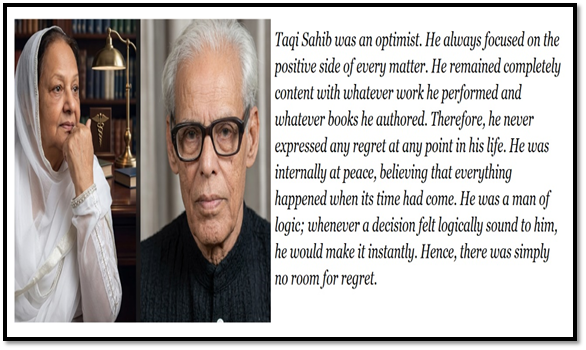
Taqi Sahib was an optimist. He always focused on the positive side of every matter. He remained completely content with whatever work he performed and whatever books he authored. Therefore, he never expressed any regret at any point in his life. He was internally at peace, believing that everything happened when its time had come. He was a man of logic; whenever a decision appeared logically sound to him, he would make it instantly. Hence, there was simply no room for regret.
ASK: Who were Taqi Sahib’s favorite authors and poets?
SS: Taqi Sahib’s favorite authors were: Aristotle, Bertrand Russell, Ibn Sina (Avicenna), Plato, and Edward Gibbon.
Taqi Sahib’s favorite poets were:
- Persian Poets: Rumi, Hafez, Urfi, Ferdowsi, and Qurratulain Tahirih.
- Arabic Poets: Imru' al-Qais al-Kindi.
- Urdu Poets: Amir Khusrow, Mir Taqi Mir, and Ghalib.
ASK: Which of Taqi Sahib’s projects or books remained incomplete?
SS: None of Taqi Sahib’s projects remained incomplete, save for one book that he had started a year before his death. He had already written several hundred pages of it, titled The New Concept of the Universe, which he could not finish before departing from this world.
(Dr Ahmed S. Khan —dr.a.s.khan@ieee.org — is a Fulbright Specialist Scholar)