Pakistan Link will publish 19 short biographical essays on some of the greatest spiritual luminaries in Islamic history, from Rābiʿa al-ʿAdawiyya to Jalāl al-Dīn Rūmī and Khwāja Muʿīn al-Dīn Chishtī. Together, these essays would form a coherent spiritual journey—from renunciation and detachment, to ecstatic divine love, and ultimately to the human calling to know, love, and serve God. These essays are condensed from a chapter in Professor Nazeer Ahmed’s recently completed book, Faith, Love and Reason in Islamic History.
Tasawwuf has been one of the great sustaining forces in Islamic history. In times of upheaval and decline, it preserved not only faith, but the inner life of faith, the longing, remembrance, and resilience that kept the lamp of Islam burning. Yet this luminous inheritance is increasingly lost to today’s youth amid modernity, secularism, materialism, war, and the relentless distractions of the digital age. It is our hope that this series will help rekindle that lost flame and inspire a new generation to rediscover the spiritual depths of their tradition. According to the eminent author of ‘Faith, Love and Reason in Islamic History’, Professor Nazeer Ahmed, “no lasting renewal of Muslim civilization can come without spiritual renewal. A civilization must awaken from within before it can rise again.”
Reclaiming our Spiritual Heritage…
15. Mawlānā Jalāl al-Dīn Rūmī: The Fire of Divine Love
By Prof Nazeer Ahmed
Concord, CA
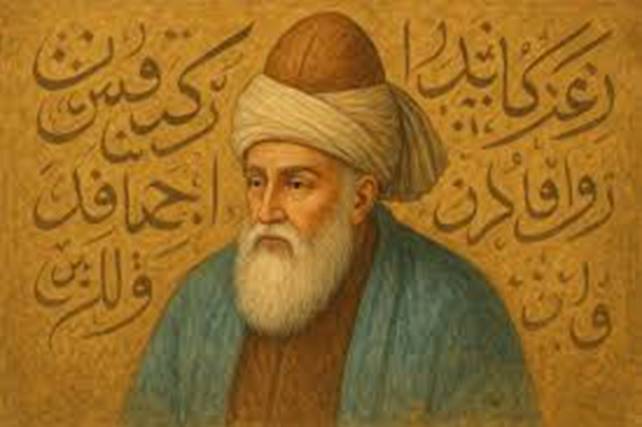
Among the saints, poets, and sages of Islamic spirituality, few have touched the hearts of humanity as profoundly as Mawlānā Jalāl al-Dīn Muḥammad Rūmī (1207–1273). To Muslims across the centuries, and increasingly to the wider world, Rūmī is not merely a poet of mystical symbolism but a profound interpreter of the soul’s longing for God. If Khwāja Muʿīn al-Dīn Chishtī embodies the social radiance of compassion, and ʿAbd al-Qādir al-Jīlānī the majesty of sober sainthood, Rūmī represents the inner fire of love, the transformative power of longing, surrender, and remembrance. In him, Sufism speaks in a language at once intimate and cosmic, tender and overwhelming, rooted in the Qur’an yet soaring into the boundless skies of spiritual symbolism. His genius lies in making the path felt as much as understood, conveying both its ache and its ecstasy.
Rūmī was born in 1207 in Balkh, in the Persianate East, into a family of scholarship and spiritual distinction. His father, Bahāʾ al-Dīn Walad, was a respected scholar and preacher with mystical sensibilities. The early thirteenth century was a time of upheaval: Mongol invasions were beginning to transform the Islamic East, displacing peoples and shattering political centers. Rūmī’s family migrated westward, traveling through Nishapur, Baghdad, and the Hijaz before settling in Konya, then part of the Seljuk Empire. This trajectory of exile and displacement profoundly shaped Rūmī’s worldview, embedding in his poetry the motif of the soul in exile, separated from its source, yearning for return.
In Konya, Rūmī received a classical Islamic education, mastering jurisprudence, Qur’anic studies, and preaching, ultimately succeeding his father as a teacher and religious authority. Yet his intellectual accomplishment alone did not define his path. The decisive turning point came in 1244 CE, when he met the wandering dervish Shams al-Dīn of Tabriz. This encounter ignited a spiritual fire within Rūmī, shattering the equilibrium of his learned religiosity and opening him to a depth of longing that would transform him into one of the greatest poets of divine love.
From a Sufi perspective, the relationship with Shams exemplifies a central truth: the heart often awakens through the presence of another heart already consumed by God. Shams acted as mirror and catalyst, a site of divine disclosure. Their intensity provoked jealousy, and Shams eventually disappeared, likely murdered or forced away. Yet this apparent loss became Rūmī’s spiritual gain. Grief was transmuted into poetry, song, and continuous remembrance. The human attachment to form was replaced by awareness of the formless Source. In losing the friend, he discovered the Beloved.
At the heart of Rūmī’s teaching is love as the engine of spiritual transformation. Love is not merely an emotion or moral virtue but the very structure of reality, the force by which creation returns to its origin. The soul longs because it remembers; it weeps because it is separated. The opening lines of the Mathnawī, in which the reed laments its severance from the reed bed, have become one of the most enduring symbols in mystical literature: the human being is hollowed by suffering, yet made capable of song and union precisely through loss. Longing itself is proof of origin.
The Mathnawī-yi Maʿnawī has been called the “Qur’an in Persian,” not as a formal exegesis but for the depth with which it conveys Qur’anic meanings through story, parable, and spiritual commentary. It moves associatively, spirally, and unpredictably, mirroring the heart’s movement. Yet beneath this fluidity lies coherence: the transformative power of love, the death of the ego, the limitations of reason without love, the spiritual guidance of the master, the certainty that multiplicity yearns toward unity recur as central themes.
Like Ibn ʿArabī, Rūmī is a metaphysician of divine presence, but his medium is the language of love, symbol, and lived experience rather than technical ontology. Reason is useful but secondary; it cannot alone traverse the threshold into God’s mysteries. The heart, purified and receptive, surpasses the calculating mind, embracing surrender and direct experience. Paradox permeates Rūmī’s teaching, not to abolish intellect but to prepare it for the higher intelligence of love.
Rūmī embodies the Sufi distinction between ʿilm (formal knowledge) and maʿrifah (gnosis). Having mastered outward learning, Shams opened him to inward realization. Poetry, parable, and spiritual practice become the vessels of gnosis. He repeatedly warns that religion without inner transformation remains incomplete. Correct ideas are necessary but insufficient; the self must be broken and remade, “cooked” by longing and surrender, not left raw.
The Mevlevi practices, especially the samāʿ or whirling dance, symbolize this cosmic remembrance: the soul revolves around the divine center, relinquishing self-centeredness, harmonizing with existence itself. Poetry, music, silence, and movement alike aim to awaken the heart to the Beloved.
Rūmī’s influence on Islamic civilization is immense and multi-layered. His poetry shaped Persian, Turkish, and later Urdu mystical literature, embedding sacred longing as the central language of devotion. Through the Mevlevi order, his teachings influenced Ottoman religious, artistic, and social life. Yet his reach extended beyond institutional boundaries: countless readers unaffiliated with any ṭarīqah have found in his work a map of the soul’s journey.
In modern times, Rūmī is globally recognized, though often decontextualized, reduced to a poet of universal feeling. The authentic Rūmī, however, is rooted in the Qur’an, the Prophet, and Sufi disciplines. His universe is profoundly Islamic: saturated with Qur’anic imagery, prophetic love, and the practices of remembrance, surrender, and ego-annihilation. Thinkers such as Seyyed Hossein Nasr emphasize that Rūmī’s universality arises not from abandonment of Islam, but from complete immersion in its spiritual depths, revealing truths accessible to every sincere heart.
Ultimately, Rūmī endures because he addresses the soul’s fundamental drama: separation and return. Restlessness is meaningful, grief becomes transformative, longing is itself remembrance, and love is the fire that consumes the false self. If Chishtī teaches the heart to serve others, Rūmī teaches that the heart must first be broken open by the Beloved. For the Sufi tradition, he remains a luminous witness to ʿishq, divine love as ontological transformation. His poetry, parable, and music remind seekers that the journey to God is not a march of cold certainty but a dance of surrender. Across the centuries, his voice continues to call the exiled soul home.
(The author is Director, World Organization for Resource Development and Education, Washington, DC; Director, American Institute of Islamic History and Culture, CA; Member, State Knowledge Commission, Bangalore; and Chairman, Delixus Group)