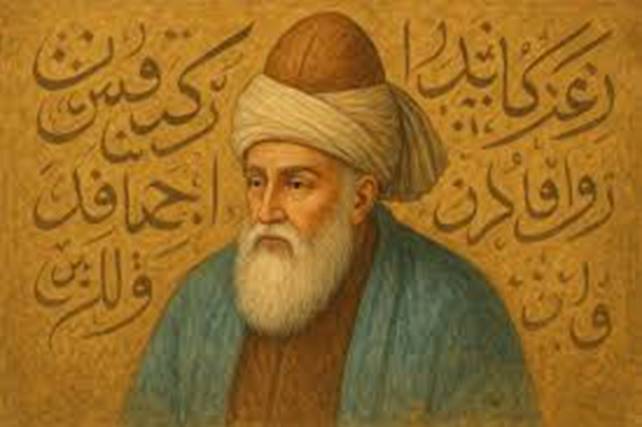
Pakistan Link will publish 19 short biographical essays on some of the greatest spiritual luminaries in Islamic history, from Rābiʿa al-ʿAdawiyya to Jalāl al-Dīn Rūmī and Khwāja Muʿīn al-Dīn Chishtī. Together, these essays would form a coherent spiritual journey—from renunciation and detachment, to ecstatic divine love, and ultimately to the human calling to know, love, and serve God. These essays are condensed from a chapter in Professor Nazeer Ahmed’s recently completed book, Faith, Love and Reason in Islamic History.
Tasawwuf has been one of the great sustaining forces in Islamic history. In times of upheaval and decline, it preserved not only faith, but the inner life of faith, the longing, remembrance, and resilience that kept the lamp of Islam burning. Yet this luminous inheritance is increasingly lost to today’s youth amid modernity, secularism, materialism, war, and the relentless distractions of the digital age. It is our hope that this series will help rekindle that lost flame and inspire a new generation to rediscover the spiritual depths of their tradition. According to the eminent author of ‘Faith, Love and Reason in Islamic History’, Professor Nazeer Ahmed, “no lasting renewal of Muslim civilization can come without spiritual renewal. A civilization must awaken from within before it can rise again.”
Reclaiming our Spiritual Heritage…
- Shihāb al-Dīn al-Suhrawardī
By Prof Nazeer Ahmed
Concord, CA
Among the great figures of Islamic spirituality and metaphysics, Shihāb al-Dīn Yaḥyā al-Suhrawardī (1154–1191) occupies a singular place. Though often remembered primarily as a philosopher, he belongs just as deeply to the inward world of the Sufis, for his life and teachings were devoted to a truth beyond mere conceptual thought: the direct illumination of the soul by divine light. Later generations called him Shaykh al-Ishrāq, the “Master of Illumination,” and also al-Maqtūl, “the Slain One,” because his short life ended in execution. Yet his death only intensified his presence in the Islamic imagination. To later seekers, Suhrawardī became a witness that true wisdom is not merely argued but tasted, not only reasoned but unveiled, and that the highest knowledge is inseparable from spiritual transformation.
Suhrawardī was born in the town of Suhraward in northwestern Iran during the twelfth century, a period of extraordinary intellectual vitality in the Islamic world. The philosophical systems of al-Fārābī and especially Ibn Sīnā (Avicenna) still dominated the landscape of speculative thought, while Sufism had matured into a powerful spiritual current, producing masters who insisted that the truths of religion must be realized inwardly, not merely affirmed outwardly. This was also the post-Ghazālian age, when the prestige of pure rationalism had been challenged and the inward path more firmly established within Orthodox Islam. It was in this rich and contested world that Suhrawardī emerged.
He received a classical education in logic, philosophy, and the rational sciences, mastering the Ibn Sina tradition with remarkable brilliance. Yet he was never content to remain within the boundaries of scholastic reasoning alone. Traveling widely through Persia, Anatolia, and Syria, he encountered scholars, sages, and ascetics, and gradually formed a vision that sought to reunite what had too often been divided: the rigor of the intellect and the illumination of the heart. For Suhrawardī, the highest wisdom was neither the exclusive possession of philosophers nor the purely emotional privilege of mystics. It was the fruit of an intellect disciplined by study and purified by spiritual realization. In this sense, he stands as one of the great reconciling figures in Islamic thought: a philosopher with the soul of a gnostic, and a mystic with the precision of a metaphysician.
The heart of Suhrawardī’s teaching is contained in the name of his school: Ishrāq, or Illumination. He taught that reality is best understood not merely through the categories of substance and accident, but through the metaphysics of light. At the summit of all existence stands the Light of Lights (Nūr al-Anwār), the supreme source from which all lesser lights proceed. The universe is a vast hierarchy of luminosity: the nearer a being is to the divine source, the more intense its light; the more immersed in material limitation, the dimmer and more shadowed its mode of existence. Darkness is not an independent reality, but the attenuation or privation of light.
This doctrine was not simply speculative metaphysics. It was, in essence, a Sufi cosmology. For Suhrawardī, the human soul is itself a luminous reality, a stranger in the world of bodily darkness, yearning to return to its higher homeland. The spiritual path is therefore a journey of remembrance, purification, and ascent. Through detachment, contemplation, inner discipline, and divine grace, the soul awakens to its true nature and rises through the degrees of light. Here Suhrawardī speaks unmistakably in the language of the Sufis: the path is one of unveiling (kashf), inward refinement, and intimate knowledge of God. Yet unlike many mystics, he sought to give this journey a full metaphysical architecture. What the Sufi tastes in ecstasy, Suhrawardī sought to describe in a language the disciplined intellect could also follow.
In this project, the influence of Ibn Sīnā is unmistakable. Suhrawardī inherited from Ibn Sina a profound respect for reason, demonstration, and philosophical coherence. He accepted that the world is intelligible and that the human mind is capable of genuine knowledge. Yet he also believed that Ibn Sina’s philosophy, for all its brilliance, did not reach the summit. It could analyze and infer, but it could not by itself confer the certainty that comes only through illumination. Reason, for Suhrawardī, is indispensable, but not sovereign. It prepares the path, disciplines the seeker, and protects against confusion. But the highest truths are not merely deduced; they are witnessed. True wisdom arises when rational inquiry is completed by inner unveiling.
This is what makes Suhrawardī so important in Islamic intellectual history. He neither rejected philosophy in favor of anti-intellectual mysticism nor reduced spirituality to symbolism within a rational system. Rather, he restored the ancient dignity of the intellect as a sacred faculty, an intellect that, when purified, becomes receptive to divine light. In this, he parallels the great Sufi masters who distinguished between ordinary discursive reasoning and the higher intelligence of the awakened heart. His originality lies in giving this intuition a fully articulated philosophical form.
Yet such a synthesis was not without danger. Suhrawardī eventually settled in Aleppo, where his brilliance and spiritual authority won the admiration of al-Malik al-Ẓāhir, the son of Ṣalāḥ al-Dīn (Saladin). But what attracted the prince alarmed the jurists. His boldness in disputation, his esoteric language, his appeal to ancient wisdom, and his union of philosophy and mystical insight made him suspect in an age anxious to preserve Orthodox orthodoxy amid political instability. The exact charges against him remain debated, but the broader truth is clear: Suhrawardī was executed because he embodied a form of sacred knowledge that exceeded the accepted categories of his time.
Later tradition remembered him as a martyr of wisdom. If al-Ḥallāj was the martyr of divine love, consumed in the fire of ecstatic utterance, Suhrawardī was the martyr of sacred intellect, slain for insisting that revelation, philosophy, and mystical vision converge in a higher unity. His death did not silence him; it gave his teachings a peculiar immortality.
Over the centuries, Suhrawardī’s philosophy of Illumination became one of the great living streams of Islamic metaphysics, especially in the Persianate world. Thinkers such as Shahrazūrī, Quṭb al-Dīn al-Shīrāzī, and later Mullā Ṣadrā drew deeply from his thought. His doctrine of light, his teaching on the soul’s ascent, and his influential concept of the imaginal world (ʿālam al-mithāl)—the intermediate realm between pure spirit and gross matter—proved especially fertile. In later Islamic philosophy, poetry, and spirituality, Suhrawardī became a guide to that subtle realm where symbols, visions, and archetypal realities disclose the hidden structure of existence.
In modern times, Suhrawardī has found one of his most important interpreters in Seyyed Hossein Nasr, who sees him as a supreme exponent of Islamic ḥikmah, or sacred wisdom—a wisdom that unites metaphysical rigor, spiritual realization, and fidelity to revelation. In an age that reduces reason to calculation, Suhrawardī reminds us that the intellect is more than analysis: it is a faculty of vision.
In the final analysis, Suhrawardī belongs to that noble company of Muslim sages who refused to choose between thought and devotion, reason and love, philosophy and the path to God. He inherited the legacy of Ibn Sīnā, but led it inward, toward the dawn of illumination. He died young, yet left behind a universe of meaning in which the soul is a pilgrim of light and all existence is a descending radiance from the One. For the Sufi tradition, he remains one of the great witnesses that true knowledge is not cold abstraction, but luminous awakening.
(The author is Director, World Organization for Resource Development and Education, Washington, DC; Director, American Institute of Islamic History and Culture, CA; Member, State Knowledge Commission, Bangalore; and Chairman, Delixus Group)