Book & Author
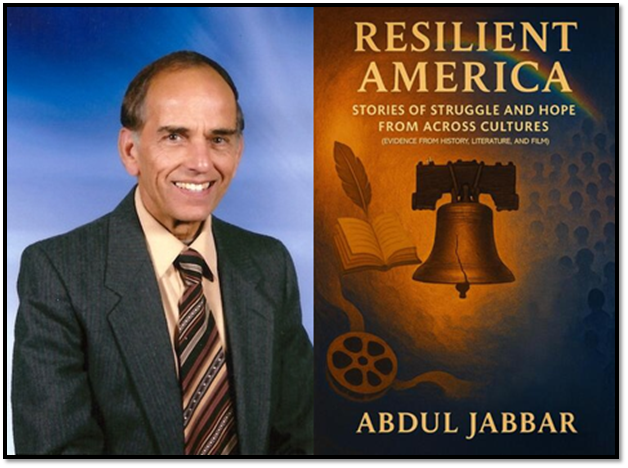
Abdul Jabbar: Resilient America — Stories of Struggle and Hope from Across Cultures(Evidence from History, Literature, and Film)
By Dr Ahmed S. Khan
“Rights are typically not granted, but rather won, by
dedicated and informed popular struggle.”
In Resilient America — Stories of Struggle and Hope from across Cultures Professor Abdul Jabbar paints a vivid picture of the American experience, depicting the diverse facets of its cultures and histories. His canvas captures a wide spectrum of American life through a rich mosaic of narratives, films, and essays, ultimately creating a work that promotes active learning and engaged teaching.
Dr Abdul Jabbar is an Emeritus Professor of English and Interdisciplinary Studies at the City College of San Francisco, where he taught full-time for 36 years and served as department chair. A recipient of a prestigious Fulbright scholarship and two National Endowment for the Humanities awards, he earned his PhD in English from Case Western Reserve University.
Throughout his career—which includes a visiting professorship at UC Berkeley—Dr Jabbar has championed multicultural education and social justice. Beyond his extensive academic writing on reconciliation and cultural diversity, he served as Board Chair for the Central Asia Institute, advocating for regional literacy. His full biographical profile is posted at professorjabbar.com .
In addition to a preface and conclusion, the book comprises ten chapters spanning 650 pages. The chapters include: (1) Introduction: What Is Needed to Make the Potential; (2) America’s Diversity: Cultural and Ethnic Groups; (3) The American Dream; (4) The Colonization of America and Parts of Oceania; (5) Immigration: Separation from Home and Search for a New Home; (6) Prejudice and Racial Stereotypes; (7) Intersecting Identities; (8) The Struggle for Equity, Recognition, and Inclusion; (9) American People’s Struggle for a Just US Foreign Policy; and (10) What Makes America Great. Each chapter has a list of readings and viewing. The book concludes with an appendix titled 'Essential Components of Interpretation in Analyzing Literature and Movies.'"
In the foreword, Karen C. Cox, Professor and Chair, Department of English, City College of San Francisco, observes that in the Spring 2019 semester, a City College of San Francisco instructor utilized Dr Abdul Jabbar’s "American Cultures" reader for an interdisciplinary course. Students highly praised the textbook for its engaging content and diverse selection of literature, which includes short stories, poems, essays, and speeches representing all major US cultural groups. The anthology successfully stimulates dialogue while fostering open-mindedness and global understanding. Highly versatile, it serves as an ideal resource for both American Cultures and composition instructors, offering an extensive section dedicated to critical reading and impactful writing. It remains an unparalleled, comprehensive resource for future teaching.
In the preface the author outlines the purpose, design, and history of the interdisciplinary textbook. Written for students and lifelong learners, the book explores the cultural and ethnic history of the United States through history, literature, and film. It directly confronts the disparity between America's democratic promise and its historical realities—such as systemic racism and colonization—by centering the experiences and struggles for justice of Native, African, Latin, Asian, Middle Eastern, European, and Pacific Islander Americans, alongside LGBTQ+ and feminist movements.
The book’s genesis stems from a historic 1987 student-led grassroots movement at UC Berkeley that established the "American Cultures" graduation requirement. Inspired by this initiative, the author developed a course and class reader at the City College of San Francisco, refining the material over decades of field testing.
Organized thematically across ten chapters, the book is available in both print and digital formats. To keep the textbook affordable and avoid a prohibitive price tag, the author designed it as an e-book that utilizes free, external links for its literary and film selections. These links are curated at the end of each chapter to ensure reading flow, are mirrored on his website for print readers, and are regularly updated online to maintain contemporary relevance.
Ultimately, the book advocates for rigorous humanities and social sciences education as the primary tool to dismantle prejudice and binary "us versus them" thinking. Embracing the optimistic "failure to quit" philosophy of historian Howard Zinn, the text emphasizes that continuous civic action is vital, even if systemic changes are not fully realized within a reformer's lifetime.
Chapter One, “Introduction: What Is Needed to Make the Potential of America a Reality,” begins with the United States’ Declaration of Independence, framing its focus on human rights as a brilliant achievement worthy of global emulation. The text positions the Declaration as a vital touchstone to recall whenever the government introduces draconian measures that curtail citizens' freedom. The author highlights the stark gap between America’s democratic promise and its reality, addressing critical issues like systemic racism, historical injustices, rampant inequalities, leadership failures, and foreign policies that spend national wealth on wars rather than domestic needs. To bridge this divide, the author calls for reparations, social justice, global responsibility, and an educational focus on literature and history that accurately reflects the nation’s struggles. The chapter concludes by outlining progressive legislative steps to eradicate racism and foster global consciousness.
Chapter Two, “America’s Diversity: Cultural and Ethnic Groups,” provides a comprehensive overview of the major ethnic and cultural groups in the United States. It explores the historical struggles and achievements of Native Americans, African Americans, Latin Americans, Asian Americans, Middle Eastern Americans, and American Pacific Islanders. Emphasizing the importance of understanding these diverse cultural backgrounds, the author illustrates how each group has shaped the nation's history. The author calls for greater recognition, equity, and inclusion for all citizens, urging readers to appreciate the complex cultural mosaic of America while confronting the painful legacies of prejudice and colonization.
Chapter Three, “The American Dream,” explores the evolution of the American Dream and its varied impacts on different cultural groups. The author discusses how this ideal has served as a powerful source of inspiration for some and a profound cause of disillusionment for others. By tracking the unique experiences of Native, African, Latin, Asian, and Middle Eastern Americans, the chapter highlights how systemic barriers—such as racism, economic inequality, and social injustices—disrupt access to opportunity. Ultimately, the text calls for a more inclusive and equitable reimagining of the American Dream that honors the contributions and struggles of all communities.
Chapter Four, “The Colonization of America and Parts of Oceania (Pacific Islands),” examines the devastating consequences of European colonization on Native Americans and Pacific Islanders, cataloging the severe loss of life, ancestral lands, and indigenous cultures. The author spotlights the historical resistance and resilience of these communities, highlighting Native American armed resistance alongside Pacific Islanders’ efforts to preserve their cultural identities. Additionally, the chapter covers the courageous European Americans who risked their careers to defend indigenous rights, addresses the environmental degradation caused by colonial exploitation, and calls for reparations and sustainable reconciliation to heal these historical wounds.
Chapter Five, “Immigration: Separation from Home and Search for a New Home,” captures the immigrant experience and the profound emotional and physical challenges of leaving a homeland. The chapter delves into the pain of family separation, the friction of cultural adaptation, and the persistent barriers of discrimination and prejudice. Concurrently, the author celebrates the vast cultural and economic contributions that immigrant groups make to American society, advocating for empathetic public policies that support their integration and well-being.
Chapter Six, “Prejudice and Racial Stereotypes,” delves into the pervasive biases that marginalize communities across America. It examines the institution of slavery as the nation's "cardinal sin" and links it directly to the rise of white supremacy, demonstrating how modern racism is an invented concept. The text discusses The 1619 Project at length to counter the historical erasure of Black Americans prior to 1776 and applies Critical Race Theory to add nuance to contemporary discussions of race. Finally, it analyzes how media, literature, and social norms perpetuate harmful stereotypes against Black, Indigenous, Latinx, Asian, Middle Eastern, Jewish, and LGBTQ+ communities, calling for systemic educational reform to dismantle these prejudices.
Chapter Seven, “Intersecting Identities,” introduces the concept of intersectionality, exploring how overlapping identities shape an individual's self-image and societal treatment. The author discusses how combinations of race, ethnicity, gender, sexuality, and class influence lived experiences. The text explicitly points out how certain combined traits act as systemic mechanisms of empowerment and privilege (e.g., whiteness, high economic status, advanced education, standard speech patterns), whereas other combinations connote marginalization, underscoring the need for cross-identity solidarity to achieve true social justice.
Chapter Eight, “The Struggle for Equity, Recognition, and Inclusion,” focuses on historical and contemporary civil rights activism. It highlights the abolitionist sacrifices of Black slave preacher Nat Turner and white preacher John Brown, framing their joint effort to end slavery as one of the most significant cross-racial alliances in US history. The chapter further explores systemic change through the legacies of luminaries like Paul Robeson, Dr Martin Luther King, Jr., and Malcolm X. The author emphasizes that passing structural policy changes and securing reparations for Native and African Americans are vital, non-negotiable milestones for national equity.
Chapter Nine, “American People’s Struggle for a Just US Foreign Policy,” examines how American military interventions overseas impact foreign nations and shape the lives of immigrants originating from them. Noting that the US has engaged in regime-change operations in over seventy countries since World War II, space constraints limit the chapter's focus to five specific regions: the Philippines, Vietnam, Iraq, Pakistan, and Palestine. The author details how these interventions generate global instability and refugees, which subsequently overburdens the domestic immigration system.
The latter portion of the chapter critiques US complicity in the Israeli military actions in Palestine, citing findings from Amnesty International, Human Rights Watch, and B'Tselem that label the conflict a genocide. It notes that by June 2025, over 52,000 Palestinians had been killed—nearly 30% of them women and children—amid a humanitarian blockade on Gaza enforced in defiance of the UN Security Council. Finally, the author condemns the US government's suppression of domestic dissent, arguing that criminalizing criticism of Israel and detaining peaceful anti-war protestors violates constitutionally protected free speech.
Chapter Ten, “What Makes America Great,” features eight reformist individuals who have championed human rights in recent US history. Rather than focusing on the well-documented contributions of the Founding Fathers or history-making presidents like Abraham Lincoln, the author honors lesser-known or heavily system-critiqued heroes whose values represent the true potential of the nation. These figures include:
- Dr Martin Luther King, Jr., Malcolm X, Toni Morrison, and Muhammad Ali: Four individuals of African origin who leveraged their platforms to fight for civil rights, structural justice, and cultural expression.
- Leslie Marmon Silko and Oscar Lopez Rivera: A Native American author and a Puerto Rican activist, respectively, who resisted the colonial subjugation of their peoples.
- Fred Korematsu: A Japanese American who spent over forty years successfully fighting to overturn his wrongful Supreme Court conviction stemming from WWII internment.
- Rachel Corrie: A 23-year-old American student and peace activist who made the ultimate sacrifice when she was crushed to death by an Israeli army bulldozer while peacefully protesting the demolition of Palestinian homes.
By documenting their sacrifices, the author explains how these individuals embody the true, definitive greatness of the American spirit.
Discussing “Why US Lost Global Sympathy and American People’s Backing” the author observes that United States bypasses the United Nations to invade Iraq on false pretexts, severely damaging its global prestige. World sympathy eroded following civilian casualties and the Abu Ghraib torture scandal. Domestically, the Pentagon faced severe backlash for failing to supply field commanders with requested body armor, which could have saved 80% of killed Marines. Next to World War II, the invasion became the second most expensive conflict in US history, costing $750 billion by 2007. Critics and journalists condemn the invasion of this historic "cradle of civilization" as a grave moral crime. Two decades later, Iraq remains a deeply fractured, destroyed nation plagued by sectarian violence and the rise of ISIS. Analysts attribute the catastrophe to a complete failure by US strategists to understand Iraqi political realities, creating a devastating power vacuum by failing to plan past the initial invasion.
Reflecting on the first major US Regime-Change Operation (July 1977) in Pakistan, the author notes: “On July 5, 1977, the US government used the then Pakistan’s army chief Gen Zia-ul-Haq to overthrow the democratic government of Zulfiqar Ali Bhutto. Bhutto was subsequently hanged on unconvincing charges. This operation was planned in the US Embassy in Pakistan on July 4, 1977. The democratic government of Pakistan was overthrown the next day. US carried out Henry Kissinger’s threat to Bhutto: ‘We will make an example of you’ if he did not stop pursuing nuclear weapons. Bhutto was attempting to develop a nuclear bomb to maintain the balance of power after India had detonated its nuclear device.”
Commenting on the Second Major US Regime-Change Operation (April 2022) in Pakistan, the author notes that when a superpower executes a regime-change operation, its immediate strategy is denial, followed by narrative spin once investigative journalists expose the truth. This exact pattern occurred following the April 2022 ouster of Pakistani Prime Minister Imran Khan. Despite initial official denials, an August 2023 report by The Intercept revealed a leaked secret cable proving the US government pressured and colluded with Pakistan's Army Chief, General Qamar Javed Bajwa, to remove Khan. Backed by numerous meetings between US consular staff and anti-Khan dissidents, this foreign interference destabilized the democracy, yielding disastrous consequences for Pakistan's citizens.
The author notes that despite ongoing denials from the United States, the strategic motives behind the removal of Pakistani Prime Minister Imran Khan stem from his pivot toward an independent foreign policy. Historically, Pakistan operated as a subservient, US-dependent state. Khan altered this dynamic by asserting strategic neutrality, barring foreign military bases, and rejecting participation in the costly US "War on Terror," which had devastated Pakistan’s infrastructure and claimed 80,000 lives.
The primary catalyst for US hostility was Khan's refusal to cancel a long-scheduled visit to Moscow on the eve of the Ukraine invasion—a trip intended to secure heavily discounted wheat and gas for his inflation-weary citizens. Western leaders demanded he condemn Vladimir Putin, but Khan maintained strict neutrality, offering instead to act as a diplomatic mediator. The US labeled this stance "aggressive neutrality," a position it deemed unacceptable for a traditional vassal state. Khan further irritated Washington by deepening economic ties with China and publicly declaring that Pakistan was not a "slave nation." Guided by a rigid "with us or against us" doctrine, the US used aggressive threats against Khan that it typically avoids leveraging against larger neutral nations like India, targeting his sovereignty.
The author observes that the US-backed ouster of Imran Khan pleased only a fraction of Pakistan’s military elite and corrupt politicians, while alienating 250 million citizens and pushing the nation toward bankruptcy. Under Khan’s unselfish leadership, Pakistan achieved 7% economic growth, drastically reduced its national deficit, generated six million jobs, and instituted globally recognized poverty alleviation programs like Ehsaas. He also eradicated internal terrorism by halting US drone strikes and refusing participation in the devastating "War on Terror."
Following his removal, human rights violations—including the detention and torture of political leaders—prompted sharp condemnation from US Congressional figures like Brad Sherman. The author parallels this geopolitical decline with cultural critiques from the film A Mighty Heart and Mohsin Hamid’s novel The Reluctant Fundamentalist, noting how aggressive US foreign operations routinely convert friendly populations into adversaries, collapse democracies, and inevitably result in a "spectacular failure" for US global interests.
Discussing US complicity in Israel’s military campaign in Gaza, the author states that it has ignited a massive global solidarity movement, mirroring the 1960s anti-war protests. Activists across all demographics oppose the onslaught, which Euro-Med Human Rights Monitor reported surpassed the World War II bombings of Dresden, Hamburg, and London combined, utilizing over 70,000 tons of US-supplied explosives.
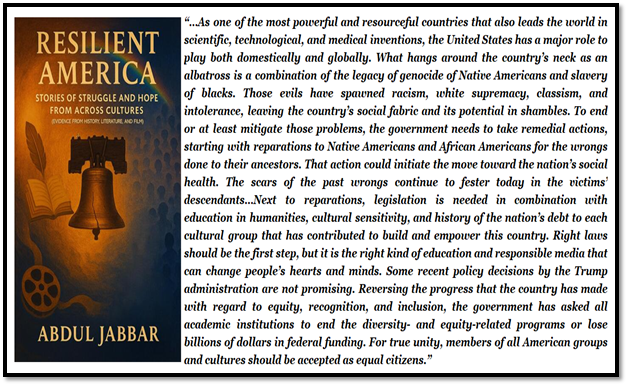
The book reviews the historical struggle for justice by major US cultural groups, aiming to align the nation's reality with its democratic promise. A legacy of slavery and Native American genocide continues to fuel systemic racism. To heal, the text advocates federal reparations, robust humanities education, and an inclusive national identity where all ethnic groups are recognized as equal citizens.
The book calls for urgent foreign policy reforms, serious environmental action grounded in indigenous wisdom, and sustained popular struggle to fulfill America's true potential.
Resilient America: Stories of Struggle and Hope from across Cultures (Evidence from History, Literature, and Film) by Professor Abdul Jabbar is a versatile text that weaves history, literature, and cinema into a cohesive, dialogue-driven narrative. The book explores the historical and cultural struggles of major US ethnic groups fighting for equity and inclusion. By analyzing systemic racism, foreign policy failures, and the climate crisis, Professor Jabbar bridges historical injustices with contemporary realities to offer a vision of national unity, healing, and progressive reform.
A unique feature of this work is its multimodal approach, which leverages the aesthetic power of literature and film to validate raw, unvarnished historical narratives. This methodology aligns the book with critical histories by scholars like Howard Zinn and Ronald Takaki. Essential for general readers, Resilient America is also an ideal undergraduate textbook for courses in ethnic studies, modern American history, American foreign policy, social justice, film studies, and contemporary literature.
(Dr Ahmed S. Khan — dr.a.s.khan@ieee.org — is a Fulbright Specialist Scholar)