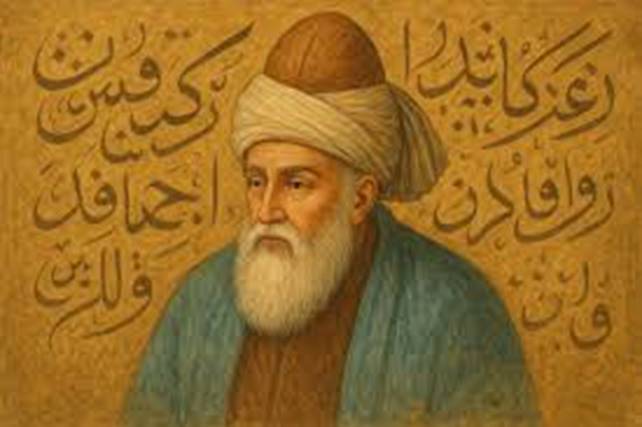
Pakistan Link will publish 19 short biographical essays on some of the greatest spiritual luminaries in Islamic history, from Rābiʿa al-ʿAdawiyya to Jalāl al-Dīn Rūmī and Khwāja Muʿīn al-Dīn Chishtī. Together, these essays would form a coherent spiritual journey—from renunciation and detachment, to ecstatic divine love, and ultimately to the human calling to know, love, and serve God. These essays are condensed from a chapter in Professor Nazeer Ahmed’s recently completed book, Faith, Love and Reason in Islamic History.
Tasawwuf has been one of the great sustaining forces in Islamic history. In times of upheaval and decline, it preserved not only faith, but the inner life of faith, the longing, remembrance, and resilience that kept the lamp of Islam burning. Yet this luminous inheritance is increasingly lost to today’s youth amid modernity, secularism, materialism, war, and the relentless distractions of the digital age. It is our hope that this series will help rekindle that lost flame and inspire a new generation to rediscover the spiritual depths of their tradition. According to the eminent author of ‘Faith, Love and Reason in Islamic History’, Professor Nazeer Ahmed, “no lasting renewal of Muslim civilization can come without spiritual renewal. A civilization must awaken from within before it can rise again.”
Reclaiming our Spiritual Heritage…
Muḥyī al-Dīn Ibn ʿArabī (1165–1240), widely revered as al-Shaykh al-Akbar, stands at the pinnacle of Islamic metaphysical thought, synthesizing mysticism, philosophy, and spiritual psychology into a coherent vision of reality. While early Sufi figures like Junayd of Baghdad gave sobriety to the path, al-Ḥallāj expressed its ecstatic annihilation, and Shihāb al-Dīn Suhrawardī articulated the language of illumination, Ibn ʿArabī offered an intellectual architecture of unprecedented breadth and depth. His vision centers on the absolute oneness of God and the continuous self-disclosure (tajallī) of the Divine in creation, transforming the inward science of the Sufi path into a universal cosmology influencing Islamic spirituality, literature, and philosophy for centuries.
Born in Murcia in Muslim Spain during the waning Andalusian flowering, Ibn ʿArabī was immersed from childhood in an environment where law, philosophy, literature, and mysticism thrived in interrelation. The intellectual heritage of Andalusian thinkers such as Ibn Ṭufayl and Ibn Rushd provided a framework within which Sufism could expand. Early spiritual awakening led him to seek guidance from diverse masters, men and women alike, cultivating a receptivity that would characterize his universal approach: a vision grounded in Qur’anic revelation, yet capable of embracing multiplicity in divine wisdom wherever it manifests.
Ibn ʿArabī’s travels from North Africa to Mecca, Anatolia, and Damascus were more than geographic; they mirrored the inner journey of a seeker whose life unfolded as continual divine disclosure. His extensive corpus, most notably al-Futūḥāt al-Makkiyyah (The Meccan Openings) and Fuṣūṣ al-Ḥikam (The Bezels of Wisdom), constitutes a vast spiritual universe blending commentary, visionary insight, symbolic exegesis, metaphysics, and reflection on the lives of prophets and saints. These works function not merely as texts, but as living frameworks for understanding the stages and stations of spiritual realization.
At the core of Ibn ʿArabī’s thought is the principle that God alone is truly Real (al-Ḥaqq), and all creation exists only as a manifestation of the Divine Being. This insight, later formulated as waḥdat al-wujūd (“unity of existence”), does not imply pantheism or illusory creation; rather, it emphasizes the contingent, borrowed reality of all things. Every created form exists solely through God’s continuous self-disclosure, making the cosmos both real and dependent. For Ibn ʿArabī, tawḥīd is not merely theological assertion but the lens through which all perception and action are transformed. The Sufi sees multiplicity simultaneously as a veil and a revelation: forms may distract from the Source, yet each also manifests a divine sign (āyah).
This perspective generates the rich paradoxes of Ibn ʿArabī’s Sufism. God is utterly transcendent (tanzīh) yet intimately near (tashbīh). A mature spiritual intellect recognizes both poles, affirming the distinction between Creator and creation while perceiving the immanence of the Divine in all things. The cosmos becomes a mirror in which the hidden treasure of God is made visible. Central to this vision is the doctrine of the Perfect Human Being (al-Insān al-Kāmil), the one who reflects the totality of Divine Names. While all creatures manifest aspects of God, prophets and saints uniquely integrate these reflections, with the Prophet Muḥammad as the supreme exemplar—the eternal Muhammadan Reality through which creation itself is ordered. This cosmological principle extends the Sufi devotion to the Prophet into an ontological axis uniting history, metaphysics, and spiritual aspiration.
Ibn ʿArabī’s engagement with reason and intellect is nuanced. He revered philosophical inquiry, yet distinguished the higher intellect illuminated by divine unveiling from ordinary rationality. Reason discerns distinctions and avoids contradiction, but the ultimate realities of tawḥīd transcend conceptual categories. Symbolic, multivalent, and often paradoxical language in his writings is therefore not rhetorical obscurity but an epistemological necessity: reality surpasses linear logic, and comprehension requires purification of the heart, ethical discipline, and contemplative receptivity.
His ideas have historically provoked both admiration and caution. Jurists and theologians sometimes feared misinterpretation of terms such as waḥdat al-wujūd and ʿālam al-khayāl (the imaginal realm), yet his influence endured through generations of interpreters. Ṣadr al-Dīn al-Qūnawī, ʿAbd al-Karīm al-Jīlī, Dāwūd al-Qayṣarī, and Jāmī, among others across Persia, the Ottoman world, and the Indian subcontinent, expanded and systematized his vision. His frameworks for understanding the relationship between God, cosmos, and human soul shaped metaphysics, psychology, and the inner science of the path. The imaginal realm, a mediating dimension between pure spirit and physical reality, provided a durable interpretive space for mystical experience, artistic symbolism, and scriptural exegesis.
Ibn ʿArabī’s influence on Islamic art, literature, and civilization is equally profound. His metaphysics inspired Persian, Turkish, and Urdu poetry, particularly in expressions of divine love and symbolic cosmology. Sufi music, devotional practices, and literary traditions drew on his vision of the world as both a manifestation of divine Names and a vehicle for spiritual transformation. In the realm of spiritual psychology, his reflections on the heart, imagination, and stages of growth established principles that continue to inform Sufi pedagogy. Even critics were compelled to clarify their own positions in relation to his thought, underscoring the intellectual force of his legacy.
Modern interpreters, including Seyyed Hossein Nasr, continue to highlight Ibn ʿArabī’s relevance. In an era dominated by secularization and materialist reductionism, he presents a vision of existence as inherently sacred, symbolic, and transparent to the Divine. Nasr emphasizes that Ibn ʿArabī does not advocate vague mysticism or pantheistic collapse, but disciplined contemplation rooted in revelation—a holistic approach uniting metaphysics, ethics, and the inward path. Through contemporary scholarship, Ibn ʿArabī remains a bridge between the classical wisdom of Islam and modern spiritual-intellectual inquiry.
Ultimately, Ibn ʿArabī represents the apogee of Sufi intellectual and spiritual synthesis. He integrates dhikr, metaphysics, love, and cosmology into a comprehensive vision that recognizes multiplicity without negating unity. The world is not a barrier but a manifestation of God; the human being is called to become a perfect mirror of divine Names; and true knowledge is transformative, ethical, and experiential. Through his writings, Sufism emerges as both a path of the heart and a universal cosmology, offering a vision of reality in which divine presence permeates all existence. Ibn ʿArabī’s enduring legacy lies in his ability to reconcile the transcendental and the immanent, the particular and the universal, guiding humanity toward the One who alone truly is.
(The author is Director, World Organization for Resource Development and Education, Washington, DC; Director, American Institute of Islamic History and Culture, CA; Member, State Knowledge Commission, Bangalore; and Chairman, Delixus Group)