Book & Author
Syed Muhammad Taqi: Essays in Philosophy
By Dr Ahmed S. Khan
“Philosophy is a battle against the bewitchment of our intelligence by means of language” – Ludwig Wittgenstein
“Science is what you know. Philosophy is what you don't know” – Bertrand Russell
Expounding on the nature and importance of Philosophy, John Dewey (1859 - 1952) the great 20th Century American philosopher, had observed: “ Philosophy is therefore the last and highest term in pure contemplation. Whatever may be said for any other kind of knowledge, philosophy is self-enclosed. It has nothing to do beyond itself; it has no aim or purpose or function—except to be philosophy—that is, pure, self-sufficing beholding of ultimate reality. There is of course such a thing as philosophic study which falls short of this perfection…Poetry, art, religion are precious things. They cannot be maintained by lingering in the past and futilely wishing to restore what the movement of events in science, industry and politics has destroyed. They are an out-flowering of thought and desires that unconsciously converge into a disposition of imagination as a result of thousands and thousands of daily episodes and contact. They cannot be willed into existence or coerced into being…We are weak today in ideal matters because intelligence is divorced from aspiration. The bare force of circumstance compels us onwards in the daily detail of our beliefs and acts, but our deeper thoughts and desires turn backwards. When philosophy shall have cooperated with the course of events and made clear and coherent the meaning of the daily detail, science and emotion will interpenetrate, practice and imagination will embrace. Poetry and religious feeling will be the unforced flowers of life. To further this articulation and revelation of the meanings of the current course of events is the task and problem of philosophy in days of transition.”
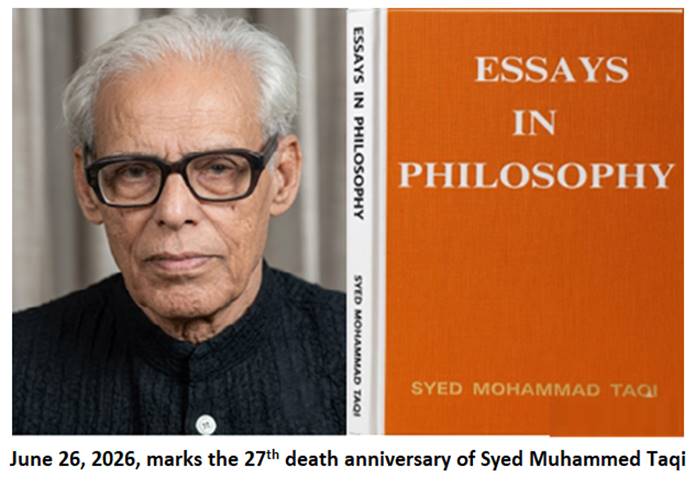
Syed Muhammad Taqi (3, 1917: Amroha, British India – June 26, 1999: Karachi, Pakistan) was a distinguished philosopher, intellectual, journalist, and author. Born in Amroha, British India, he later migrated to Karachi, Pakistan, where he spent the rest of his life.
Taqi Sahib holds a unique distinction among both Eastern and Western thinkers as the first modern philosopher of the East to expound a fully consistent, internally coherent system of the universe. His comprehensive philosophical framework seamlessly integrated history, epistemology (the theory of knowledge), and cosmology.
He belonged to a highly illustrious literary family. His father, Shafiq Hasan Elia, was a prominent scholar of Amroha, and his renowned brothers included the celebrated intellectual Rais Amrohvi (1914–1988) and the legendary poet Jaun Elia (1931–2002).
Syed Muhammad Taqi was a philosopher par excellence and a prolific writer who dedicated his life to propagating logic and reasoning. Remarkably, he was the first and only philosopher to popularize and promote the domain of philosophy through the Urdu language. His extensive body of work spanned economics, politics, sociology, constitutional theory, and literary criticism. For over 20 years, he also served as the Editor-in-Chief for the Daily Jang, Pakistan's leading Urdu newspaper.
Three of his core philosophical books—compiled from his insightful newspaper articles—received global acclaim. His major publications include:
- Rooh aur Falsafa (Soul and Philosophy) — 1962: An early exploration of metaphysics and thought.
- Hindustan: Pas-manzar wa Pesh-manzar (India: Past and Future) — 1968: A widely celebrated work that earned him the prestigious Adamjee Literary Award.
- Mantiq, Falsafa aur Science (Logic, Philosophy, and Science) — 1970: A seminal work bridging rational thought and modern science.
- Tareekh aur Kainat: Mera Nazaria (History and the Universe: My Viewpoint) — 1973: Widely regarded as his magnum opus. In this book, he devised a sound, rational philosophical system centering on the human mind and society, covering all facets of humanity's philosophical quests.
- Nahj al-Balagha ka Tasawwur-e-Uloohiyat (The Concept of Divinity in Nahj al-Balagha) — 1977
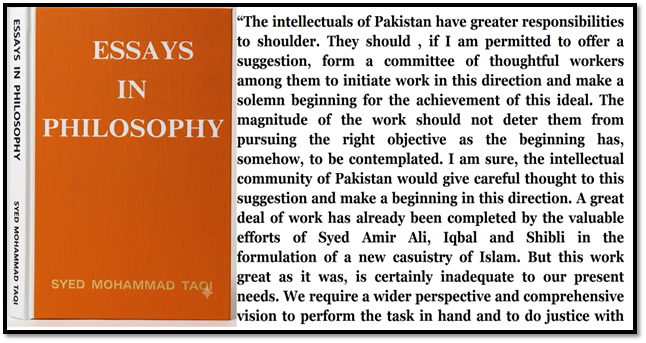
- Essays in Philosophy — 1981: Published originally in English, expanding his reach to a global audience.
- Karbala... Tehzeeb ka Mustaqbil (Karbala... The Future of Civilization) — 2017: Published posthumously.
Recognizing the lack of advanced philosophical literature in the vernacular, Taqi Sahib translated several monumental English texts into Urdu, including: Karl Marx’sDas Kapital (Vols. I & II), Sir James Jeans’sThe Mysterious Universe, and Sir Arthur Eddington’s philosophical works on science.
Through his original writings and translations, Syed Muhammad Taqi’s services to language, literature, and rationalism remain widely recognized and deeply influential.
Representing Pakistan, Taqi Sahib regularly attended the international philosophy conferences held every four years across Europe and North America. These global forums allowed him to engage with some of the world's leading intellectual minds and Nobel laureates, including Bertrand Russell and Subrahmanyan Chandrasekhar.
Later in his career, he was invited to chair a prestigious philosophy conference in Mexico (1981). During this travel, he also visited his brother-in-law, Professor Naqi Akhter, in Chicago, where he participated in various local academic and intellectual circles.
In his book Essays in Philosophy, Taqi Sahib covered a remarkably wide spectrum of intellectual thought. His essays bridged abstract metaphysics with concrete political theory, focusing on three core areas: Cosmology & Metaphysics: He explored the nature of existence, time, and space, tackling profound questions such as Universe and Reality, What is Reality?A New Concept of the Universe, and Is the Universe Eternal? Logic & the Philosophy of Science: He closely examined the structural boundaries of human knowledge through pieces on Formal Logic, Logic and Mathematics, and The Intellectual Decadence of Modern Science. Society & Political Philosophy: He analyzed the intersections of human governance and media through essays like Reason, Law and Society, The Ontological Basis of Law, Reason and Theocracy, and Newspapers and Society.
A central pillar of his socio-political commentary was the health of democratic institutions. Writing on the repeated democratic failures in Pakistan, Taqi Sahib argued that blaming external or imaginary forces is a cop-out for a lack of collective maturity. He issued a sharp call to action: " It is our national responsibility therefore to do necessary thinking in this matter and ferret out causes which twice led to unhappy results. It is no use creating imaginary devils and cursing them for the misdeeds which are really the outcome of the immaturity of our national consciousness. Now the question before our nation is this: Whether democracy has failed us or, in other words, we as a nation could not size up ourselves to the ideals of democracy. The question is of paramount importance, as its answer would open a new vista to the understanding of our collective consciousness, which ultimately determines the success or failure of a political and constitutional system."
Discussing the role of Newspapers in society, Taqi sahib observes: “Newspaper is the most powerful weapon modern society has forged to meet the ever-recurring threat of societal collapse which was an intermittent phenomenon of Pre-Renaissance social order. Until quite recently the newspaper was the only cohesive force which embodied all other cementing social factors operating in a society…In the ancient world, civilizations declined and fell in a rhythmic fashion but in the modern world civilizations only decline, they never fall…In modern society, the newspaper has to perform a two-fold task. On the one hand it has to reflect public opinion and sentiments, which means, in other words, to crystallize it and to sanctify it. This, per se, is not a very laudable function. The other responsibility which a conscientious newspaper is expected to perform is imparting of education and directing of public opinion to intellectual pursuits. Fundamentally, these two are seldom to concur…Urdu newspapers have tried to raise the understanding of the nation at large and thus contributed to the development of the country as a whole…. Nations develop with the development of newspapers and so newspapers grow with the growth of society…”
In the chapter titled “Intellectual Renaissance,” Taqi sahib discussing the new demands of the modern era states: “During the momentous decade which preceded the establishment of Pakistan when Muslim Politics was in its virile state of effervescence and new hopes and expectations were emerging on the national horizon it was the student community which spread through all nooks and corners of this subcontinent and enthused Muslim masses for the freedom struggle….Every nation which shapes its destiny according to some high ideals and struggles for a brighter life in future innumerable
difficulties crop up. Intricate problems block the way of progress. In these problems, some at least are very difficult to solve, especially those which concern human prejudices and unenlightened complexes of ignorant masses, offer difficulties and obstacles. In this unsatisfactory world in which we, the condemned mortals, are forced to live in unusual insight into things and events is demanded, by every individual. Obscurantism, narrow-mindedness and parochialism are very dangerous companions in the new set-up of things. Pakistan, like other Muslim peoples of the world, has to strike its path through the maze of innumerable difficulties. Hoary and sanctimonious values are dying rapidly, leaving in their place some new though unwieldy ones. In this dynamic world Muslims have to refresh on their cultural structure and intellectual outlook in accordance with the fundamental tenets of their religion on the one hand and the needs of the modern world on the other.”
Expounding on dealing with the modern challenges, Taqi sahib observes: “From seventeenth century onward human knowledge has suffered devastating shocks from intermittent discoveries due to the untiring efforts of a host of scientific workers. These epoch-making discoveries have altogether changed the old intellectual landscape and posed unwieldy problems for modern generation to handle. Muslim countries cannot possibly escape this new challenge thrown by modern science. This challenge has to be accepted and a reorientation of outlook is to be wrought to meet the incessant onslaught of Western lore on our cultural heritage. In other words, a syncretism is the need of the hour. Precious decades of our existence as an independent nation are already alone. Now the situation cannot brood any delay. Either we have to dovetail a substantive syncretism of ancient and modern cultural values sooner or we would be forced to prepare ourselves for eventual collapse of our whole cultural structure in not very distant future. Much can be retained of the past while a lot has to go by the board. This onerous task of syncretism requires a comprehensive study of Muslim culture as well as an extensive critical analysis of modern European thought. Thus, as it is evident, is an ambitious project which cannot be executed under the patronage of a government which seems to be completely apathetic to all these academic and cultural activities. In this nauseating commercial atmosphere, it is the responsibility of mental workers to at least have a clearer perspective of what will have to be done to save Muslim culture from utter collapse.”
Discussing the responsibility of the intellectuals, Taqi sahib states: “The intellectuals of Pakistan have greater responsibilities to shoulder. They should, if I am permitted to offer a suggestion, form a committee of thoughtful workers among them to initiate work in this direction and make a solemn beginning for the achievement of this ideal. The magnitude of the work should not deter them from pursuing the right objective as the beginning has, somehow, to be contemplated. I am sure, the intellectual community of Pakistan would give careful thought to this suggestion and make a beginning in this direction. A great deal of work has already been completed by the valuable efforts of Syed Amir Ali, Iqbal and Shibli in the formulation of a new casuistry of Islam. But this work, great as it was, is certainly inadequate to our present needs. We require a wider perspective and comprehensive vision to perform the task in hand and to do justice with our present-day responsibilities.”
During the book launch of Taqi Sahib’s Karbala – Tehzeeb Ka Mustaqbil at the Karachi Arts Council, the prominent writer Dr Aliya Imam shared a profound observation regarding the intellectual decline of modern society: "...in an era where the fascination with the 'darul kitaab' (the library) has long been overshadowed by the allure of the 'darul kabaab' (restaurants), one deeply misses scholars like Syed Muhammad Taqi."
Taqi Sahib was a philosopher par excellence. For those who still value the darul kitaab, his monumental contributions—including Essays in Philosophy—stand as a testament to his intellect. To truly appreciate his scholarly achievements, society must revisit his work and heed his profound advice on rationalism and collective consciousness.
(Dr Ahmed S. Khan - dr.a.s.khan@ieee.org - is a Fulbright Specialist Scholar)