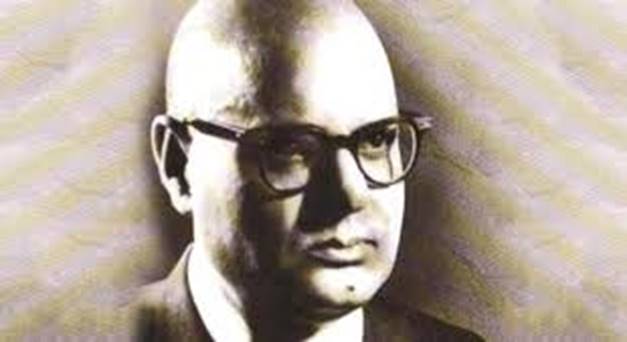
Photo Rekhta
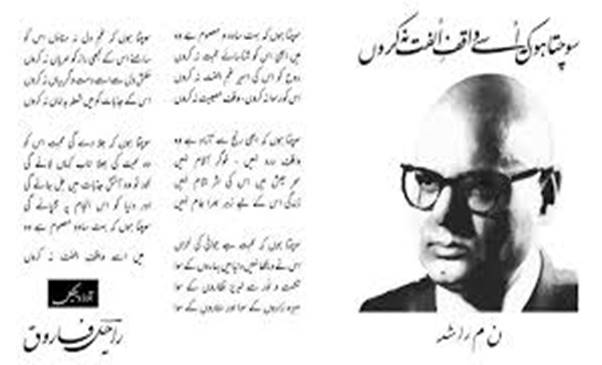
Noon Meem Rashid
By Dr Asif Javed
Williamsport, PA
Nazar Mohammad Rashid had abbreviated his name to Noon Meem Rashid rather than NM Rashid. This was unlike Dr Mohammad Deen Taseer who had shortened his to MD Taseer. It is not clear whether this was Rashid’s preference for Urdu or his lifelong desire to be just different. At Govt College Lahore, he had already made quite a name for himself as a poet when Faiz Ahmad Faiz arrived. Faiz, ever so polite and humble, once admitted that at Govt College, Rashid was the star among student poets. And he (Faiz), at that point, was more inclined towards critique and translation work. But in life our paths are often chosen for us. And so, Faiz did become a poet after all.
After college, Rashid moved through several jobs including a low paying clerical job in Multan. Interestingly, he became a member of Allama Mashraqi’s Tehrik-e-Khaksar while at Multan. There is an interesting anecdote about Rashid’s time as a Khaksar. As a former student, he was invited to Govt College to read a paper in Majlas-e-Iqbal. He turned up, in his Khaksar uniform. At the college gate, a bailcha-carrying group of uniformed khaksars gave a guard of honor to their leader. Rashid read his paper and left. But poor Sufi Tabassam, Professor of Persian at the college, and presumably the patron of Majlas-e Iqbal, had to write a letter of explanation to the college principal about the episode.
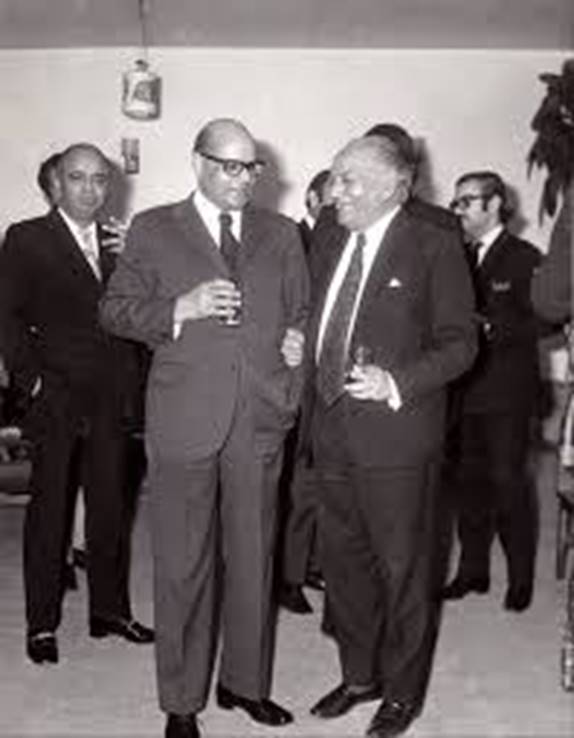
Noon Meem Rashid and Faiz Ahmed Faiz – Rashid Ashraf, Flickr
Rashid then moved on to All India Radio and was posted at Delhi. It is likely that Pitras Bokhari, who was among the high-ups at AIR, and likely knew Rashid from Govt College, got him hired. During the 2 nd WW, Rashid joined the British Indian Army along with Charag Hasan Hasrat and Faiz. Released from the service after the war, he joined Radio Pakistan. Having spent time at Azad Kashmir Radio based at Murree, and later at Peshawar, he joined the UN Information Service.
Rashid spent several years working at the UN Information Service. He was posted at Karachi for a few years and then in Iran. It was in Iran that he fell in love with Persian language and culture. By a strange coincidence, Dr Akhtar Raipuri, who worked for UNESCO, was also posted in Tehran at the time. They became friends and would meet often. It was during one of those meetings that Begum Hamida Akhtar overheard her husband telling Rashid:
Rashid, our people will take a long time to appreciate the greatness of your poetry. I sincerely hope that it happens in your lifetime.
Rashid is generally considered to be the imam of free verse in Urdu. Although the free verse in Urdu was written by Tasadaq Husain Khalid before him, it was Rashid along with Miraji who made it popular. “Early on
Rashid and Faiz appeared to be quite fond of each other,” writes Dr Aftab Ahmad. “Rashid had dedicated his first book Mavra to Faiz while Faiz had asked Rashid to write the foreword of Naqsh-e-Faryadi, his first book. But in poetic style, and in life, they were poles apart and slowly drifted away. Rashid disagreed with Faiz’s literary and political views and often said so.”
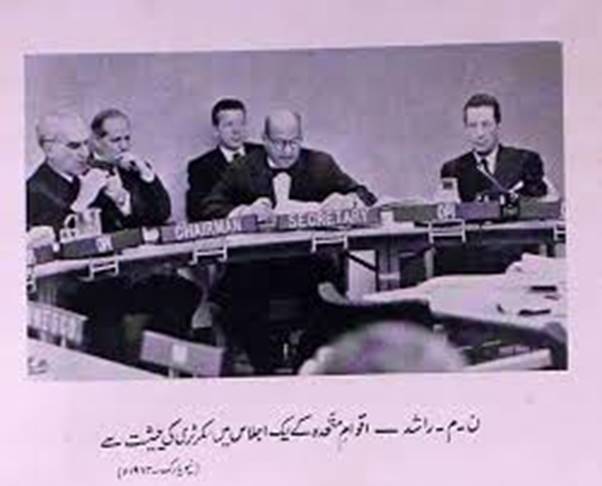
Rashid had married his first cousin and had four children, three daughters and a son. Unfortunately, Rashid’s wife went through a prolonged sickness and was bedridden. It was at Karachi that she died of air embolism, a complication of IV injection. A few days later, a grieving Rashid proceeded to NY to take up his new assignment at UN. His young children went with him. It was in NY that Rashid made a fateful decision that was to adversely affect his life and tarnish his legacy.
It seems that Rashid moved from one extreme to another in his life. From being a dedicated Khaksar early on, he fell in love with the Western way of life. Those who visited him in NY noted his fondness for everything Western: food, music, literature, and alcohol. And then Rashid, a middle-aged father of four, fell
madly in love with a much younger European woman who was his daughter’s school teacher at NY. They married later. Dr Aftab Ahmad who met Rashid and Sheila - Rashid’s second wife - several times, before and after their marriage, has left an amusing and also somewhat painful picture of their marital life:
Rashid had asked my wife to cook Aloo ghost, his favorite dish. And he consumed it with some relish. But I noticed a visible disapproval on Shelia’s face when Rashid used fingers (rather than knife and fork) to eat. These types of frictions and disagreements existed in their married life early on; overtime it got worse.
Begum Hamida Akhtar Raipuri has left a similar account of Rashid’s predicament:
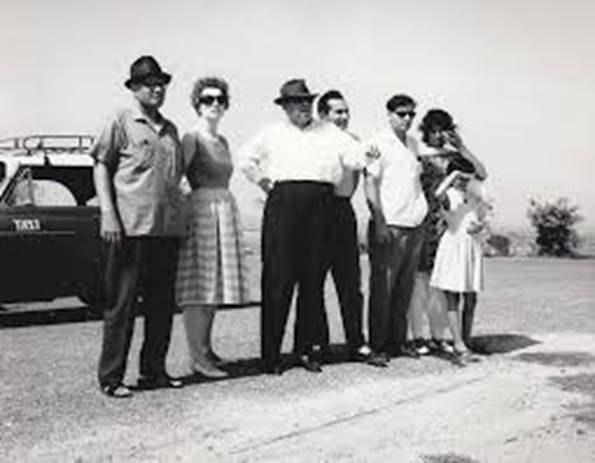
Noon Meem Rashid, wife Sheila, Zameer Jafri and others - Flickr
Rashid was very unhappy and troubled by his wife’s behavior. Not many knew about it. There was such a big age difference. He appeared to be dominated by her. He asked me several times to tell her not to criticize his country and not to misbehave with his son when he visited…I did tell her several times to appreciate her husband who was a great poet, not to criticize his language, music, food, and his religion. She was a cruel, insensitive being.
Rashid found himself in a quandary. Sheila’s harsh treatment of his son Shehryar really bothered him. His children started to move away from him. Rashid was very attached to and proud of his son who was bright and also a poet. Rashid once admitted being relieved that Shehryar got married to a Pakistani girl and that he joined the Foreign Service of Pakistan. “Working for the Pak Foreign Service, and married to a local girl, at least, he would stay attached to his roots,” is how Rashid felt about it. Rashid was not invited to his son’s wedding. A sensitive man, he must have felt hurt.
Rashid and Ijaz Batalwi got together in an Italian café, and later, at the London’s Paddington rail station. It was the summer of 1975. Batalwi, a renowned lawyer in Lahore, was visiting England from Pakistan while Rashid, who had made a home in Cheltenam England after retirement from UN, had travelled to London to see his old friend. Rashid asked for Batalwi’s help to get his last book of poetry published in Lahore. Batalwi agreed but was curious as to why it was to be Rashid’s last. “For one, I do not want to live beyond my time; and also, I do not want to repeat myself like some other poets.” Batalwi returned to Lahore with Rashid’s book script in hand. He was in the process of negotiating with a local publisher when he heard the news of Rashid’s passing. Rashid had published three books of poetry in his lifetime. The fourth, and the last one, was published after his death.
Rashid’s sudden death in 1975 created a controversy that refuses to go away. Rashid may have been a heart patient since he was on a restricted diet when he met his friend, the famous writer, A. Hamid in Lahore a few years before death. Rashid’s was a sudden death, most likely a heart attack. It is what followed that has become controversial. His dead body was cremated. This shocked his family, friends, admirers and the public alike. Over the years there has been a lot of speculation over this. Rashid’s children from his first wife, who were in Pakistan, have been of the view that it was their stepmother Sheila’s decision. They argue that there was no will to that effect. His daughter has written that Rashid was quite familiar with the Qur’an and, while at Multan, used to teach
Qur’an to Khaksars. They find it hard to believe that Rashid wished to be cremated.
YouTube
Begum Hamida Akhtar Raipuri notes that, having known Rashid closely for several years, she and her late husband, were equally shocked about the cremation. “I am of the opinion that Sheila was trying to save money since cremation is cheaper than formal burial. She may have also worried about Rashid’s family’s desire to take his dead body to Pakistan that would also have been expensive.” Strangely, Rashid’s close friend Ijaz Batalwi who had met Rashid just a few days before Rashid’s death, has not written a word about his cremation.
Dr Aftab Ahmad, however, has an entirely different point of view about this.
Rashid had expressed a desire to be cremated in his lifetime. This may have been a reflection of his lifelong tendency to be different in everything, to break from tradition and the norms. He certainly had expressed a strange fascination with fire in one of his poems in which he describes fire as ‘treasure of colors’ and ‘ultimate satisfaction’. I also wonder whether, by getting cremated, Rashid had prevented his remains to be buried in England. This may have been his way of exacting vengeance for he had been forced to settle in England.
Dr Akhtar Raipuri’s apprehension about Rashid’s poetry appears to have been valid: It has not received the popular acclaim that it certainly deserved. “Rashid’s poetry has more depth and a broader vision than Faiz’s,” writes Hamid Naseem. That may be so. But even in their lifetime, Faiz’s popularity graph had clearly gone above that of Rashid’s. But some who do understand free verse, a more difficult version of poetry, regard Rashid’s poetry highly. Surprisingly, five decades after death, Rashid has been recognized by his country and recently received an award on 23 rd March. His name appears somewhere on a long list of bureaucrats, army officers and several deserving as well as undeserving sycophantic citizens. Hard to know whether the author of Mavra, Iran Mein Ajnabi, La Musawi Insaan and Gumaan KaMumkin would have even approved, or really cared much, about this award bestowed by His Excellency Asif Zardari.
All his life Rashid had carved his own path. Perhaps, deep inside him was a believer in Robert Frost’s line, “I took the one less travelled by.”
References : Beyade Suhbate Nazak Khayalan by Dr Aftab Ahmad; Ijaze Bayan by Ijaz Hussain Batalwi; Garde Rah by Dr Akhtar Hussain Raipuri; Hamsafar by Hamida Akhtar Raipuri; Namumkin Ki Justaju by Hamid Naseem; Gulistane Adab Ki Sunehri Yaden by A. Hamid
(The writer is a physician in Williamsport, PA and may be reached at asifjaved@comcast.net)