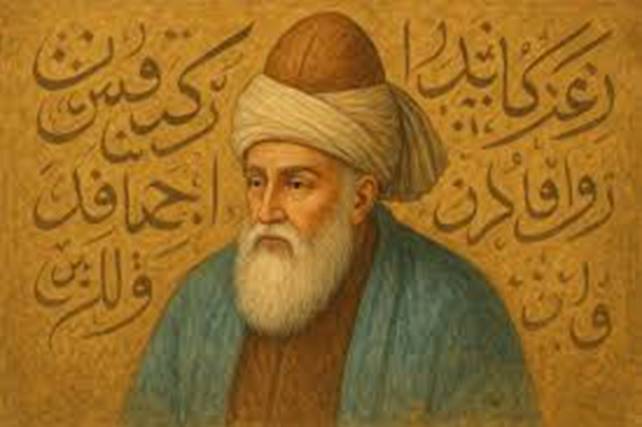
Pakistan Link will publish 19 short biographical essays on some of the greatest spiritual luminaries in Islamic history, from Rābiʿa al-ʿAdawiyya to Jalāl al-Dīn Rūmī and Khwāja Muʿīn al-Dīn Chishtī. Together, these essays would form a coherent spiritual journey—from renunciation and detachment, to ecstatic divine love, and ultimately to the human calling to know, love, and serve God. These essays are condensed from a chapter in Professor Nazeer Ahmed’s recently completed book, Faith, Love and Reason in Islamic History.
Tasawwuf has been one of the great sustaining forces in Islamic history. In times of upheaval and decline, it preserved not only faith, but the inner life of faith, the longing, remembrance, and resilience that kept the lamp of Islam burning. Yet this luminous inheritance is increasingly lost to today’s youth amid modernity, secularism, materialism, war, and the relentless distractions of the digital age. It is our hope that this series will help rekindle that lost flame and inspire a new generation to rediscover the spiritual depths of their tradition. According to the eminent author of ‘Faith, Love and Reason in Islamic History’, Professor Nazeer Ahmed, “no lasting renewal of Muslim civilization can come without spiritual renewal. A civilization must awaken from within before it can rise again.”
Reclaiming our Spiritual Heritage…
Among the towering saints of the Islamic spiritual tradition, few have commanded as much reverence across the centuries as ʿAbd al-Qādir al-Jīlānī (1077–1166). To generations of Muslims, he is not merely a scholar, preacher, or Sufi master, but a living symbol of sanctity itself, an exemplar of repentance, humility, steadfastness, and absolute trust in God. Known by honorifics such as al-Ghawth al-Aʿẓam (“the Supreme Helper”) and Muḥyī al-Dīn (“Reviver of the Religion”), ʿAbd al-Qādir Jilani came to embody a form of Sufism that was at once inwardly profound and outwardly disciplined: a path rooted in the Qur’an and Sunnah, grounded in sacred law, purified by ascetic struggle, and illuminated by direct knowledge of God. If al-Ḥallāj represents the blazing extremity of mystical utterance, and Ibn ʿArabī the vast architecture of metaphysical realization, then ʿAbd al-Qādir al-Jīlānī represents the majestic center of sober sainthood, the integration of law, theology, moral reform, and spiritual transformation in a form accessible to the broader Muslim community.
He was born in Jīlān (or Gilan), in the region south of the Caspian Sea, in 1077, during a formative period in the development of classical Orthodox Islam. The Muslim world of his time was intellectually rich and institutionally consolidating. The great legal schools had matured; Ashʿarī and Māturīdī theology had achieved broad authority; and Sufism, though already well established, was still in the process of being fully integrated into the mainstream religious life of the ummah. This was also the age of al-Ghazālī, whose monumental synthesis of law, theology, and spirituality helped to legitimate the inner path within Orthodox orthodoxy. It is not accidental that ʿAbd al-Qādir belongs to this same broad civilizational moment. Like al-Ghazālī, he helped demonstrate that Sufism need not stand outside the religious sciences, but could instead deepen and complete them.
As a young man, ʿAbd al-Qādir traveled to Baghdad, then the intellectual and spiritual capital of the Muslim world. Baghdad in the late eleventh and early twelfth centuries was a city of immense religious energy, home to jurists, theologians, hadith scholars, ascetics, and wandering seekers. There he studied Hanbali jurisprudence, hadith, Qur’anic sciences, and the religious disciplines in their formal sense.
His path was not confined to scholarship alone; he also entered into a long and difficult period of spiritual struggle, marked by ascetic retreat, poverty, hunger, solitude, and inward purification. Later tradition remembers him wandering in the deserts and outskirts of Baghdad, engaged in mujāhadah (the spiritual combat against the ego) until he emerged as a fully ripened master.
This early phase is essential to understanding his message. ʿAbd al-Qādir Jilani did not present Sufism as speculative metaphysics or as ecstatic disclosure detached from discipline. For him, the path begins with tawbah (sincere repentance) and continues through self-purification, humility, truthfulness, detachment from the world, and complete reliance upon God. His Sufism is practical, moral, and transformative. It is concerned less with extraordinary states than with the purification of the heart. He repeatedly warns against spiritual vanity, false claims, and attachment even to mystical experiences. Miracles, visions, and unusual openings are not the measure of sainthood; rather, the true saint is the one who remains obedient, sincere, inwardly broken before God, and outwardly faithful to the prophetic path.
This is why ʿAbd al-Qādir al-Jīlānī became such a pivotal figure in the public life of Sufism. He united the Sharīʿah and the Ṭarīqah in a manner that was both authoritative and accessible. In his sermons and teachings, one hears again and again the insistence that there is no true inward path without obedience to the outward law. The seeker must pray, fast, guard the tongue, purify intention, fulfill obligations, and submit the lower self to divine command. But these outward acts are not enough by themselves. Without sincerity, vigilance, and remembrance, they can become empty forms. Thus, ʿAbd al-Qādir Jilani’s genius lies in his ability to insist simultaneously on rigor and tenderness: he is uncompromising about discipline, yet suffused with mercy. He speaks as one who has known both the majesty and the nearness of God.
In this sense, he stands in profound continuity with Junayd al-Baghdādī, the great master of sober Sufism. Like Junayd, ʿAbd al-Qādir Jilani rejects the excesses of uncontrolled ecstatic expression and places great emphasis on spiritual balance. Yet unlike the more restrained, almost esoteric tone of early Baghdad Sufism, ʿAbd al-Qādir Jilani brought this sobriety into the public square. His sermons in Baghdad reportedly drew vast crowds, not only scholars and aspirants, but ordinary men and women, rulers, merchants, and the poor. He became a preacher of repentance on a civilizational scale. In him, Sufism moved beyond small circles of initiates and became a force of mass moral and spiritual renewal. His influence after death was immense, and in many ways unparalleled. The Qādiriyyah, the spiritual order associated with him, became one of the oldest, widest, and most enduring Sufi orders in the Muslim world. From Iraq it spread across Persia, Anatolia, India, Africa, the Ottoman lands, and eventually far beyond into Africa and Indonesia and Malaysia. In many regions, to invoke the name of ʿAbd al-Qādir al-Jīlānī became almost synonymous with invoking saintly blessing and protection. His tomb in Baghdad became a major center of devotion, and his sermons and counsels were copied, memorized, and recited for centuries. What is remarkable is that his influence crossed social and intellectual boundaries: jurists revered him, Sufis claimed him, common believers loved him, and rulers sought legitimacy through association with his name.
His legacy also lies in the way he helped normalize and legitimize a certain form of Orthodox Sufism: disciplined, orthodox, morally demanding, spiritually rich, and publicly engaged. In him, sainthood is not a departure from the prophetic model but its inward flowering. This is one reason why later Sufis across very different traditions, from the Qādiriyyah to the Chishtiyyah and beyond could see him as a common ancestor of spiritual authority. Even those who did not belong formally to his order often drew upon his example as a model of what a true walī (friend of God) should be.
In modern times, ʿAbd al-Qādir al-Jīlānī remains one of the most universally beloved saints in the Muslim world. His appeal has endured precisely because his message speaks not only to metaphysical elites, but to the moral and spiritual needs of ordinary believers. In an age of distraction, spiritual confusion, and fragmented religious authority, his call to repentance, sincerity, humility, and steadfast obedience retains extraordinary force. Modern traditionalist thinkers, including figures such as Seyyed Hossein Nasr, have often regarded him as one of the supreme embodiments of Islamic sanctity: a saint in whom outward orthodoxy and inward illumination are perfectly reconciled. For Nasr and others concerned with recovering the sacred center of Islam, ʿAbd al-Qādir Jilani stands as a reminder that the spiritual life is not built on novelty or spectacle, but on purification, remembrance, and fidelity to the divine order.
In the end, ʿAbd al-Qādir al-Jīlānī endures because he represents a form of greatness that is both exalted and deeply human. He is not remembered chiefly for dazzling philosophical constructions or daring mystical paradoxes, but for the nobility of a heart surrendered to God. He took the inner science of Sufism and made it a path of reform for the whole community. He taught that true knowledge begins with repentance, that true power lies in helplessness before God, and that true sainthood is inseparable from service, humility, and obedience.
For the Sufi tradition, he remains one of the clearest mirrors of prophetic inheritance: a saint of majesty and mercy, whose voice still calls seekers away from the illusions of the self and toward the freedom of surrender. In every age, his life proclaims the same enduring truth: that the path to God is not only for the few who soar in metaphysical heights, but for every soul willing to be humbled, purified, and remade by divine grace.
(The author is Director, World Organization for Resource Development and Education, Washington, DC; Director, American Institute of Islamic History and Culture, CA; Member, State Knowledge Commission, Bangalore; and Chairman, Delixus Group)