Book & Author
Michael Axworthy: A History of Iran — Empire of the Mind
By Dr Ahmed S. Khan
All men are fellow-members of one body
For they were created from one essence
When fate afflicts one limb with pain
The other limbs may not stay unmoved
Sa’di Shirazi (1210-1291)
The empires of the future are the empires of the mind.
—Winston Churchill
(Speech at Harvard University, September 6, 1943)
The Islamabad Memorandum, signed on June 17, 2026, serves as an interim agreement aimed at ending a very devastating war between the United States and Iran while establishing a framework to resolve long-standing nuclear tensions. At its core, the deal mandates an immediate and permanent cessation of military operations across all fronts, which explicitly includes bringing an end to the Israel-Hezbollah conflict in Lebanon. To stabilize global commerce, Iran has committed to reopening the vital Strait of Hormuz to shipping within 30 days by clearing all mines and military obstructions, notably waiving all transit tolls for the first 60 days of operations.
On the nuclear front, Iran reaffirmed its pledge to never develop nuclear weapons and agreed to maintain the current status quo of its program during ongoing talks. Crucially, Iran will down-blend its stockpile of highly enriched uranium directly on Iranian soil under the strict supervision of the International Atomic Energy Agency (IAEA). In exchange for these immediate concessions, the United States issued Treasury waivers allowing Iran to freely export crude oil and access international banking services, alongside a commitment to begin unfreezing restricted Iranian assets. However, permanent and broad sanctions relief remains strictly conditional on reaching a final accord.
This memorandum ultimately triggers a 60-day negotiation window to finalize a permanent settlement—which includes a proposed $300 billion reconstruction plan funded by the US and regional partners — effectively reducing the tensions and hostilities between the world’s two great civilizations.
The world’s earliest civilizations—Mesopotamian, Ancient Egyptian, Indus Valley, Ancient Chinese, and Ancient Persian—emerged independently in fertile river valleys, yet each developed a distinct social, political, and cultural character.
Mesopotamia, which arose around 3500 BCE between the Tigris and Euphrates rivers, was marked by political fragmentation into competing city‑states and frequent conflict. Nevertheless, it pioneered foundational innovations such as cuneiform writing, codified law, and urban governance.
In contrast, Ancient Egypt, beginning around 3100 BCE along the Nile River, achieved remarkable political continuity and stability under centralized rule based on divine kingship. The Nile’s predictable flooding supported long‑term prosperity, monumental architecture, and a religious worldview centered on order and the afterlife.
The Indus Valley Civilization (c. 3300–1300 BCE) differed sharply from both, showing little evidence of kingship or monumental temples. Instead, it emphasized egalitarian urban planning, standardized construction, advanced sanitation systems, and extensive trade, suggesting a highly organized yet less overtly hierarchical society.
Ancient Chinese civilization, emerging around 2000 BCE in the Yellow River valley, combined strong dynastic authority with enduring philosophical traditions such as Confucianism and Daoism, which emphasized moral governance, social harmony, and continuity across political change.
Finally, the Ancient Persian civilization, particularly under the Achaemenid Empire (c. 550–330 BCE), stood out for its unprecedented imperial scale and administrative sophistication. It governed diverse peoples through provincial administration, legal codification, infrastructure development, and religious tolerance rather than forced cultural uniformity.
While all five civilizations relied on river‑based agriculture, writing systems, and social stratification, they differed markedly in political organization—from Mesopotamian city‑states to Egyptian theocracy, Indus civic planning, Chinese moral bureaucracy, and Persian imperial pluralism. Together, these civilizations laid the foundations of law, governance, culture, philosophy, and technology, demonstrating multiple pathways through which complex societies emerged and shaping the course of world history and forming the bedrock of world civilization.
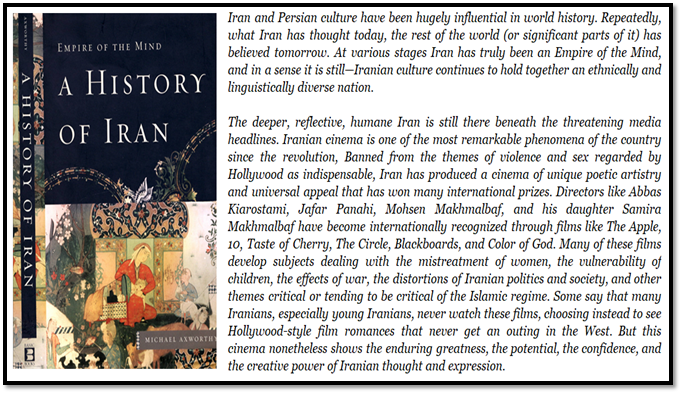
Michael Axworthy’s A History of Iran: Empire of the Mind (2008) is a lucid, ambitious, and deeply humane survey of Iranian civilization from antiquity to the present. Written for a broad readership yet informed by serious scholarship, the book seeks to move beyond narrow political stereotypes and situate contemporary Iran within the long arc of Persian history. The author’s central argument is that Iran is best understood not merely as a succession of regimes or territorial states, but as an enduring civilization—an “empire of the mind”—whose cultural, intellectual, and moral influence has often outlasted its political power.
The idea for book title A History of Iran: Empire of the Mind originated unexpectedly during a public panel discussion held at the British Museum in 2005 to inaugurate the Forgotten Empire exhibition. During the audience question session, the author suggested that because the center of Iranian culture had shifted across regions—ranging from Fars and Mesopotamia to Khorasan, Central Asia, and Azerbaijan—and because Iranian influence extended far beyond Iran’s borders, it might be more useful to think of Iran not in conventional national or imperial terms, but as an “Empire of the Mind.” The idea was warmly received, inspiring the book itself.
The author presents the history of Iran in nine chapters:1. Origins: Zoroaster, the Achaemenids and the Greeks; 2. The Iranian Revival: Parthians and Sassanids; 3. Islam and Invasions: The Arabs, Turks, and Mongols—The Iranian Reconquest of Islam, the Sufis, and the Poets; 4. Shi’ism and the Safavids; 5. The Fall of Safavids, Nader Shah, the Eighteenth-Century Interregnum, and the Early Years of the Qajar Dynasty; 6. The Crisis of the Qajar Monarchy, the Revolution of 1905-1911, and the Accession of the Pahlavi Dynasty; 7. The Pahlavis and the Revolution of 1979; 8. Iran Since the Revolution: Islamic Revival, War, and Confrontation; and 9. From Khatami to Ahmadinejad, and the Iranian Predicament.
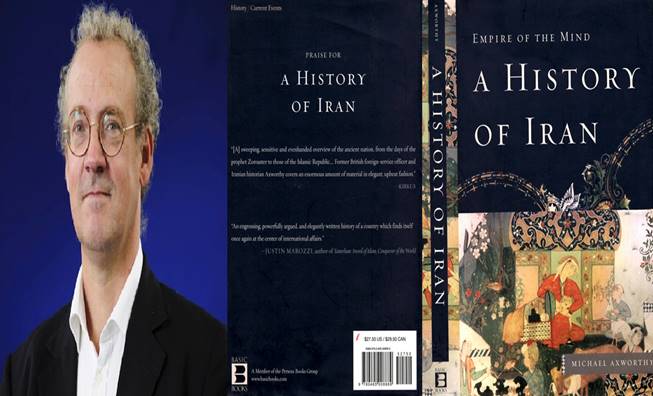
Michael Axworthy (September 26, 1962 - March 16, 2019) was an academic, a career diplomat and a leading authority on Iran. He read History at Peterhouse, Cambridge, where he fell under the influence of Maurice Cowling. After graduation, he entered the Foreign and Commonwealth Office (FCO) in 1986, serving in Malta and Bonn before being appointed first secretary and head of the Iran Section in the FCO’s Middle East department in 1998. Two years later he switched to an academic career, teaching Middle East History at Durham and at Exeter, where he became Director of the Center for Persian and Iranian Studies.
Through a series of influential books, Michael Axworthy made significant contributions to the understanding of Iranian history, politics, and society. His first major work, The Sword of Persia: Nader Shah, from Tribal Warrior to Conquering Tyrant (2006), focuses on one of the most consequential figures of Iran’s early modern period. The book traces the extraordinary rise of Nader Shah, who began life as a shepherd boy and went on to liberate Persia from foreign occupation. Ruling from 1736 to 1747, Nader Shah restored political stability to a fragmented state and transformed Persia into the dominant regional power, though his rule ultimately descended into tyranny.
In A History of Iran: Empire of the Mind (2008), Michael Axworthy challenged simplistic Western stereotypes (Axis of Evil) of Iran by highlighting the depth and continuity of Persian civilization. He emphasized Iran’s cultural, religious, and intellectual influence, from Zoroastrian monotheism to figures such as Cyrus the Great, arguing that Persian thought shaped both Judaism and Christianity. He also explained Iran’s modern political tensions as the result of its long entanglement in great‑power rivalries, which fostered resentment toward foreign interference and helped give rise to revolutionary leaders such as Ayatollah Khomeini.
Axworthy’s later work, Revolutionary Iran: A History of the Islamic Republic (2013), examines the origins and outcomes of Iran’s 1979 revolution. He argues that the revolution was initially driven by economic and political grievances rather than religious ideology. Over time, however, these forces culminated in the establishment of the world’s first Shiʿa Muslim theocracy, fundamentally reshaping Iran’s political system and identity.
In Iran: What Everyone Needs to Know (2017), Axworthy aimed at a general readership, offering a concise and accessible overview of Iran’s long history, from ancient times to the present. The book also provides clear summaries of key developments following the 1979 revolution, helping readers understand contemporary Iran within its historical context. Additionally, Axworthy co‑edited Crisis, Collapse, Militarism and Civil War: The History and Historiography of 18th Century Iran (2018), further demonstrating his scholarly engagement with Iran’s political and military past. A common theme that runs through Axworthy’s books was that Iran has always seen itself as misunderstood and exploited or threatened by external enemies.
Michael Axworthy regularly wrote on contemporary Iran and related topics for leading publications, including Prospect, The Independent, The Guardian, and The Telegraph, and frequently appeared on major television and radio programs such as the BBC, CNN, and Sky News. In addition to his media work, he served as a consultant for financial institutions, briefly held a non‑executive directorship with an Iran‑focused investment fund, and provided briefings and speaking engagements for several Western governments and NATO. In 1996 he married Sally Hinds, Britain’s Ambassador to the Vatican. The couple has three daughters and a son. He passed away on March 16, 2019, due to cancer.
In A History of Iran — Empire of the Mind, the author presents Iran as the heir to the ancient civilization of Persia, celebrated for its refined culture, elegant poets who composed ghazals about nightingales, and influential thinkers and prophets whose ideas shaped figures such as Jesus, Plato, and the humanists of fifteenth‑ and sixteenth‑century Italy. The author notes that the Persian prophet Zoroaster introduced the concept of monotheism grounded in moral responsibility, while the Persian ruler Cyrus the Great restored the Israelites to Jerusalem. On this basis, the author provocatively argues that Christianity “probably owes more to Tehran than Athens.”
The author challenges the dominant Western tendency to view Iran primarily through the lens of contemporary geopolitics—revolution, clerical rule, nuclear tensions—by emphasizing the depth and resilience of Persian civilization. The author highlights Persia’s role as a civilizational crossroads, absorbing and transforming influences from Greece, India, Central Asia, and the Arab world while retaining a strong sense of self. The subtitle “Empire of the Mind” captures this idea well: even when Iran was politically weakened or conquered, its language, administrative practices, poetry, religious thought, and concepts of kingship continued to influence others. From Zoroastrian moral dualism to Shi‘a political theology, and from Persian poetry to models of governance, Iran’s legacy persisted even in periods of apparent decline.
Another theme covered in the book is Iran’s troubled relationship with external powers. The author situates modern Iranian mistrust of the West within the historical context of the “Great Game,” colonial rivalries, and twentieth-century foreign interference. Rather than portraying Iranian nationalism or revolutionary politics as irrational or uniquely ideological, he presents them as historically conditioned responses to repeated marginalization and manipulation by stronger powers.
At the heart of Empire of the Mind lies the claim that Iranian identity has persisted across millennia despite conquest, fragmentation, and foreign domination. The author challenges the dominant tendency in Western discourse to reduce Iran to the Islamic Republic or to portray it as an inherently radical or aberrant state. Instead, he presents Iran as the heir to the ancient civilization of Persia, renowned for its poets, thinkers, prophets, and ethical traditions.
The author identifies the poetry of Rumi, Iraqi, Saʿdi, and Hafiz as the culmination of Persian literary development. The author introduces the poetry of Rumi—one of the most widely read poets in the United States—by quoting the opening lines of his Masnavi, which express the soul’s longing for union with God.
Now listen to this reed flute's deep lament
About the heartache being apart has meant:
Since from the reed-bed they uprooted me
My song's expressed each human's agony,
A breast which separation's split in two
Is what I seek, to share this pain with you:
When kept from their origin, all yearn
For union on the day they can return…
The reed consoles those forced to be apart,
Its notes will lift the veil upon your heart,
Where's antidote or poison like its song
Or confidant, or one who's pined so long?
This reed relates a tortuous path ahead,
Recalls the love with which Majnoun's heart bled:
The few who hear the truths the reed has sung
Have lost their wits so they can speak this tongue...
At the core of Rumi’s thought is the idea of unity—of God, of the human spirit with God, and of the soul’s yearning for reunion with the divine. Plato echoes this idea in the Symposium. Rumi presents it again in the following ruba’i:
The Beloved starts shining like the sun,
And the lover begins to whirl like a dust-mote
When the spring wind of love begins to move,
Any branch that is not withered starts to dance
To illustrate Iraqi’s personality, the author presents a poem he wrote after encountering a Sufi qalandar upon his arrival in Hamadan:
We've moved our bedrolls from the mosque to the tavern of ruin [kharabat]
We've scribbled all over the page of asceticism and erased all miracles of piety
Now we sit with the lovers in the lane of the Magians
And drink a cup from the hands of the dissolute people of the tavern.
the heart should tweak the ear of respectability now, why not?
The author notes that both Saʿdi and Hafez have had a profound influence on the thinking of ordinary Iranians, and that lines from their poetry are commonly used as everyday sayings. Teachers of the Persian language traditionally used Saʿdi’s Golestan (The Garden of Roses) as a teaching text, requiring students to memorize passages to help build vocabulary and moral understanding. His works were also among the first Persian texts translated into European languages in the eighteenth century. One well‑known passage from the Golestan is inscribed above the entrance to the United Nations headquarters in New York.
All men are fellow-members of one body
For they were created from one essence
When fate afflicts one limb with pain
The other limbs may not stay unmoved
The author presents a sample of Hafez’s poetry, highlighting his status as one of the most revered Persian poets:
0 wind, tell her my story secretly.
Tell her my heart's secret in a hundred tongues.
Tell her, but not in a way that may offend her
Speak to her and between the words tell her my story.
One of the book’s greatest strengths is its clarity and accessibility. The author writes with elegance and narrative momentum, avoiding jargon while preserving complexity. His prose reflects the discipline of diplomatic writing: precise, measured, and persuasive without polemic.
The book’s major shortcoming is the uneven depth of coverage. Ancient and medieval periods are treated swiftly, sometimes at the expense of social and economic analysis. Specialists may find these sections too compressed, while the twentieth century receives comparatively detailed attention.
The narrative is also predominantly political, with limited sustained engagement with everyday social life, gender history, or economic structures. The book also lacks scholarly tone, with relatively few endnotes and limited engagement with Persian‑language sources —choices that enhance readability but reduce academic rigor.
Reflecting on Iran’s enduring “Empire of the Mind,” the author concludes the book by observing: “The deeper, reflective, humane Iran is still there beneath the threatening media headlines.” He points to Iranian cinema as one of the most remarkable cultural achievements since the 1979 revolution. Despite strict censorship and bans on themes of violence and sexuality — elements regarded by Hollywood as essential — Iran has produced a cinema of exceptional poetic artistry and universal appeal, winning numerous international awards. Filmmakers such as Abbes Kiarostami, Jafar Panahi, Mohsen Makhmalbaf, and his daughter Samira Makhmalbaf have gained global recognition through works like The Apple, 10, Taste of Cherry, The Circle, Blackboards, and The Color of God. Many of these films explore themes such as the mistreatment of women, the vulnerability of children, the impact of war, and the distortions of Iranian politics and society.
The author acknowledges that some observers argue these films are not widely watched within Iran, particularly among younger audiences who often prefer Hollywood‑style romances unavailable to Western viewers. Nevertheless, he maintains that Iranian cinema powerfully demonstrates the enduring greatness, creative confidence, and intellectual vitality of Iranian culture.
The author further emphasizes Iran’s profound influence on world history: “Iran and Persian culture have been hugely influential in world history. Repeatedly, what Iran has thought today, the rest of the world (or significant parts of it) has believed tomorrow.” At various points in history, Iran has truly functioned as an Empire of the Mind, and in many respects, it remains so today. Iranian culture continues to bind together an ethnically and linguistically diverse society. While Iran appears poised to assume a greater regional role in Iraq, Afghanistan, and the wider Middle East, the author expresses doubt about whether it can fully realize such influence. This uncertainty stems partly from resistance within the international community, and partly from Iran’s own post‑1979 trajectory, which has challenged Western notions of civilization but has also produced repression, suffering, and disillusionment. The book ultimately raises a poignant question: whether Iran could—and should—offer the world something more than it has thus far been able to realize.
A History of Iran: Empire of the Mind is a rare achievement—learned without pedantry, critical without hostility, and empathetic without indulgence. While it may not satisfy specialists seeking academic rigor, it succeeds brilliantly in its primary aim: to restore historical depth, dignity, and complexity to a civilization too often flattened by ideology and headlines.
The book is essential reading for students of history, political science, international relations, and Middle Eastern studies, as well as for discerning general readers. More than a national history, it is an argument for understanding how culture, memory, and ideas shape political life. In this sense, the work stands not only as a history of Iran, but as a meditation on civilization itself—and on the cost of failing to understand it.
(Dr. Ahmed S. Khan — dr.a.s.khan@ieee.org — is a Fulbright Specialist Scholar)