Book & Author
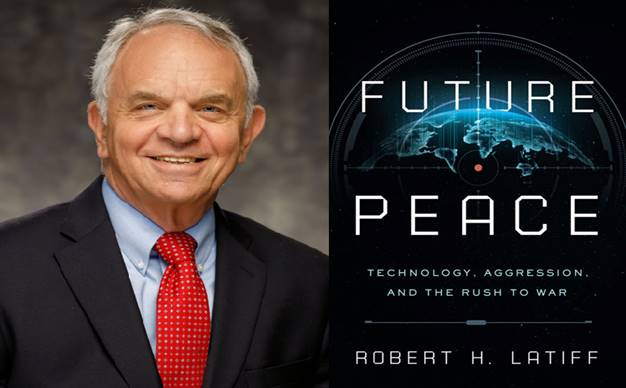
Robert H. Latiff: Future Peace —Technology, Aggression, and the Rush to War
By Dr Ahmed S. Khan
All war is a symptom of man’s failure as a thinking animal. - John Steinbeck, Once There Was a War, 1943
A strange game. The only winning move is not to play. —War Games, 1983
In Future War: Preparing for the New Global Battlefield, retired US Air Force Major General Robert H. Latiff offers a sobering analysis of how emerging technologies are reshaping the nature of warfare. Rather than presenting a speculative or sensational vision of future conflict, he provides a measured and cautionary assessment informed by decades of experience in military operations, intelligence, and advanced technology.
The book’s central argument is straightforward yet urgent: although technological innovation has always shaped warfare, the unprecedented speed and scale of contemporary advances—particularly in artificial intelligence, robotics, cyber warfare, biotechnology, and autonomous systems—have created ethical, strategic, and political challenges unlike any seen before. The author is less concerned with predicting specific future battles than with examining how nations, especially the United States, are preparing to responsibly manage the consequences of these technologies.
One of the book’s greatest strengths is its sustained focus on ethics. The author repeatedly asks not only whether new technologies can be deployed, but whether they should be. He explores morally complex scenarios such as autonomous weapons making life‑and‑death decisions without human oversight, genetic or pharmaceutical enhancements to soldiers, and technologies capable of altering or erasing traumatic memories. These discussions elevate the book beyond a technical overview, firmly situating it within broader debates on Just War Theory, civilian control of the military, and moral accountability in modern conflict.
Robert H. Latiff is a retired US Air Force Major General and a prominent voice in the field of military ethics and emerging weapons technology. After a 32‑year career in senior operational, engineering, and intelligence roles — including leadership positions at the National Reconnaissance Office and command of the NORAD Cheyenne Mountain Operations Center — Latiff turned his focus to the ethical implications of modern warfare.
In academia, General Latiff has made significant contributions to military ethics through teaching, research, and public engagement. As an adjunct professor at the University of Notre Dame and affiliate of its Technology Ethics Center, he has taught the widely recognized course “The Ethics of Emerging Weapons Technology,” which examines autonomous weapons, AI, cyber warfare, and human enhancement through the frameworks of Just War Theory and the Law of Armed Conflict.
General Latiff’s books, Future War and Future Peace, extend this ethical inquiry to broader audiences, warning that unchecked technological acceleration threatens moral accountability, civilian oversight, and peace itself. Together, his scholarship and teaching, position him as a leading advocate for ethical restraint and human judgment in modern military affairs.
Comparing his present work with his earlier book, the author observes: “Like Future War, Future Peace addresses the disgraceful lack of knowledge of the public and some politicians concerning important issues of foreign policy, war, and peace. Worse yet, politicians appear to see the armed forces as just another tool to implement their agendas, lacking any sensitivity to, or consideration of, the human dimensions of armed conflict. Peace is possible, but it will require intensive efforts on the part of technologists, military leaders, diplomats, politicians, and the public. Future Peace amplifies some well-known ideas about how to address the issues and provides far-, mid-, and short-term recommendations for actions that will be needed to reverse the apparent headlong rush into conflict. It is not about being totally antiwar or stopping wars al-together. That would be unrealistic. Rather, it is about doing all we can to prevent unnecessary wars and to end those that do occur as soon and as humanely as possible.”
Future Peace is organized around four thematic chapters: the military as a “giant armed nervous system,” the cultural and institutional urge toward violence, the danger of stumbling into war, and potential pathways for avoiding conflict. This structure allows the author to move from diagnosis to prescription, though his emphasis clearly rests on identifying the dangers rather than detailing precise solutions.
In the preface, the author commenting on the challenges and perils of new technologies, observes: “Americans are fascinated by new technologies and advanced weapons, and the American way of war has long been built around reliance on technological superiority. However, citizens and most political leaders have precious little understanding of those technologies and no more than a passing interest in the complex issues of foreign policy and military affairs. This combination of characteristics leads to an uninformed embrace of military power that may well create a dangerous situation where we think that all conflicts can be solved by our advanced weapons. Unfortunately, new wars fought with new technologies will not be nearly as easy as the public has been led to believe. Worse yet, those same new technologies that so enthrall us may actually increase the chances of war.”
Explaining his motivation for writing the book, the author notes:“ My overriding concern, and the reason I wrote Future Peace, is to draw attention to the fact that we, collectively, are not paying enough attention to the growing influence complex technologies are having on warfare and, critically, the role technology plays in the motivations of our leadership to employ military forces. In the past, even the new technologies for war were relatively simple and their effects more predictable. Today's technologies are rapidly exceeding our ability to understand them, how they operate, or what their long-term consequences might be. Like the previous work, Future Peace raises many questions for which it has insufficient, unsatisfying, or no answers. While it attempts to find solutions to the problems raised, the issues remain exceedingly complex, sometimes perhaps even intractable. There is value, nonetheless, in shining a bright spotlight on the questions and beginning a widespread dialogue about them. Scholars in previous eras debated whether technology would solve all the ills of society or become an enslaving force.”
Future Peace is best read in direct conversation with the author’s earlier Future War. In that 2017 work, the author focused largely on jus in bello—ethical questions surrounding the conduct of war once it has begun. He examined autonomous weapons, human enhancement technologies, cyber warfare, and other innovations through the lens of moral responsibility, soldier agency, and civilian oversight. Future Peace extends this ethical inquiry backward to the moment of decision, shifting decisively toward jus ad bellum, or the justice of going to war.
Together, the two books form a coherent ethical arc. Future War warns of the moral consequences of fighting technologically enabled wars without adequate reflection; Future Peace argues that the same technologies now threaten to make war itself more frequent and less deliberative. The tone of the later book is notably more urgent and pessimistic, reflecting the author’s concern that technological complexity and speed are outpacing political and ethical restraint.
One of Future Peace’s greatest strengths is its moral clarity. The author insists that technology is not morally neutral and that decisions about war cannot be outsourced to machines without profound ethical consequences. He repeatedly emphasizes that the core danger lies not in malicious intent but in systems designed to act faster than humans can think. This framing places responsibility squarely on political leaders, military institutions, technologists, and—crucially—the public.
Despite its strengths, Future Peace has notable limitations. First, its perspective remains heavily US-centric. While the author acknowledges global competition, particularly with China and Russia, his analysis focuses primarily on American political culture, institutions, and decision-making processes. Readers seeking a more comparative or international treatment of how different states approach militarized technology may find the scope limited.
Second, many of the book’s critiques—particularly those concerning the military industrial complex, technological escalation, and public apathy—will be familiar to readers versed in Cold War nuclear ethics or contemporary debates on autonomous weapons.
In sum, the book’s prescriptions are comparatively thin. While the author calls for civic engagement, ethical education, diplomatic restraint, and international cooperation, he offers fewer concrete mechanisms for how states might realistically slow arms races or reassert human control over increasingly automated AI systems. As a result, the book is more persuasive as a warning than as a roadmap.
In Future Peace, General Latiff issues a clear policy warning: emerging military technologies are increasing the likelihood of war by accelerating decision-making, obscuring accountability, and prioritizing speed over judgment. Although the book is not a technical policy manual, it outlines a coherent set of policy priorities aimed at restoring human control and ethical restraint in decisions about the use of force.
At the strategic level, the author urges policymakers to exercise deliberate restraint in the adoption and deployment of advanced weapons systems, particularly those dependent on automation, artificial intelligence (AI), or hypersonic speed. He challenges the assumption that technological superiority inherently enhances security, arguing instead that such systems often encourage preemptive behavior and heighten the risk of accidental escalation. Rigorous ethical and strategic review, he contends, must precede deployment decisions — especially where systems operate faster than human cognition.
At the institutional level, the author emphasizes the need to reassert civilian oversight and clear human accountability in military and national security decision-making. As technologies grow more complex, authority increasingly shifts toward opaque systems and technical experts, weakening democratic control. To counter this trend, the author calls for stronger integration of ethics education within military and policy institutions, along with clearer lines of responsibility for decisions mediated by technology.
General Latiff also stresses the importance of rebalancing military power with diplomacy. He argues that advanced technologies make military responses appear faster and politically easier than diplomatic engagement, distorting policy choices. Reinvestment in diplomacy, arms‑control dialogue, and confidence building measures is therefore essential.
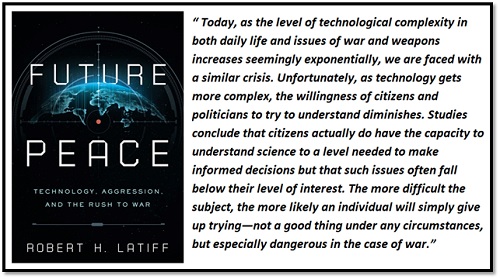
Discussing the issues of public comprehension of the use of complex technology in war, the author notes: “Today, as the level of technological complexity in both daily life and issues of war and weapons increases seemingly exponentially, we are faced with a similar crisis. Unfortunately, as technology gets more complex, the willingness of citizens and politicians to try to understand diminishes. Studies conclude that citizens actually do have the capacity to understand science to a level needed to make informed decisions but that such issues often fall below their level of interest. The more difficult the subject, the more likely an individual will simply give up trying—not a good thing under any circumstances, but especially dangerous in the case of war.”
General Latiff assigns a central role to the public. Democratic restraint on war, he argues, cannot function without an informed and engaged citizenry. Improved civic education and sustained public scrutiny of military technology are necessary to maintain meaningful barriers to war. Taken together, these recommendations frame Future Peace as a call to slow decision-making, restore human judgment, and rebuild ethical and political constraints on violence in an age of accelerating technology.
The author concludes the book by offering advice on preventing future crises: “The public should demand that its representatives take a position on military operations and insist on an authorization to use military force whenever the executive considers deploying US forces. Each new deployment above a certain size must be separately authorized and funded—no more fighting wars on a credit card. Government leaders must better inform citizens of the costs and benefits of military deployments. If we are to go to war, individual citizens must be asked to participate. Conscription and national service should be considered. These would ensure that the public had an interest in minimizing the use of US forces in unnecessary wars. Finally, weapon systems must incorporate safeguards against dangerous applications of machine decision-making...Aggression and military posturing seem jarringly out of place when large numbers of citizens in all countries are succumbing to the violence of a natural killer. Coordinated, collaborative actions—not mistrust and old antagonisms—will be the key to mitigating the effects of future crises. ‘Nothing in history is inevitable, including the probable,’ said Reinhold Niebuhr. ‘So long as war has not broken out, we still have the possibility of avoiding it.’”
Future Peace is not a strategic forecast, a policy manual, or a technological survey. It is a moral appeal written by a former practitioner who has grown deeply concerned about the trajectory of modern warfare. General Latiff’s central warning is stark: without deliberate ethical frameworks, informed civilian oversight, and active public engagement, advanced technologies may make war easier to start, harder to stop, and more detached from human responsibility. The book is an essential resource for readers seeking to understand how emerging technologies shape modern warfare and the profound ethical dilemmas they introduce in a geopolitical context.
(Dr Ahmed S. Khan — dr.a.s.khan@ieee.org — is a Fulbright Specialist Scholar)