Book & Author
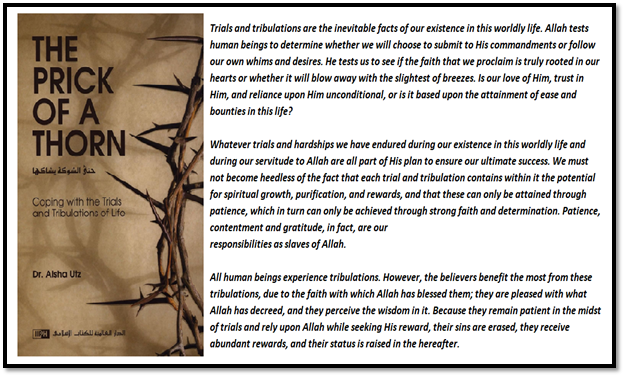
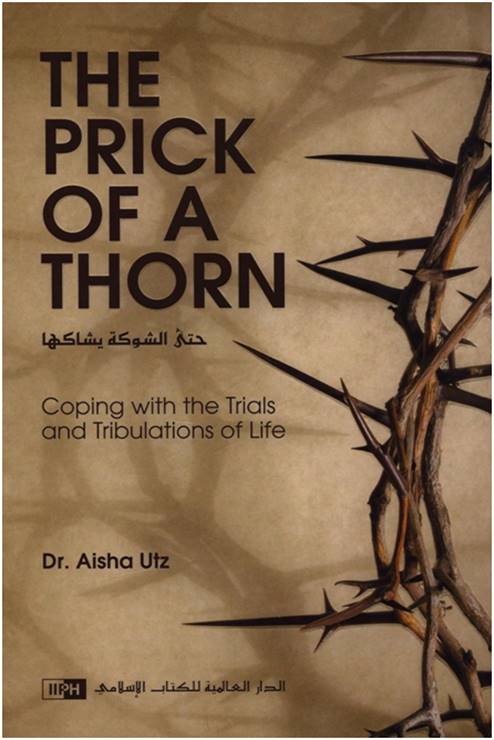
Aisha Utz: The Prick of a Thorn — Coping with the Trials and Tribulations of Life
By Dr Ahmed S. Khan
“And We test you with evil and with good as a trial; and to Us you will be returned.”
(Qur’an 21:35)
“Allah will not leave the believers in the state in which you are until He distinguishes the wicked from the good.”
(Qur’an 3:179)
“Do you think that you will enter Paradise without Allah testing those of you who strive and are patient?”
(Qur’an 3:142)
Across all Abrahamic scriptures — the Torah, the Bible, and the Qur’an — trials are presented as deliberate divine tests that reveal moral character, faith, and accountability at both individual and national levels. While the three scriptures share many figures and events, they differ in scope, emphasis, and explanation.
In the Torah, trials are primarily covenantal. Individuals such as Abraham are explicitly tested to demonstrate obedience, while Israel as a nation undergoes repeated trials in the wilderness involving hunger, fear, and trust. These experiences are intended to shape Israel into a disciplined covenant people. Other nations, such as Egypt or the Canaanites, are judged after periods of warning and moral evaluation, indicating collective responsibility.
The Bible (Old Testament) expands this framework. Individual trials include not only obedience but also unexplained suffering, as seen in Job, where endurance and integrity are tested without clear guilt. National trials become moral‑historical, with Israel and Judah facing exile after sustained injustice and rejection of prophetic warnings. Foreign empires like Assyria and Babylon are also judged, showing that no nation is exempt from moral accountability.
In the Qur’an, human beings and entire nations are repeatedly described as being “tested” or “tried” by God. These trials are presented as part of divine wisdom—either to distinguish belief from disbelief, purify faith, warn societies, or bring moral accountability. The Qur’an consistently teaches that: Individuals are tested through faith, hardship, and blessings, Nations are tested through moral responsibility and response to guidance. Nations such as the people of Noah, Ad, Thamud, Pharaoh, and Lot are repeatedly cited as examples of civilizations that failed their trials after rejecting messengers. These narratives are consciously framed as warnings and lessons for later generations. Trials are not meaningless suffering, but purposeful examinations.
In summary, the Torah emphasizes covenant formation, the Bible highlights moral perseverance and historical justice, and the Qur’an universalizes trials as a defining feature of human existence. Together, they portray history itself as a moral test.
The Prick of a Thorn: Coping with the Trials and Tribulations of Life is a reflective and spiritually grounded work in which Dr Aisha Utz addresses one of humanity’s most enduring concerns: how to understand and endure suffering. Published by the International Islamic Publishing House, the book situates personal hardship within an Islamic theological and psychological framework, offering readers meaning, resilience, and faith‑based coping strategies.
Dr Aisha Utz , formerly Aisha (Laureen Marie) Hamdan, was an American academic who lived in Riyadh, Kingdom of Saudi Arabia. She earned a PhD in Clinical Psychology from West Virginia University and a Bachelor’s degree in Islamic Studies from the American Open University.
She served as Assistant Professor of Clinical Psychology at several academic institutions: the College of Medicine, King Saud bin Abdulaziz University for Health Sciences, Riyadh, Saudi Arabia (2010–2019); the College of Medicine, University of Sharjah, Sharjah, UAE (2005–2010); the College of Family Sciences, Zayed University, Abu Dhabi, UAE (2002–2003); and the Department of Psychology, University of St Thomas, St Paul, Minnesota, USA (1999–2002).
Dr Utz authored over 100 articles on a wide range of topics for Al‑Jumuah Magazine, an international Islamic publication. She also authored three books: Nurturing Eeman in Children, Psychology from the Islamic Perspective, and The Prick of a Thorn: Coping with the Trials and Tribulations of Life. In addition, she wrote several professional journal articles and book chapters on the intersection of psychology and Islam, presented her work at numerous professional conferences, and consistently integrated Islamic perspectives into her teaching.
She also served as Associate Editor of the Faith‑Based Practice section of the Journal of Muslim Mental Health. Her scholarly efforts focused on developing research programs examining the relationship between religiosity and mental health in Muslim populations. Dr Aisha Utz passed away on March 31, 2019, in Riyadh, Saudi Arabia.
At its core, The Prick of a Thorn is a faith‑based exploration of adversity. Dr Utz presents trials—ranging from personal grief and illness to wider social and global calamities—not as arbitrary misfortunes, but as integral aspects of the human experience. As described by the author, the book seeks to help readers “understand the logic of events in a seemingly chaotic world” and to “comprehend the rationale for seemingly unbearable trials and tribulations,” while also providing sound Islamic methods for coping effectively.
The title is drawn from a well‑known Prophetic tradition in Islam, which teaches that even the smallest harm — “the prick of a thorn”— can serve as expiation for sin. This idea establishes the book’s central thesis: suffering, when properly understood, is not meaningless but can be spiritually transformative. In this regard, the author states: “ The Messenger of Allah (SAW) said: Every fatigue, illness, distress, worry, grief, or harm that befalls the Muslim, including the prick of a thorn, will be accepted by Allah as expiation for some of his or her sins (Bukhari). If only this were restricted to suffering as inconsequential as the prick of a thorn… but Allah informs us that our existence on this earth is destined to be a constant series of trials and tribulations, hardships and challenges…We have certainly created man into hardship (Qur’an 90: 4).”
The book consists of following sections: The nature of this life, Types of trials and tribulations, Fundamental causes of trials and tribulations, Purposes and benefits of trials and tribulations, Coping with the trials and tribulations of this life, Trials and tribulations of the prophets and the messengers, and Fruits of Righteous Coping.
The author identifies various types of trials and tribulations: Physical trials, Social and community trials, Divisions and killing within the Ummah, Family and children, Psychological and spiritual trials, Fitnah of doubts, Fitnah of lusts and desires, and Satanic trials.
The author, expounding on the suffering of the people in these testing times, observes: “One only needs to watch half an hour of international news to grasp this reality. Wars, natural disasters, crimes, sickness, death ― the list is unending. If not for the unassailable belief in the wisdom of Allah, one would certainly fall into deep despair. In fact, the level of suffering and misery in the world seems to be rising. Research has indicated that the frequency and severity of natural disasters have increased and so have their devastation and destruction. According to the Centre for Research on the Epidemiology of Disasters of the United Nations Development Program, during the period 2000 to 2009: 1. Nearly 4,000 disasters were recorded, 2. More than 780,000 people died, 3. More than two billion people were affected, and 4. Economic losses were an estimated USD 960 billion. Wars, with their ‘weapons of mass destruction’, create precisely the type of destruction and human suffering that their name implies ― not only for soldiers but also for innocent women, children, and elderly persons. In reality, the anguish of victims in this latter category equals or exceeds that of the combatants themselves, through no choice of their own. The physical, psychological, and social suffering continues for years beyond the actual event.”
Dr Utz’s professional background strongly establishes the book’s tone and substance. Holding a PhD in Clinical Psychology, she has written extensively on the intersection of psychology and Islam. This dual expertise is evident in her sensitivity to mental‑health concerns and her careful avoidance of reducing psychological distress to a mere spiritual shortcoming.
The book addresses common cognitive and emotional responses to hardship—such as guilt, despair, and feelings of divine punishment—and places them within both psychological theory and Islamic belief. In doing so, Dr Utz offers a framework that validates emotional pain while gently correcting harmful interpretations, resulting in a balanced discourse that honors both spiritual devotion and mental‑health awareness.
The Prick of a Thorn is written in clear and accessible language. The author’s compassionate and empathetic tone is especially effective given the sensitive subject matter. The use of personal stories and illustrative examples enhances readability and emotional engagement, helping translate abstract theological concepts into concrete, relatable experiences.
One of the major strengths of the book is that it highlights the importance of the “heart” in Islamic Faith. According to the Qur’an and Hadith, the heart (Qalb) is not viewed merely as a physical organ that pumps blood. Rather, it is understood as the spiritual, moral, and cognitive center of the human being. The Qur’an and the teachings of Prophet Muhammad (SAW) consistently emphasize that a person’s faith, understanding, intentions, and ultimate salvation depend on the state of the heart.
The heart is regarded as the station of the human spirit. Traditionally, scientific understanding has viewed the heart primarily as a pump responsible for circulating blood throughout the body. More recently, however, researchers have mapped and characterized specialized nerve cells (neurons) within the human heart, known collectively as the intrinsic cardiac nervous system (ICNS). This complex network is sometimes informally described as the heart’s “little brain” or “mini‑brain.” It is hoped that continued advances in scientific research will further expand our understanding of the heart and reveal additional functions beyond its mechanical role.
Islam teaches that God does not judge people by appearances, wealth, or intellect alone, but by the state of their hearts. The following are various dimensions of heart mentioned in Qur’an and Hadith:
1. The Heart as the Center of Understanding and Perception: (The Qur’an repeatedly attributes reasoning and comprehension to the heart, not solely to the brain: “Have they not traveled through the land, so that they may have hearts with which to reason and ears with which to hear? Indeed, it is not the eyes that are blind, but the hearts within the breasts that are blind.” (Qur’an 22:46)
2. The Heart as the Seat of Faith (Eman): Islam teaches that faith resides in the heart. The Qur’an describes hearts as vessels that may be: open and receptive, hardened, sealed, or tranquil through remembrance of God. “Indeed, in the remembrance of Allah do hearts find rest.” (Qur’an 13:28)
3. The Heart Determines Moral and Spiritual Health: The Prophet Muhammad (SAW) made the heart the decisive factor in human conduct: “Truly, in the body there is a morsel of flesh which, if it is sound, the whole body is sound; and if it is corrupt, the whole body is corrupt. Truly, it is the heart.” (Ṣaḥiḥ al‑Bukhari; Ṣaḥiḥ Muslim)
4. The Heart as the Source of Intention (Niyyah): In Islam, deeds are judged not only by actions, but by intentions, which arise from the heart: “Actions are judged by intentions, and each person will have only what they intended.” (Sahih al‑Bukhari)
5. A Sound Heart (Qalb Salim) as the Key to Salvation: The Qur’an clearly states that ultimate success in the Hereafter depends on the condition of the heart: “The Day when neither wealth nor children will benefit, except one who comes to Allah with a sound heart.” (Qur’an 26:88–89) A qalb salim (sound heart) is described by scholars as a heart free from arrogance, hypocrisy, envy, hatred, and attachment to false gods or desires.
6. Multiple Dimensions of the Heart in the Qur’an: The Qur’an uses several terms to describe the heart, each highlighting a different dimension: Qalb – the turning heart; the seat of faith and understanding, Fu’ad – the emotional, burning heart (intense fear, grief, or love), and Sadr – the inner chest where thoughts and whispers enter.
7. Purification of the Heart (Tazkiyah): Islam places great emphasis on purifying the heart from spiritual diseases such as pride, greed, jealousy, and hypocrisy. Numerous Hadith encourage believers to cultivate humility, sincerity, and compassion, emphasizing that true wealth and poverty are states of the heart, not material conditions.
Discussing the methods of coping, the author states: “ Islam offers a range of methods for coping with the trials and the tribulations of our times. Although the list presented below is fairly comprehensive, it is not meant to be exhaustive. Bear in mind that the specific approach to be taken in any situation may depend upon the type and severity of the trial being experienced. 1. Seeking refuge with and supplicating to Allah…2. Performing ruqyah…3. Believing sincerely that Allah will respond…4. Submitting humbly to, and relying upon, Allah…5. Remembering Allah and reading the Qur’an…6. Recalling the purposes and benefits of trials and tribulations…7. Accepting the qadr of Allah… 8. Realizing that ease follows difficulty… 9. Adhering to the Qur’an and the Sunnah…10. Developing taqwa (awareness of Allah)…11. Increasing acts of worship and good deeds…12. Repenting to Allah and seeking forgiveness… 13. Recalling the temporal nature of this world…14. Remembering death…15. Focusing on hereafter… 16. Recalling rewards in the hereafter for being patient… 17. Focusing on the blessings of Allah…18. Struggling against Satan…19. Leaving anything that is doubtful…20. Seeking knowledge…21. Turning to reliable scholars…22. Adhering to the jama‘ah and strengthening the bonds of brotherhood…23. Distancing and secluding oneself from fitnah…and 24. Forgiveness or revenge?
Discussing the trials and tribulations of the prophets and the messengers, and how they coped with them, the author notes: “I n the lives and the stories of prophets and messengers, one finds many lessons and reminders; this explains why these stories have been preserved to be read by generation after generation. Astute readers, and those of understanding, will attempt to garner the wisdom and benefits of these.
The author concludes the book by observing: “We ask Allah to grant us protection from the trials and the tribulations of life, and to bestow upon us patience, fortitude and wisdom in bearing those that come our way. May He purify our souls, expiate our sins, and increase our spiritual level. May He make us among the successful ones who learn the lessons of tribulations and take them to heart. May He reward us with His paradise in the hereafter and with the pleasure of seeing His face ― the ultimate recompense. May He save us from His wrath and from the punishment of the hellfire, Ameen. As one of our pious predecessors said, “Were it not for the calamities of the world, we would come empty-handed on the Day of Resurrection.”
The Prick of a Thorn: Coping with the Trials and Tribulations of Life stands as a thoughtful and compassionate contribution to Islamic self‑help and spiritual psychology literature. Dr Aisha Utz brings credibility, empathy, and intellectual rigor to a subject that touches every human life. By reframing suffering as an avenue for spiritual growth rather than a sign of abandonment or failure, the book offers comfort without denial and hope without trivialization.
For readers—particularly Muslims—seeking to reconcile faith with emotional struggle, the book offers a reassuring and intellectually grounded companion. More broadly, it illustrates how religious tradition and psychological insight can work together to address life’s most difficult questions. In an era marked by uncertainty and distress, The Prick of a Thorn offers a perspective that is both spiritually rooted and profoundly humane, guiding seekers toward wisdom, resilience, and inner peace.
( Dr Ahmed S. Khan —dr.a.s.khan@ieee.org — is a Fulbright Specialist Scholar.)