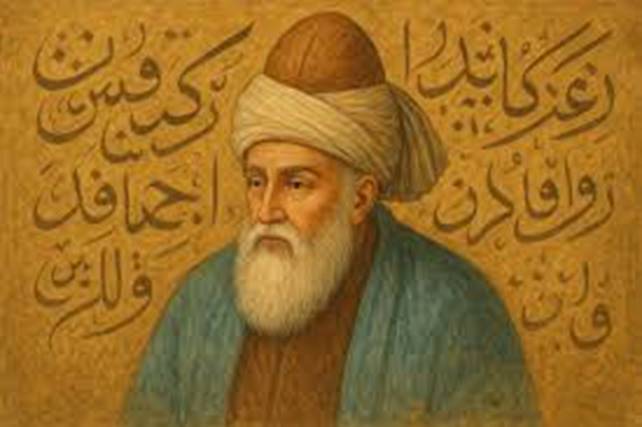
Pakistan Link will publish 19 short biographical essays on some of the greatest spiritual luminaries in Islamic history, from Rābiʿa al-ʿAdawiyya to Jalāl al-Dīn Rūmī and Khwāja Muʿīn al-Dīn Chishtī. Together, these essays would form a coherent spiritual journey—from renunciation and detachment, to ecstatic divine love, and ultimately to the human calling to know, love, and serve God. These essays are condensed from a chapter in Professor Nazeer Ahmed’s recently completed book, Faith, Love and Reason in Islamic History.
Tasawwuf has been one of the great sustaining forces in Islamic history. In times of upheaval and decline, it preserved not only faith, but the inner life of faith, the longing, remembrance, and resilience that kept the lamp of Islam burning. Yet this luminous inheritance is increasingly lost to today’s youth amid modernity, secularism, materialism, war, and the relentless distractions of the digital age. It is our hope that this series will help rekindle that lost flame and inspire a new generation to rediscover the spiritual depths of their tradition. According to the eminent author of ‘Faith, Love and Reason in Islamic History’, Professor Nazeer Ahmed, “no lasting renewal of Muslim civilization can come without spiritual renewal. A civilization must awaken from within before it can rise again.”
Reclaiming our Spiritual Heritage…
Bāyazīd Basṭāmī
By Prof Nazeer Ahmed
Concord, CA
Among the great formative figures of early taṣawwuf, few are as arresting, enigmatic, and influential as Bāyazīd Basṭāmī (d. ca. 874 CE), also known in Persian tradition as Abū Yazīd al-Bisṭāmī. If Ḥasan al-Baṣrī gave early Islamic spirituality its moral seriousness, Rābiʿa al-ʿAdawiyya gave it the language of divine love, and Dhū al-Nūn al-Miṣrī deepened its understanding of maʿrifa (direct experiential knowledge of Asma wa Sifat) then Bāyazīd gave Sufism one of its most dramatic and enduring dimensions: the language of ecstatic nearness, the overwhelming experience of the soul in the presence of the Divine, and the early articulation of what later Sufis would call fanāʾ, the annihilation of the ego before God.
Bāyazīd occupies a defining place in the history of Sufism because he represents a new intensity in the inner life of Islam. Earlier ascetics had stressed repentance, renunciation, fear of divine judgment, and moral vigilance. Bāyazīd did not reject these disciplines, but in the memory of the Sufi tradition, he appears as a figure in whom the fruits of spiritual struggle became so intense that the ordinary boundaries of the self seemed to dissolve in the overwhelming awareness of God. His life and teachings are thus associated not with a carefully systematized doctrine, but with the raw immediacy of mystical experience, a spirituality marked by rapture, astonishment, and states of inward absorption so powerful that ordinary language itself seemed strained to the breaking point.
Historically, Bāyazīd belongs to the third/ninth century, a crucial period in which early Islamic asceticism was developing into a more distinct and self-conscious Sufi tradition. By his time, the vocabulary of the inner life had already begun to expand through figures such as Dhū al-Nūn al-Miṣrī and al-Muḥāsibī. Yet Bāyazīd stands apart because the Sufi memory of him is dominated not primarily by method, ethical discourse, or systematic teaching, but by the intensity of his states. He is remembered as one of the first great exemplars of what later tradition would call sukr (spiritual intoxication).
This notion of “intoxication” in Sufism must be understood carefully. It does not refer to literal intoxication, but to a condition in which the heart becomes so overwhelmed by the remembrance, majesty, or nearness of God that ordinary self-consciousness is eclipsed. In such states, the seeker no longer experiences himself as an independent agent standing before God in ordinary awareness, but as one utterly effaced in divine presence. It is here that Bāyazīd’s name becomes inseparable from the concept of fanāʾ. Though later Sufis would define and refine the term with greater precision, Bāyazīd’s remembered utterances and spiritual profile made him one of its earliest and most vivid exemplars.
He is especially famous for his shaṭaḥāt, ecstatic sayings or paradoxical utterances spoken in moments of overwhelming spiritual absorption. These sayings, preserved in later Sufi literature, are among the most striking in the entire early tradition. They were never understood by the sober masters as normative theological propositions in the ordinary sense, nor as literal claims to divinity. Rather, they were interpreted as expressions of a state in which the ego had become so eclipsed that only the overwhelming consciousness of God remained present to the mystic. In this sense, Bāyazīd’s sayings became crucial for later Sufis because they forced the tradition to ask a profound question: What happens to language when the self that ordinarily speaks has been spiritually effaced?
This is why Bāyazīd’s importance is both spiritual and conceptual. He did not produce formal treatises, nor did he engage in systematic theology in the manner of later scholars. Yet his life and sayings compelled the Sufi tradition to grapple with the limits of ordinary religious language, the meaning of union and nearness, and the distinction between transient spiritual states and enduring theological truths. His legacy thus lies not only in the power of his example, but in the questions he bequeathed to the entire tradition.
At the heart of Bāyazīd’s spirituality is a radical insight: that the soul’s highest realization is found not in the assertion of self, but in its effacement. The ego, with its claims, fears, calculations, and attachments, is the great veil between the seeker and God. When that ego is stripped away through remembrance, love, discipline, and divine grace, the believer does not become God—an idea utterly foreign to orthodox Islam—but rather becomes profoundly aware that there is no true power, agency, or reality apart from God. What appears in ecstatic utterance is not a metaphysical fusion of Creator and creature, but the collapse of egocentric consciousness before the overwhelming reality of the Divine.
This is also where Bāyazīd’s relationship to reason must be understood with nuance. He did not deny the value of reason, nor did he advocate lawlessness or doctrinal chaos. Rather, his remembered spirituality points to the fact that reason has limits. The intellect can guide, distinguish, and protect the seeker from error. It can clarify doctrine and help regulate conduct. But in moments of overwhelming divine nearness, reason as discursive analysis no longer governs the experience. It is not destroyed but surpassed by a mode of knowing that is affective, immediate, and inwardly total. In such moments, the soul does not argue about God; it is consumed by the awareness of God.
Yet the Sufi tradition never allowed this ecstatic mode to stand alone. One of Bāyazīd’s most important historical roles is precisely that he became the paradigmatic example through which later Sufism learned to distinguish between ecstatic experience and its proper interpretation. His legacy helped establish one of the central polarities of classical Sufism: the tension between sukr (intoxication) and ṣaḥw (sobriety). Later masters, above all Junayd al-Baghdādī, would clarify that ecstatic states may be real and spiritually authentic, but they must be understood, governed, and ultimately reintegrated into the stable life of obedience, humility, and ethical discipline.
In this sense, Bāyazīd’s influence is twofold. First, he gave the Sufi tradition a language for the rapture of mystical encounter, for those moments when the nearness of God becomes so overwhelming that the self appears to vanish in awe and love. Second, he helped force the tradition toward greater maturity by making clear the need for spiritual guidance, interpretive caution, and sober reintegration. His legacy is therefore not antinomian or lawless, as it is sometimes misunderstood. Rather, it is a testimony to the power of mystical experience—and to the necessity of grounding that experience within the wider framework of the Sharīʿa, humility, and disciplined spiritual formation.
For contemporary Muslims, Bāyazīd Basṭāmī remains deeply relevant. In an age that often reduces religion either to formal correctness without inner fire or to vague spiritual sentiment without structure, he reminds us that the path to God is neither dry nor superficial. Islam contains depths of intimacy, awe, and inward transformation that can overwhelm the soul. But his example also warns that genuine spiritual intensity requires discernment, guidance, and submission. The deepest experiences are not ends in themselves; they are signs of the soul’s need to disappear before the majesty of God.
Bāyazīd Basṭāmī thus endures as one of the great saints of early Islam and one of the defining architects of ecstatic Sufism. He gave voice to the mystery of fanāʾ, to the soul’s trembling nearness to God, and to the possibility that in the highest moments of remembrance, the ego may fall silent before the only true Reality. Yet his legacy also helped prepare the way for the sober balance of later masters, showing that mystical intensity must be held within the luminous discipline of the Prophetic path. In the history of taṣawwuf, Bāyazīd remains the saint of ecstasy, one whose burning nearness still challenges and inspires seekers on the path to God.
(The author is Director, World Organization for Resource Development and Education, Washington, DC; Director, American Institute of Islamic History and Culture, CA; Member, State Knowledge Commission, Bangalore; and Chairman, Delixus Group)