Book & Author
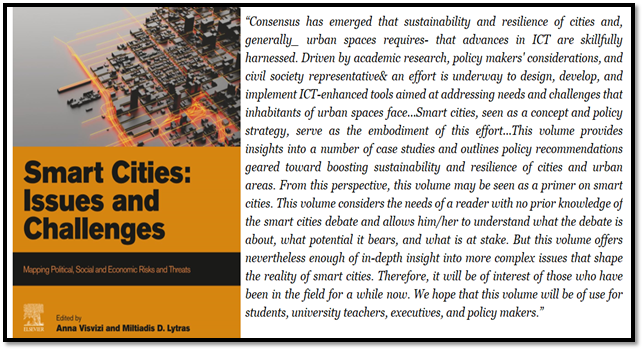
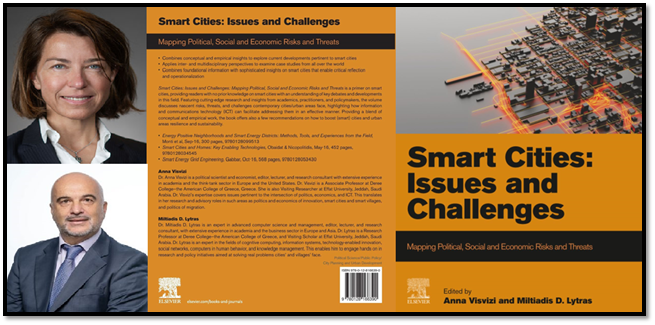
Anna Visvizi & Miltiadis Lytras (editors): Smart Cities: Issues and Challenges —Mapping Political, Social and Economic Risks and Threats
By Dr Ahmed S. Khan
A Smart City refers to a city that uses digital technologies, data, and connectivity to improve how the city functions and citizen’s needs. The core idea is to use technology wisely to support people, governance, and long-term urban sustainability.
A smart city collects data—from sensors, devices, and people—analyzes it, and uses the insights to manage city services better—such as transportation, energy, water, waste, public safety, and healthcare—while improving the quality of life.
Smart cities typically involve several connected elements: (a) Technology-enabled infrastructure: Use of information and communication technologies (ICT) and the Internet of Things (IoT) to monitor roads, utilities, buildings, and public spaces; (b) Data-driven decision-making: Real-time and historical data help city leaders plan, predict issues, and respond faster; (c) Efficient public services: Smarter traffic control, energy management, water distribution, waste collection, and emergency response; (d) Sustainability focus: Reduced energy use, lower emissions, and more efficient use of natural resources; and (e) Citizen engagement: Digital platforms that let residents report issues, access services, and participate more easily in city life.
Examples of “smart” applications also known as smart city initiatives, include: (a) Adaptive traffic lights that respond to congestion, (b) Smart meters that track energy or water use, (c) Sensors that monitor air quality or waste levels, (d) Digital platforms for reporting city issues or paying services online, and (e) These kinds of applications are commonly cited as part of smart city initiatives.
The rapid integration of artificial intelligence (AI) into smart cities is transforming urban governance, public service delivery, and everyday life. AI‑enabled systems now support traffic management, public safety, utilities, and digital governance by processing large volumes of data generated from sensors, cameras, mobile devices, and online platforms. While these technologies promise greater efficiency, sustainability, and responsiveness, they also raise critical ethical concerns related to privacy, surveillance, algorithmic bias, accountability, and social inclusion.
In response, researchers across disciplines are increasingly examining the ethical implications of AI in smart cities, with particular attention to the roles and responsibilities of governments, technology providers, and informed, engaged citizens who actively shape the ethical deployment of AI in urban environments. Reflecting this growing interest, the State University of New York (SUNY) at Fredonia recently hosted an international seminar - the Kraus Seminar on Smart City Research (SCRES’26) - dedicated to advancing the future of smart cities. The seminar aimed to foster collaboration, share innovative solutions, and explore strategies for building resilient, efficient, and inclusive urban environments.
Distinguished researchers from around the world presented their latest work on critical topics, including artificial intelligence in urban systems, sustainable infrastructure, intelligent transportation, IoT‑enabled services, data‑driven governance, and the ethical challenges and accountability of AI in smart cities.
The accelerating global turn toward “smart city” models—characterized by the integration of digital technologies, data analytics, and networked infrastructures into urban governance—has generated both enthusiasm and skepticism. Amid promises of efficiency, sustainability, and enhanced quality of life, critical questions persist regarding governance, equity, security, and democratic accountability. Smart Cities: Issues and Challenges: Mapping Political, Social and Economic Risks and Threats, edited by Anna Visvizi and Miltiadis Lytras, enters this debate as a substantial, multidisciplinary contribution.
Dr Anna Visvizi is an economist and political scientist and a faculty member at The American College of Greece. Her work focuses on international economics and international politics, with particular emphasis on the impact of technology on the economy, politics, and society. Her research interests include smart cities, the emergence of innovation, and competitiveness.
Dr Miltiadis D. Lytras is a faculty member at The American College of Greece and an internationally recognized expert in Knowledge Management, Data Science, Artificial Intelligence, and Digital Transformation. His work focuses on applications in government, education, smart cities, and digital health.
The book explicitly aims to map the political, social, and economic risks and threats associated with contemporary smart city initiatives, rather than promoting a purely technocratic or celebratory narrative. The volume brings together cutting‑edge research and perspectives from academics, practitioners, and policymakers worldwide, combining conceptual academic analysis with empirically grounded case studies.
Consisting of 18 chapters, the book is organized into four thematic parts — Managing public space: democracy, participation, wellbeing; Safety, security, resilience; Smart cities sustainability; and, Global contexts — that reflect central dimensions of the smart city discourse.
Each section comprises chapters that address specific issues, such as ICT‑enhanced surveillance systems, public safety policies using volunteered geographic information, civic participation through social media, knowledge‑society technologies, mental health, and sustainable development within smart city ecosystems.
In the preface, the editors commenting on the relationship between technology and modern cities, observe: "This volume and, indeed, the process of making it come to live, attest to the key topic and the key message that this book conveys, i.e., that the dialogical relationship between information and communication technology (ICT) and our lives unfolds in the theater of modern cities. ICT proved to be the key enabler in the process of conceiving this volume, working with our authors and the Publisher as we were changing the geographical venues and—by default—were testing the degree of "smartness" of the cities that we visited. Athens, Berlin, Warsaw, Rome, Trikala, Jeddah, Mons, Mexico City, Ottawa, Barcelona, and New York are just a few of the places that we had the opportunity to visit when working on this volume and see into the ways advances in ICT are employed to benefit cities' inhabitants.”
The editors expounding on the state of surveillance and monitoring, and research on smart cities, note: “… and as cities transition toward being smarter, several contentious issues arise. These include seemingly irreconcilable juxtapositions such as the one of how much surveillance and monitoring is needed to ensure safety in city space or, for instance, to what extent feedback obtained from social media and decisions infused with that feedback are legitimate. A great number of questions are bound to emerge. The good news is that research on smart cities has been unfolding for a considerable while now. Today, the momentum has come for the diverse strands of research on smart cities to engage in dialog and cross-fertilize discussion otherwise taking place in a considerable disconnect.”
One of the book’s core contributions lies in its critical framing of smart cities as socio‑technical systems, rather than neutral technological upgrades. Across chapters, smart city technologies are examined in relation to power, governance, and institutional capacity. The volume’s stated emphasis on “mapping risks and threats” signals a departure from purely solutionist narratives, encouraging readers to interrogate the unintended consequences of digital urbanism.
From an analytical perspective, the book highlights how data‑driven governance can reproduce existing inequalities if it lacks inclusive decision‑making structures. The recurring attention to civic participation and democratic processes reflects an understanding that smartness in cities is not merely a function of technological sophistication, but also of social legitimacy and trust.
The volume draws on global case studies, referencing cities and regions across Europe, the Middle East, and beyond. This comparative orientation enables readers to see how smart city strategies are shaped by diverse political economies, governance traditions, and cultural contexts.
While the book does not claim exhaustive global coverage, its inclusion of cities outside the often‑cited North American and Western European contexts broadens the analytical lens. This is particularly relevant for understanding how smart city models are adapted—or contested—in rapidly urbanizing regions.
A recurring theme throughout the book is the tension between data‑driven efficiency and democratic accountability. Chapters on civic participation and social media, as described in publisher materials, explore how digital platforms can both enable and constrain public engagement.
The section on safety and security addresses ICT‑enhanced monitoring and surveillance systems, public safety policies, and resilience. These chapters engage with the ethical and political dilemmas associated with pervasive data collection in urban spaces. Rather than framing surveillance as an unequivocal benefit, the book foregrounds its promise and limitations, prompting reflection on privacy, civil liberties, and trust in public institutions.
Reflecting on the ethical dimensions, the book raises uncomfortable questions about the "Algorithmic City." If an AI manages traffic flow, does it prioritize the speed of private vehicles (economic efficiency) or the safety of pedestrians (social welfare)? The contributors argue for a "Value-Sensitive Design" approach, where ethical considerations are baked into the code of urban systems from day one.
While the book’s focus on risks and challenges constitutes a major contribution, readers seeking highly technical or operational guidance on smart city implementation may find this aspect intentionally limited. The volume does not aim to function as a technical manual, and this should be understood as a deliberate editorial choice rather than a weakness.
Reflecting on what the contributors describe as the “smartness paradox,” the book argues that greater technological integration can increase urban fragility. While artificial intelligence and the Internet of Things promise efficiency and optimization, they also introduce new vulnerabilities, including cybersecurity risks, fragmented data ecosystems, and algorithmic bias. Addressing these challenges, the volume contends, requires sophisticated non‑technological responses—such as robust governance structures, ethical oversight, and social engagement—alongside technical innovation.
In summary, the central argument of the book is that a city’s “smartness” is not a binary condition but a dynamic and ongoing process. The editors emphasize that technology should be treated as an enabler rather than an end in itself. Within this framework, the volume identifies three key spheres of tension that shape smart city development: the technological–structural, the governance–institutional, and the human–social.
Smart Cities: Issues and Challenges stands as a thoughtful and critically engaged contribution to the smart city literature. By foregrounding political, social, and economic risks alongside technological possibilities, the volume challenges readers to move beyond simplistic narratives of urban “smartness.” Grounded in interdisciplinary scholarship and enriched by global case studies, it offers enduring insights into the governance, ethical dimensions, and human consequences of data‑driven urban transformation.
For scholars and policymakers seeking a nuanced understanding of smart cities—not merely as technological projects but as contested sociopolitical arenas—this book provides a valuable and timely resource. It is essential reading for anyone involved in building, governing, or inhabiting the cities of tomorrow. The volume serves as a reminder that the most “intelligent” cities are not those with the greatest number of sensors, but those that deploy data to advance human flourishing, environmental sustainability, and democratic participation.
In the context of the contemporary urban landscape — where the integration of artificial intelligence is no longer optional but increasingly necessary for resilience in a climate‑stressed world — this book offers a critical framework for ensuring that our cities remain not only smart, but humane.
[Dr Ahmed S. Khan (dr.a.s.khan@ieee.org) is a Fulbright Specialist Scholar. Professor Khan has more than 40 years of experience in Higher Education as professor of Electrical Engineering, Chair and Dean of the College of Engineering and Information Sciences. He is the author of many academic papers, technical and non-technical books, and a series of books on Science, Technology & Society (STS) — used globally in the academic programs of more than 200 universities.]