Book & Author
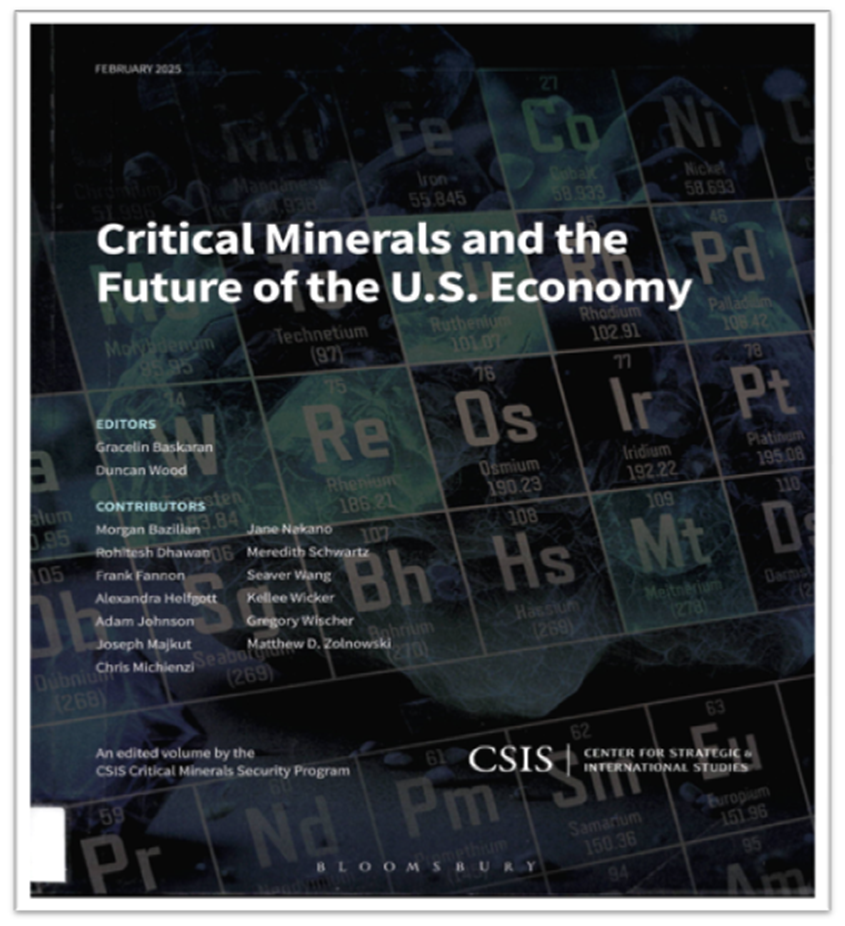
Gracelin Baskaran & Duncan Wood (Eds.): Critical Minerals and the Future of the U.S. Economy
By Dr Ahmed S. Khan
Critical minerals serve essential functions across modern technology and defense: lithium, cobalt, and nickel power electric vehicle batteries and energy storage systems; rare earths are vital for permanent magnets in wind turbines, EV motors, and military guidance systems; and graphite, copper, and specialized metals like gallium and germanium form the backbone of electronics, semiconductors, and renewable power infrastructure.
The global critical minerals market is driven by surging demand and intense geopolitical competition, with extraction and midstream processing remaining heavily concentrated despite international efforts to diversify supply chains. Market leaders vary by mineral: China dominates rare earth element extraction (69%) and natural graphite (78%), the Democratic Republic of the Congo mines over 70% of global cobalt, Indonesia accounts for nearly two-thirds of nickel output, Australia leads in hard-rock lithium mining (32%), and Chile serves as the principal source of copper (23%) and brine-extracted lithium.
Crucially, China controls 70% to 90% of global midstream refining across these categories, giving it substantial leverage over refined materials. The United States maintains a modest footprint in raw extraction—ranking second in rare earths via California’s Mountain Pass mine—but remains heavily dependent on imports for most of its critical mineral needs. To bolster its supply security, the US is expanding domestic subsidies through federal funding programs, building strategic stockpiles like Project Vault, developing processing facilities, and expanding international alliances like the Minerals Security Partnership.
Critical Minerals and the Future of the U.S. Economy , an edited volume compiled by Gracelin Baskaran and Duncan Wood under the auspices of the Center for Strategic and International Studies (CSIS), offers an authoritative examination of the vulnerabilities and strategic imperatives defining the American raw materials supply chain. Gathering insights from a broad group of policy, industry, and geopolitical experts, the book positions critical minerals not merely as commodities, but as the foundational bedrock of 21st-century economic competitiveness, national defense, and technological leadership. Structured around a multi-sector analysis followed by actionable strategic recommendations, the volume underscores how heavily reliant key American industries—from electric vehicles and semiconductors to defense systems and renewable power grids—are on inputs that remain overwhelmingly controlled by foreign competitors, particularly China.
The co-editors of the volume are Dr Gracelin Baskaran, the director of the Critical Minerals Security Program at the Center for Strategic and International Studies (CSIS) and a mining economist with extensive international and academic experience, and Dr Duncan Wood, president and CEO of the Pacific Council on International Policy who previously held leadership and advisory roles at the Wilson Center.
The volume features contributions from a diverse group of prominent experts, researchers, and former government officials specializing in public policy, energy security, defense, and trade. The contributors include Dr Morgan Bazilian and Gregory Wischer focusing on the Colorado School of Mines and public policy; Rohitesh Dhawan representing the International Council on Mining and Metals; and Frank Fannon, former assistant secretary of state for energy resources. Other contributors consist of Alexandra Helfgott, Adam Johnson, Dr Joseph Majkut, and Christine Michienzi, who previously served as chief technology officer at the Office of the Secretary of Defense. The roster is rounded out by Jane Nakano, Meredith Schwartz, Dr Seaver Wang, Kellee Wicker, and Matthew Zolnowski, a former special advisor for strategic materials at the US Department of Defense.
Mining has historically served as the foundational bedrock of American economic strength, national security, and industrial capability, providing essential raw materials for infrastructure, technology, and defense systems. However, the United States now faces severe strategic vulnerabilities due to extreme import reliance, depending entirely on foreign sources for 12 critical minerals and over 50 percent for another 29. This overreliance leaves key US industries—including semiconductors, defense, automotive, and renewable energy—vulnerable to export restrictions weaponized by China, which heavily dominates global supply chains. These external risks are compounded by domestic institutional bottlenecks, such as a fragmented governance structure featuring 15 separate agencies without a central coordinating body, the lack of a unified critical minerals list, and a permitting process that ranks as the second-longest in the world. Address these systemic challenges is vital to safeguarding US industrial competitiveness and national security.
Recent presidential administrations have elevated critical minerals security to a bipartisan priority, deploying executive actions and legislative measures like the Inflation Reduction Act, the CHIPS and Science Act, and the Defense Production Act to spark private investment and fund projects. International initiatives, such as the Minerals Security Partnership, further aim to diversify global supply chains alongside allied democracies. However, significant vulnerabilities remain, particularly in midstream processing, where China retains a near-monopoly on refining essential elements like rare earths, lithium, and cobalt. To resolve these gaps and ensure long-term security, policymakers must execute comprehensive reforms: modernizing the domestic mining permitting framework under high environmental standards, expanding domestic refining infrastructure, utilizing commercial diplomacy in emerging markets, exploring frontier resources like deep-sea mining, and creating a single point of governmental accountability. These coordinated steps are essential to protecting America's technological edge, military readiness, and economic resilience.
Semiconductors serve as the foundational building blocks of modern technology, enabling everything from consumer electronics to advanced defense, quantum computing, and aerospace systems. Integrated circuits depend heavily on critical minerals such as silicon, gallium, and germanium for wafer production, alongside elements like palladium, copper, and titanium for doping, wiring, and packaging. These materials provide superior electron mobility and power density vital for high-performance applications.
However, the supply chains for these inputs are severely concentrated in China, which controls the vast majority of global production and refining for silicon, titanium, gallium, and germanium. This dynamic exposes the United States to major national security risks, as demonstrated by Chinese export restrictions and bans that have spiked prices and threatened US economic output. Because these rare elements are recovered primarily as byproducts of aluminum and zinc processing, Western producers struggle to compete against subsidized Chinese oversupply.
While the CHIPS and Science Act successfully funded downstream semiconductor fabrication facilities, it omitted provisions for upstream mineral supply chains. To bridge this gap, policymakers must fund Department of Commerce research laboratories to enhance refining expertise and enact targeted tax credits and grant incentives for domestic and allied projects, thereby securing the raw materials required for semiconductor manufacturing.
Critical minerals form the furthest upstream tier of defense supply chains, proving essential for nearly all Department of Defense (DOD) platforms through direct applications, such as titanium and aluminum aircraft components, and indirect uses like petroleum refining catalysts. To assess national defense requirements, the DOD utilizes economic models managed by Defense Logistics Agency Strategic Materials. However, these models rely on an optimistic post-Cold War "short war" planning construct consisting of a one-year conflict and a three-year reconstitution period. Under this baseline, a 2023 report identified critical mineral shortfalls for 69 defense materials valued at $2.41 billion, alongside civilian shortfalls for 24 materials valued at $12.21 billion.
To address these vulnerabilities, the DOD leverages several administrative mechanisms. Defense Production Act (DPA) Title I allows the military to prioritize defense orders via roughly 300,000 rated contracts annually. Sourcing regulations like the "specialty metals clause" restrict purchasing alloys and rare earth magnets from adversarial nations, while Defense Authorization Act reforms have modernized the National Defense Stockpile. Industrial base programs, including DPA Title III, further assist companies in transitioning from research to commercial production.
Significant policy gaps persist despite these measures. Unpredictable financing remains a major challenge, as nearly 70 percent of DOD critical mineral funding ($778 million) comes from supplemental appropriations rather than base budget requests. Additionally, mobilization doctrines under Joint Publication 4-05 have not been updated since 1995 to account for modern industrial expansion, and complex sourcing rules impose steep compliance burdens on defense suppliers.
While the United States has expanded its raw mining capacity, it faces a critical midstream bottleneck in processing and refining essential minerals. extracted domestic materials like rare earth elements and copper are often exported to China for refining, only to be repurchased as finished components. This reliance on foreign processing—where China holds absolute dominance—exposes the US to severe geopolitical vulnerabilities, price manipulation, and supply chain disruptions.
The domestic midstream sector is constrained by technical complexities in pyrometallurgy and hydrometallurgy, high energy costs, environmental hurdles, and severe workforce shortages in mining and metallurgical engineering. Additionally, non-exchange-traded mineral markets lack price transparency and liquidity, deterring private sector investment.
To overcome these barriers, the US must execute a comprehensive strategy. First, establishing a National Critical Minerals Workforce Initiative will rebuild the technical talent pipeline through educational grants and loan forgiveness. Second, creating a federally backed US Critical Minerals Reserve will stabilize prices and mitigate market risks for private investors. Finally, modernizing the federal permitting process by expanding FAST-41 and deploying programmatic environmental reviews will eliminate bureaucratic delays, securing long-term US economic resilience and technological leadership.
To conclude the book the editors state that critical minerals security is a vital imperative for US national security, economic competitiveness, and the clean energy transition, as defense technologies, semiconductors, electric vehicles, and renewable energy rely heavily on these materials. The United States faces severe risks from overreliance on China, which controls critical supply chains and has previously weaponized exports of materials like gallium, germanium, antimony, and graphite.
Because complete domestic independence is unfeasible, the US must adopt a strategy centered on domestic development, recycling technologies, and international partnerships. To accomplish this, ten key policy recommendations are outlined: expanding production incentives beyond the current scope of the Inflation Reduction Act and CHIPS Act; investing in innovation and recycling; and strengthening National Defense Stockpile mechanisms to stabilize volatile markets. Additionally, the framework calls for establishing single-point accountability across federal agencies, supporting responsible mining and deep-sea standards, expanding financing instruments like price floors, and creating a National Critical Minerals Workforce Initiative. Finally, streamlining domestic permitting under FAST-41 and NEPA, pursuing strategic international partnerships like the Minerals Security Partnership, and bolstering the defense industrial base are essential to securing long-term supply resilience.
To fully secure the defense industrial base against future emergencies, the contributors outline four primary recommendations. First, the Joint Staff must update war-planning assumptions to reflect the Department of Defense's shift toward preparing for protracted conflict; ensuring base budgets do not underestimate critical mineral requirements. Second, the Department of Defense and Joint Staff should modernize Joint Publication 4-05 to realign industrial mobilization doctrine with modern response strategies. Third, Congressional defense committees must stabilize funding by providing predictable program increases and transfers within base budget mobilization programs. Finally, defense acquisition authorities should streamline complex, overlapping sourcing rules to reduce compliance barriers for contractors.
The book's greatest strength lies in its detailed sectoral framework and policy clarity. Rather than treating critical minerals as a monolithic category, Baskaran and Wood divide the volume to systematically evaluate how specific supply disruptions affect individual sectors. For instance, the chapters mapping the semiconductor and defense manufacturing bases highlight exact material bottlenecks, such as dependence on refined rare earth elements, gallium, and germanium. This granular focus moves the discussion beyond abstract economic theory and provides concrete risk assessments. Furthermore, the contributors do not limit their focus to raw extraction; they place necessary emphasis on midstream refining and processing capacity. By illustrating that raw extraction without domestic or allied refining infrastructure leaves the nation equally vulnerable, the editors offer a holistic blueprint that addresses domestic permitting reforms, commercial diplomacy, deep-sea mining considerations, and streamlined interagency coordination.
However, the volume carries noticeable limitations inherent to policy-driven edited collections. Its focus is overwhelmingly holistic US-centric, which occasionally leads to an oversimplified treatment of international partners' competing domestic interests. While the authors advocate for robust commercial diplomacy and alliances like the Minerals Security Partnership, the text at times minimizes the political, environmental, and economic friction that developing nations face when asked to serve as raw material suppliers for Western supply chains. Additionally, because the market dynamics, technological requirements, and trade restrictions surrounding critical minerals evolve at a rapid pace, some of the specific legislative and market projections risk becoming quickly outdated. Despite these constraints, Baskaran and Wood deliver a vital, practical, and highly engaging blueprint that serves as an essential resource for policymakers, industry leaders, and scholars navigating the geopolitics of resource security.
(Dr Ahmed S. Khan — dr.a.s.khan@ieee.org— is a Fulbright Specialist Scholar.)