Book & Author
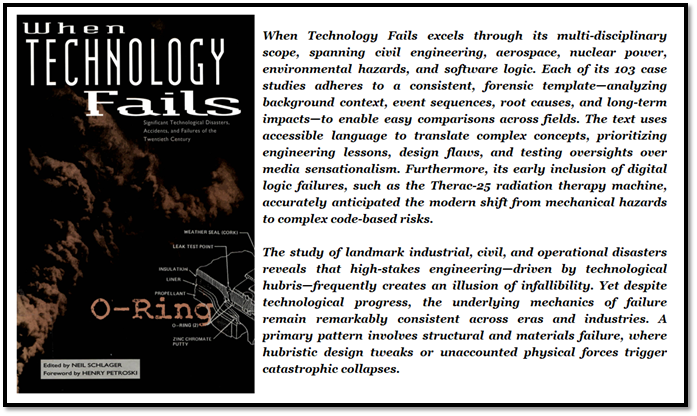
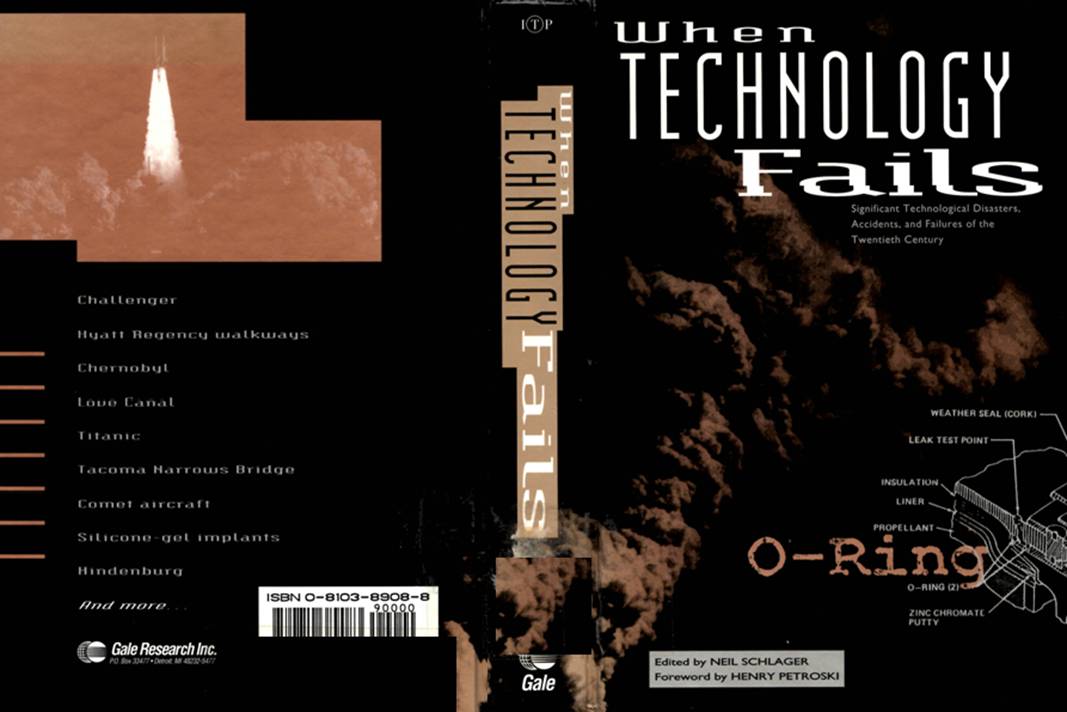
Neil Schlager (Ed.): When Technology Fails — Significant Technological Disasters, Accidents, and Failures of the Twentieth Century
By Dr Ahmed S. Khan
The August 26, 2026, Himalayan rock-and-glacier collapse near Langtang-Lirung ranks as one of the most severe modern examples of cryospheric hazards overwhelming state-of-the-art engineering. In terms of physical and systemic impact, it stands alongside historical benchmark disasters—such as the 2011 Fukushima nuclear meltdown or the 2021 Chamoli flash flood in India—where natural forces exposed critical blind spots in high-tech design. The disaster crippled Nepal's energy sector by destroying or disabling 12 to 14 major hydropower plants along the Trishuli corridor, instantly severing approximately 10% of the nation's total power-generating capacity.
Like the Chamoli event, the hyper-concentrated slurry surge overwhelmed subterranean engineering, inundating deep headrace tunnels and powerhouses to trap nearly 1,000 workers inside facilities previously deemed structurally resilient. Furthermore, by destroying the $1.2 billion Rasuwagadhi land-port infrastructure, the surge erased the primary overland commercial artery between Nepal and China.
In human and economic impact, the 2026 disaster severely surpasses recent regional hazards. Causing over 1,000 deaths, 3,200 missing, and $8 billion in damages—over 10% of Nepal’s GDP—it became the region’s deadliest slope failure in decades. Crucially, traditional rain gauges and weather radars failed because thermal permafrost thaw triggered the catastrophic collapse on a dry day, rather than via a cloudburst or lake outburst. By generating energy equivalent to a magnitude 5.2 earthquake that temporarily confused automated sensors, the disaster proved that state-of-the-art infrastructure in warming cryospheric zones remains fundamentally fragile without integrated, basin-wide multi-hazard AI monitoring networks.
Experts attribute the environmental instability that triggered the catastrophic August 26, 2026, Himalayan disaster along Nepal’s Bhote Koshi and Trishuli corridors directly to global warming. A regional atmospheric temperature rise of roughly 1.8°C has systematically degraded high-altitude permafrost, which serves as a vital structural binder within bedrock fissures. This thermal thaw severely compromised the mountain face beneath Langtang-Lirung at 5,200 meters, causing a massive section of bedrock to shear off alongside a thinned, heavily fractured 0.56 km² hanging glacier. Geologists from institutions such as ICIMOD and the US Geological Survey (USGS) noted that while local geology dictated where the slope failed, climate-driven warming established the conditions that determined when and how violently it collapsed.
Plunging over 1,000 meters into the valley at speeds exceeding 160 km/h, the massive mass generated immense kinetic energy and frictional heat. This instantly liquefied the near-melting ice, transforming the collapse into a fast-moving, hyper-concentrated slurry of water, mud, and boulders without requiring heavy monsoon rainfall. Ultimately, the disaster underscores a critical paradigm shift: climate warming is actively driving non-precipitation, cryosphere-triggered slope failures that pose severe threats to downstream communities and infrastructure.
High-altitude mountain ranges globally face severe risks from catastrophic rock-and-glacier collapses driven by permafrost thaw and extreme terrain. In the Peruvian Andes, thawing ice threatens populated valleys and hydroelectric stations. Central Asia’s Pamir and Tian Shan ranges risk river-damming avalanches that imperil trade corridors and dams. Rising temperatures in the European Alps weaken mountain cohesion, endangering alpine communities, while North America’s Alaska Range faces debris surges that threaten vital regional infrastructure.
The Hindu Kush mountain range—spanning Afghanistan, Pakistan, and Tajikistan—faces severe vulnerability to catastrophic, high-altitude cryospheric failures similar to the 2026 Himalayan disaster. Driven by accelerating atmospheric warming, deep permafrost thaw above 4,000 meters is eroding the structural cohesion of steep rock faces in high-relief zones like the Tirich Mir and Chitral massifs. When these destabilized ice-rock masses collapse, they drop thousands of meters into narrow gorges, rapidly transitioning into high-velocity, hyper-concentrated slurry flows that overwhelm conventional river-level defenses.
This structural vulnerability is further compounded by the prevalence of surge-type glaciers and thousands of glacial lakes across the range. A major rock-ice detachment falling into a glacial lake can generate massive displacement waves that breach moraine dams, while glacier surges can temporarily block river channels to create unstable impoundments prone to sudden outburst breaches. These cascading surges directly threaten vital downstream infrastructure, including run-of-the-river hydropower projects, agricultural networks, and critical transport arteries like the Salang Pass and the Karakoram Highway along the Swat, Chitral, and Kabul river basins.
Compounding these physical hazards are significant socio-technical and geopolitical vulnerabilities. Unlike regions with dense monitoring infrastructure, the Hindu Kush lacks comprehensive high-altitude seismic and Synthetic Aperture Radar (SAR) sensor coverage needed to detect pre-collapse slope displacement. Furthermore, because its main river corridors span international borders, the absence of real-time transboundary data-sharing protocols ensures that an upstream failure in one jurisdiction can strike downstream populations across the border with virtually no advance warning.
Mitigating cascading high-altitude disasters requires shifting from reactive flood management to proactive, multi-layered strategies. Prevention relies on high-altitude remote sensing using Synthetic Aperture Radar and seismic networks to detect slope shifts before catastrophic failures occur. Downstream, emergency response is accelerated through zone-targeted Cell Broadcast technology, automated sirens, and cross-border data-sharing protocols. Additionally, climate-resilient engineering must mandate subterranean bulkheads for mountain hydropower infrastructure, strict floodplain zoning, and basin-wide cumulative risk assessments. Finally, legally binding protocols ensure automated warnings immediately trigger mandatory community evacuations without administrative delays.
Artificial intelligence (AI) and Internet of Things (IoT) sensors are transforming disaster management in mountainous environments, shifting the focus from reactive recovery to proactive risk mitigation. Orbital satellites using InSAR and machine learning analyze radar data and drone imagery to map ground displacement and pinpoint micro-cracks before slope failures occur. On the ground, seismic arrays, tiltmeters, and river gauges detect rockfalls, pore-pressure shifts, and dangerous river blockages in real time. Multi-hazard neural networks process these data streams to model avalanche and surge probabilities, predicting downstream inundation zones. Ultimately, these integrated systems safeguard critical infrastructure and autonomously trigger targeted cell broadcasts and acoustic sirens within seconds of a threat. To protect vulnerable communities worldwide, existing early warning networks must be strengthened to maximize emergency response times, while new sensor networks must be deployed across unmonitored high-altitude glacial regions.
The dynamic between nature's raw force and modern engineering reveals a recurring vulnerability: extreme natural phenomena consistently expose systemic design flaws, proving that advanced infrastructure remains remarkably fragile when facing unmodeled hazards. In Libya, 2023’s Storm Daniel overtopped two neglected dams constructed around outdated hydrological assumptions, releasing a 30-million-cubic-meter torrent through Derna that claimed over 4,000 lives. Similarly, 2021’s Winter Storm Uri brought the Texas power grid within minutes of a total system collapse when un-winterized gas wells and freeze-sensitive plant instrumentation failed during unprecedented Arctic conditions. In India, the 2021 Chamoli rock-ice avalanche overwhelmed hydropower stations engineered solely for conventional liquid flooding, inundating subterranean work bays with a high-density slurry surge and trapping over 200 workers underground. Finally, Japan's 2011 Fukushima Daiichi nuclear meltdown occurred after a 14-meter tsunami overtopped protective seawalls, flooding low-lying basement compartments and disabling the emergency backup generators required to cool reactor cores. State-of-the-art technology is far from infallible; whenever risk models fail to anticipate the full scale, intensity, and compound nature of environmental threats, even the most sophisticated engineering remains deeply vulnerable.
In an era defined by seamless technological automation, rapid infrastructural expansion, and ever-increasing dependencies on complex systems, Neil Schlager’s seminal reference volume, When Technology Fails: Significant Technological Disasters, Accidents, and Failures of the Twentieth Century, stands as a sobering testament to human fallibility.
Published by Gale Research in 1994, this comprehensive encyclopedic work presents and analyzes 103 of the most consequential technological catastrophes of the twentieth century. From structural collapses and maritime collisions to nuclear meltdowns, transportation tragedies, and chemical leaks, Schlager et al. construct an exhaustive chronicle of what happens when human ingenuity outpaces human foresight.
Far from being a mere collection of sensationalist disaster stories, When Technology Fails is a meticulously researched, highly structured academic reference designed to probe the root causes of technological breakdown. By examining cases spanning from the early 1900s through the early 1990s, the volume provides engineers, historians, policymakers, and general readers with a critical framework for understanding failure not as an isolated anomaly, but as an inherent property of complex socio-technical systems.
The organizing principle of When Technology Fails is both intuitive and analytical, categorizing its 103 case studies into nine core domains. It explores transportation disasters across Air (e.g., DC-10 cargo door failures, Munich air disaster), Space (e.g., Apollo 1 fire, Challenger), Rail (e.g., Malbone Street Wreck, Armagh disaster), and Maritime sectors (e.g., RMS Titanic, Exxon Valdez, Torrey Canyon). Beyond transit, the text examines engineering and structural failures during natural events under Earthquakes and Natural Disasters, as well as general Structural Failures like the Kansas City Hyatt Regency walkway, Tacoma Narrows Bridge, and St. Francis Dam. Finally, it addresses high-consequence operational hazards through dedicated categories for Nuclear and Radiation Accidents (e.g., Three Mile Island, Chernobyl), Environmental and Chemical Hazards (e.g., Bhopal, Love Canal), and Computer and Software Failures (e.g., Therac-25 radiation overdoses, early military radar glitches).
Each entry follows a standardized, highly rigorous template designed to facilitate cross-case comparison. This structure begins with an Overview & Timeline that provides a concise summary of the event—including the exact date, location, loss of life, financial damage, and immediate legal outcomes—followed by the Background & Technical Context detailing the historical, political, economic, and engineering backdrop surrounding the technology's design and deployment. The entry then presents The Disaster / Event Sequence as a step-by-step chronological reconstruction of the failure as it unfolded in real time, leading directly into the Investigation & Root Cause Analysiswith detailed findings from official inquiry boards, forensic engineering teams, and post-accident academic analyses. It closes with Impact & Legacy, which examines the long-term regulatory, structural, design, and societal changes prompted by the disaster, and a Further Reading list featuring primary sources, official government inquiry reports, and academic literature for deeper research. This structural consistency is one of the book’s greatest strengths; rather than drowning the reader in dramatic prose or sensationalist journalism, the book maintains an objective, forensic tone that prioritizes technical accuracy, operational context, and systematic analysis.
The study of landmark industrial, civil, and operational disasters reveals that high-stakes engineering—driven by technological hubris—frequently creates an illusion of infallibility. Yet despite technological progress, the underlying mechanics of failure remain remarkably consistent across eras and industries. A primary pattern involves structural and materials failure, where hubristic design tweaks or unaccounted physical forces trigger catastrophic collapses. This overconfidence is clearly demonstrated by the double-loaded support rods in the 1981 Hyatt Regency walkway collapse, the aeroelastic flutter in the 1940 Tacoma Narrows Bridge failure, and the progressive flat-slab collapses at Harbour Cay Condominium (1981) and L'Ambiance Plaza (1987).
Beyond physical design, organizational hubris plays a critical role through complex system normalization and institutional blindness; the 1986 Space Shuttle Challenger disaster illustrates how administrative pressure can override known technical risks, like O-ring vulnerability in cold weather. Additionally, human-machine interface issues and operational misjudgments frequently escalate minor anomalies into full-scale disasters, as seen in the ambiguous instrumentation at Three Mile Island (1979), operator error combined with reactor design flaws at Chernobyl (1986), and pylon damage from improper maintenance on American Airlines Flight 191 in 1979.
Finally, corporate hubris and environmental toxicity highlight the severe ethical dimensions of industrial operations. The 1984 Bhopal Gas Tragedy in India shows how a deadly mix of deferred maintenance, disabled safety systems, understaffing, and poor municipal zoning near a Union Carbide plant can culminate in an unprecedented civilian catastrophe—a pattern mirrored in the ecological devastation of the 1989 Exxon Valdez oil spill and the naval implosion of the USS Thresher in 1963. Ultimately, because pre-deployment testing for massive structures is often impossible, real-world operation serves as the ultimate empirical test, where human overconfidence inevitably drives essential safety reforms and technical advancements after disaster strikes.
When Technology Fails excels through its multi-disciplinary scope, spanning civil engineering, aerospace, nuclear power, environmental hazards, and software logic. Each of its 103 case studies adheres to a consistent, forensic template—analyzing background context, event sequences, root causes, and long-term impacts—to enable easy comparisons across fields. The text uses accessible language to translate complex concepts, prioritizing engineering lessons, design flaws, and testing oversights over media sensationalism. Furthermore, its early inclusion of digital logic failures, such as the Therac-25 radiation therapy machine, accurately anticipated the modern shift from mechanical hazards to complex code-based risks.
Despite these achievements, the book exhibits notable limitations when viewed from a contemporary perspective. Because the text covers over a hundred individual cases within a single volume, the entry lengths remain relatively brief, providing high-level overviews rather than mathematically rigorous, granular forensic breakdowns. The volume also lacks deep engagement with formal academic system-safety frameworks, relying on descriptive narrative histories rather than explicitly applying models like Charles Perrow's Normal Accidents theory or James Reason's Swiss Cheese Model.
Additionally, because entries were drafted by a varied panel of scholars, journalists, and technical writers, the depth of technical nuance fluctuates slightly throughout the text.
Finally, its 1994 publication date creates an inevitable temporal cutoff, omitting modern landmark disasters—such as Deepwater Horizon, the Fukushima Daiichi meltdowns, and the Boeing 737 MAX flight control software crashes—that have fundamentally reshaped modern risk analysis and safety engineering.
When Technology Fails remains a landmark work in Science, Technology, and Society (STS) studies, serving as both an authoritative reference and a cautionary treatise on human hubris. Its central lesson is that safety is never a static achievement, but a continuous, vigilant practice.
The volume shows that technological progress is intrinsically linked to failure. Progress occurs not by avoiding risk altogether, but by rigorously analyzing breakdowns when they occur, accepting institutional accountability, and embedding the lessons learned into future designs. For educators, engineering students, safety managers, and readers interested in the hidden mechanics of modern civilization, When Technology Fails remains an essential, thought-provoking reference that underscores the fragile balance between human ambition and operational limits of technology.
(Dr Ahmed S. Khan — dr.a.s.khan@ieee.org — is a Fulbright Specialist Scholar.)