
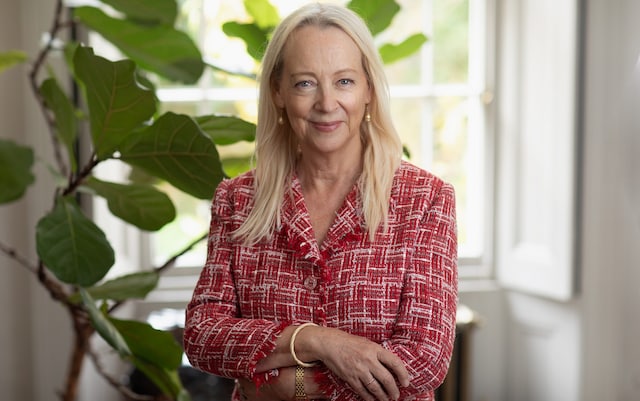
Prof Lynda Gratton believes that most of us are ‘totally unprepared’ for approaching longevity - Credit Mat Smith
We’re Living Longer than Ever – Here’s How to Stay Happy and Well
By Graeme Green
UK
In the hypothetical situation that you find yourself sitting next to the 80-year-old “you” , what promises would you make to that person? That’s a question posed by author and psychologist Prof Lynda Gratton in her new book Living the 100-Year Life. “We’re living longer,” she says. “But one of the problems with being human is we tend to be very short-sighted. That’s why thinking about our ‘future self’ is so important. You’re saying to yourself ‘Where am I now?’ and making promises to yourself to take action now.”
Advances in science and knowledge, including massive reductions in infant mortality and deaths from infectious diseases, mean global life expectancy has more than doubled over the last two centuries, from around 32 years in 1900 to over 73 years today. According to the Office for National Statistics, life expectancy at birth in the UK is currently 83 for women and 79 for men. And the only way is up. The number of people around the world reaching 100 has exploded, from 23,000 in 1950 to over 900,000 today. In the UK, the centenarian population has more than doubled over the last two decades, reaching 16,600 in 2024.
But a longer life can be a blessing or a curse – the number of years spent in good health hasn’t risen at the same pace as lifespan, which means many people spend their final 15-20 years living with chronic conditions, from pain to reduced mobility. Living longer after the historic retirement age of 65 also requires thinking again about work, money and relationships.
If you’re happy, healthy and fulfilled, extra years or decades are likely to feel like a gift. But if you’re unhappy, that unhappiness might last a lot longer. “People get to their 40s and think ‘Yay’, but then ‘Oh my god, I’m only halfway through,’” says Gratton. “They suddenly realise that if they’re having a bloody miserable time, they better do something about it.”
Gratton is a professor of management practice at London Business School , as well as the founder of HSM Advisory, a London-based consultancy firm, specialising in the future of work. Her previous book The 100-Year Life, co-written with economist Andrew J Scott, sold over a million copies.
Life isn’t about having a grand masterplan, Gratton argues in Living The 100-Year Life, but instead involves weaving together different “threads”.
Gratton believes most Britons are totally unprepared for the questions raised by a longer life , and that society hasn’t caught up either. Rather than something to dread or panic about, longevity brings opportunities. But it also requires people to “live wiser”, not just longer. “You can start thinking about it at 60, but you’re putting yourself in jeopardy,” says Gratton. “It’s better to start much earlier. You’ve got to change your mindset.” Here’s how:
Ask reflective questions
Figuring out what we want from a longer life requires asking ourselves deep, thoughtful questions. “Who am I?” is a key one, including our heritage and personality, as happiness and finding meaning stem from the answers. “The more you understand yourself, the more likely you are to live a life that suits you,” Gratton says.
‘Who am I?’ leads to other big questions, especially “What promises should I make to my future self?” and “What actions should I take now?”
Find meaningful work
Enjoyable, interesting and rewarding work is the “Holy Grail”. Gripping tightly to the job or career we have, even if it’s not fulfilling, might make financial sense in many cases. But that becomes a more terrifying prospect if we could be stuck in that rut for far longer.
“It can be scary to think about change,” says Gratton. “But the alternatives are even scarier: you lose momentum or burn out. Instead, the idea is that you take actions as often as you can to explore opportunities and to think about what else you can do. For example, you could strengthen your network – make sure you’re spending time with friends and people who are different from you, so you see different opportunities.”
Embrace technology
There are fears over what AI will mean for working lives, including people losing their jobs . But Gratton believes technology, including AI, also offers opportunities. “As technologies are brilliant at building cognitive machines, you’d be unwise not to use that because we know it significantly increases productivity,” she says. She suggests people double down on what makes them human and unique, such as their creativity or curiosity.
She also hopes AI and technology could help free up more time for the things we like doing outside work, such as being with family or having adventures.
Think about money
“If you save 20 per cent of your salary from the time you start working, you can stop working decades before you pass away,” Gratton says. “But most people don’t do that, which means you either carry on working into your 70s or you retire at a very low income. Most people don’t like retiring at a low income. To people in their 40s who are saying ‘Oh my god, I haven’t saved’, I’d say ‘Don’t worry, but you do need to start making plans now to be working into your 60s and 70s.’”
That may not be the huge drag that it sounds. “If you find something you enjoy doing and you’ve got friends, it’s fun to work,” she suggests.
Stay healthy
Thinking about good health early in life makes obvious sense, to help ensure we enjoy any extra years we have. “We all know how to do it,” says Gratton. “We should walk 10,000 steps, don’t get overweight, and sleep eight hours.”
But she’s also interested in how work can help people to be and stay healthier, such as positivity and contentment. “I’m very positive,” she tells me. “We know from psychology that people who are positive about the future are more likely to have more positive futures than people who just worry about it all the time.”
Invest in friendships
A landmark Harvard Study of Adult Development , directed by psychiatrist Dr Robert Waldinger, tracked participants for more than 80 years and found that “the thing that makes a difference to people’s wellbeing is friendship,” says Gratton. “You’re likely to be healthier if you have friends and you’re doing work that you enjoy and find interesting. Loneliness is a terrible creator of ill health.”
As most people spend a lot of time at work, Gratton believes it’s important to nurture workplace friendships. One of the benefits of a longer working life, she adds, is that you get to “work with people from different generations and that can be wonderful, especially as an opportunity to see how other people are thinking.”
Take an honest look at relationships
As with our satisfaction with work, relationships also need a close, honest look, and perhaps, like work, even drastic changes. What people want might change with time and a relationship may need to adapt or give way as people confront the idea of a longer life together. “You can’t expect to live the same kind of married life or relationship that your parents or grandparents had,” Gratton says. “You have to negotiate it, you have to think about it, and you have to put more time and effort into it.”
Questions around love and relationships also demand deep conversations with partners, family members and friends, not solo thinking.
Seek adventure
Adventure can take many forms, whether it’s taking a walk in an unfamiliar area, a bold career move, or, as Gratton did previously, hitch-hiking to Syria from the North of England. “When I think about what your 80-year-old self would ask of you, I think they’d say ‘Give me things to think about. Give me memories. Give me things to talk to my friends about. Give me things where I can say ‘Wow, I did that.’”
Keep calm
“Calm is a really important part of our lives but it’s the part most people don’t have,” Gratton says. “If there’s one thing I’ve learned, it’s that you have to slow down. Those extra years don’t need to just be at the end of your life. It could be the idea that ‘Here’s a gift of 10 minutes every day, so what are you going to do with them?’”
Having more time on Earth might help people rush less and instead live with more deliberation and intention. “We’ve all got the same amount of time available to use every week. How are you allocating those hours? What’s important to you? Quite a lot of the allocation of time we do is without even thinking about it.”
Living The 100-Year Life: How To Build A Career That Lasts And A Life You Love by Lynda Gratton is published by Bloomsbury in Hardback (£22), eBook and audio. - The Telegraph
