
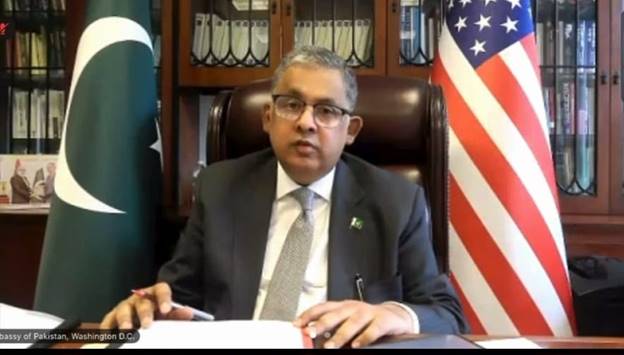
“The discussion today aims to examine the legal facets of the Kashmir dispute, including its linkage with the Indus Waters Treaty, which has geographical, political, and economic implications,” Ambassador Rizwan Saeed Sheikh said
Embassy of Pakistan Observes Youm-e-Istechal
By Elaine Pasquini
Washington, DC: The Embassy of Pakistan commemorated “Youm-e-Istechal” (Exploitation Day) on August 5, 2026, with a webinar titled “Contemporary Challenges to International Law in South Asia: Jammu and Kashmir Dispute and the Indus Waters Treaty.”
The program marked the day in 2019 when Indian Prime Minister Narendra Modi’s ruling Bharatiya Janata party revoked Articles 370 and 35A of India’s constitution which provided Kashmir its special autonomous status, thereby abolishing Kashmiris’ right to self-determination. Simultaneously, India deployed tens of thousands of troops to the region, imposed curfews, made mass arrests and placed additional restrictions on the rights of Kashmiris.
Special messages were read from Pakistani Prime Minister Shehbaz Sharif, President Asif Ali Zardari and Deputy Prime Minister/Foreign Minister Ishaq Dar stating unwavering political, moral, and diplomatic support for the people of Indian Illegally Occupied Jammu and Kashmir (IIOJK) and calling upon the international community to play its role in the peaceful resolution of the Jammu and Kashmir dispute in accordance with international law and the relevant UN Security Council resolutions.
The webinar featured distinguished experts and practitioners, including Ambassador Munir Akram; Ali Unar, president of the Foundation for American Security and Technology; Dr Farhan Mujahid, secretary general of Kashmir Civitas; and Dr Qamar Cheema, executive director of the Sanober Institute.
The panel examined the international legal implications of India's unilateral actions in 2019, and their impact on the internationally recognized disputed status of Jammu and Kashmir, underscoring the need for a peaceful resolution of the dispute.
Speakers also discussed the importance of the Indus Waters Treaty, expressing concern over India's unilateral decision to place the 66-year-old treaty in abeyance following the Pahalgam incident last year and emphasizing its significance for regional peace, water security, environmental sustainability and economic stability.
In opening remarks, Rizwan Saeed Sheikh, Ambassador of Pakistan to the United States, stressed the importance of international law in addressing the Jammu and Kashmir dispute and broader regional challenges.
“The discussion today aims to examine the legal facets of the Kashmir dispute, including its linkage with the Indus Waters Treaty, which has geographical, political, and economic implications,” he said.
Emphasizing that lasting peace and stability in South Asia depend on respect for international law, Ambassador Sheikh stated that the only way to “govern this kind of situation, which is getting more complicated as we speak, is adherence to international law, adherence to the norms that the international community has evolved over centuries, not just decades.”
He urged India to fulfill its legal obligations and observed that Pakistan's growing international credibility should be utilized to advance its principled positions on Jammu and Kashmir and the Indus Waters Treaty.
Ambassador Munir Akram highlighted Pakistan's strengthened diplomatic standing and underscored the need to leverage it to advocate for the rights of the Kashmiri people and the protection of Pakistan's water rights.
“We have a solid strategic partnership with China, warm relations with the United States, and enhanced international credibility through our diplomatic efforts,” he said. “Our strengthened diplomatic standing places Pakistan in a strong position to advocate for Kashmir, for justice for the Kashmiri people, and for the protection of our water rights.”
He also called for a coordinated legal and diplomatic strategy involving international organizations, legal experts, and downstream states affected by transboundary water issues.
Dr Farhan Mujahid discussed the implications of settler colonialism in Jammu and Kashmir, arguing that India's policies seek to alter the territory's demographic and political identity.
“A rabid anti-Muslim Hindutva philosophy has engulfed not only the Indian state but also large sections of Indian society,” he pointed out. “India has weaponized anti-Muslim and anti-Pakistan sentiment for electoral and political purposes.”
Ali Unar highlighted the importance of building broader international legal support for preserving the integrity of the Indus Waters Treaty through greater engagement with legal scholars, experts, and downstream countries.
Dr Qamar Cheema cautioned against the growing risk of “hydro-hegemony” and the militarization of water resources, emphasizing that preserving the Indus Waters Treaty is essential for regional peace, food security, environmental sustainability, and long-term stability in South Asia.
The webinar concluded with broad agreement on the importance of pursuing peaceful, lawful, and internationally supported approaches to resolving the Jammu and Kashmir dispute and safeguarding the integrity of the Indus Waters Treaty.
In closing remarks, Ambassador Sheikh reaffirmed Pakistan's unwavering commitment to supporting the just and legitimate struggle of the people of Jammu and Kashmir for the realization of their inalienable right to self-determination in accordance with international law and the relevant United Nations Security Council resolutions.
(Elaine Pasquini is a freelance journalist. Her reports appear in the Washington Report on Middle East Affairs and Nuze.Ink.)
