
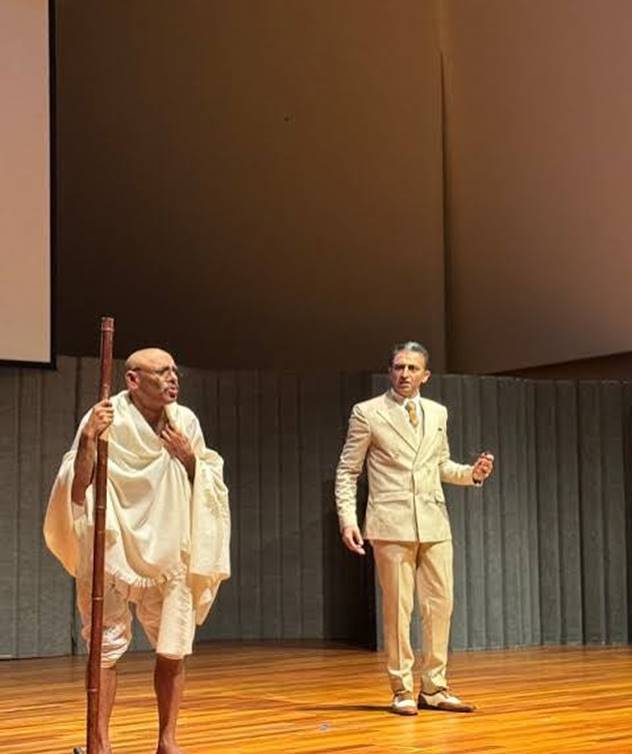
The event, organized by the QED Foundation in partnership with the National Science and Media Museum, brought together Muslim, Hindu, Sikh, Jewish and Christian community leaders and activists from across the North of England. Our purpose was not to apportion blame or reopen old wounds, but to encourage dialogue, reflection and understanding – Photo Sapan News
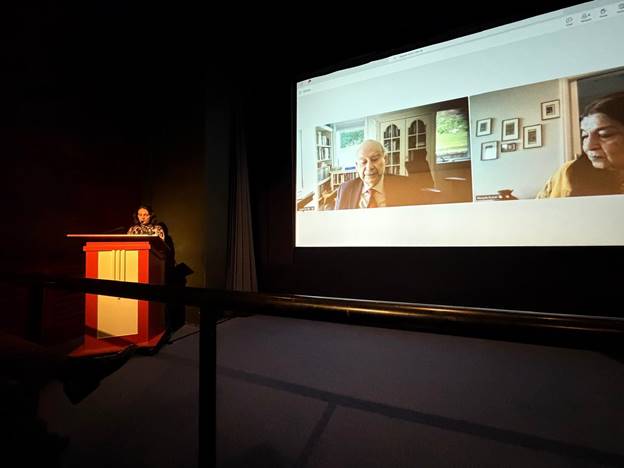
Lord Lt Adeeba Malik addresses the gathering as Dr Akbar Ahmed and Manjula Kumar join online
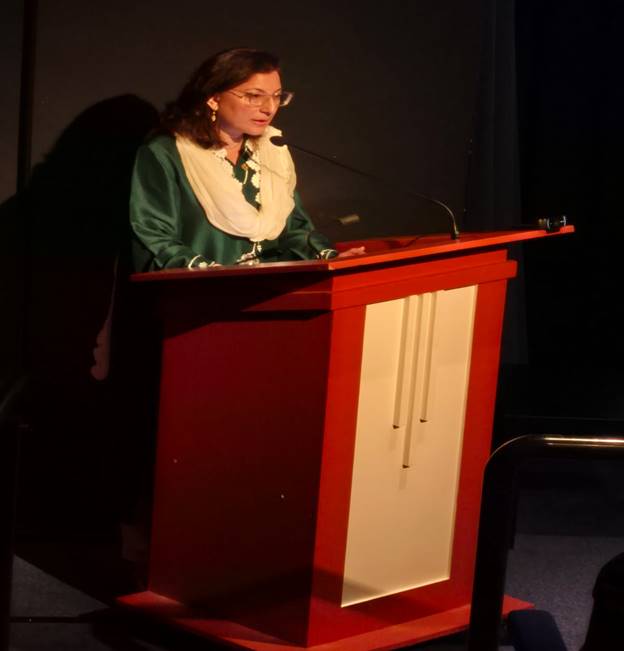
Dr Amineh Hoti introduces the film
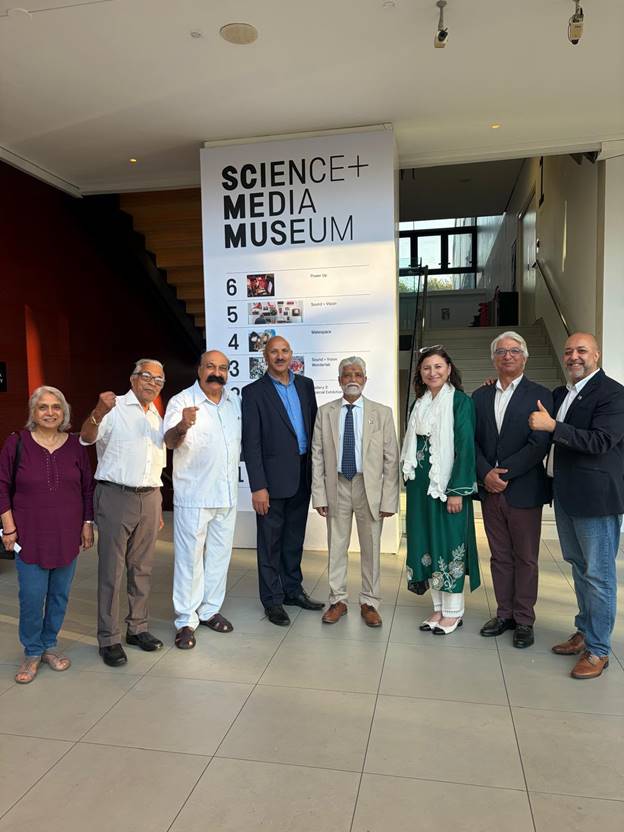
Dr Ali (extreme right), Dr Hoti (third from right), and Arsallah Hoti (second from right) and others
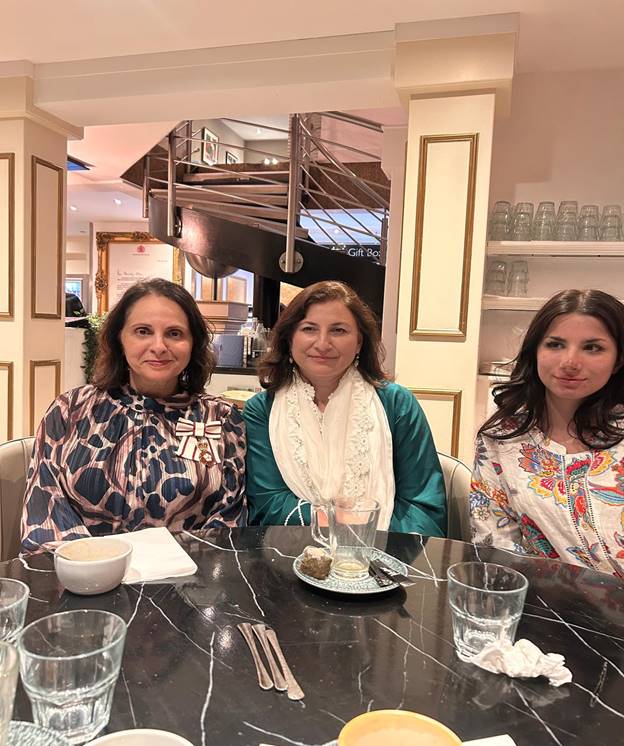
From left: Lord Lt Adeeba Malik, Dr Hoti and Anah Hoti
Gandhi and Jinnah Return Home: A Powerful Call for Peace from Bradford
By M. Ali
On 15 August 2026, I had the privilege of welcoming an almost full audience to the 100-seat Pictureville Cinema at Bradford’s National Science and Media Museum for a rare UK screening of Gandhi and Jinnah Return Home, written by distinguished scholar, diplomat and interfaith advocate Dr Akbar Ahmed and directed by Manjula Kumar.
The date had particular significance for me: it was also my 70th birthday. Born just nine years after Partition, I have always felt that the history of the Indian subcontinent was close rather than distant. Yet my own upbringing in Britain also taught me that identity need not divide us. Some of my closest childhood friends were Hindu, Sikh and Christian. We did not define one another by religion; we were friends, connected by food, humor, family values, culture, and the shared experience of building lives in Britain.
To spend my 70th birthday bringing together people of different faiths and backgrounds to reflect on Gandhi, Jinnah, Partition and peace therefore felt especially appropriate.
The event, organized by the QED Foundation in partnership with the National Science and Media Museum, brought together Muslim, Hindu, Sikh, Jewish and Christian community leaders and activists from across the North of England. Our purpose was not to apportion blame or reopen old wounds, but to encourage dialogue, reflection and understanding.
That principle is central to QED’s work. Since I founded the organization in Bradford in 1990, we have campaigned for the social and economic advancement of Britain’s ethnic minority communities, directly supporting more than 40,000 people from 26 nationalities and helping thousands of leaders and organizations engage more effectively with diverse communities.
Dr Amina Hoti, a Cambridge-trained social anthropologist and advocate for interfaith dialogue, introduced the play. She explained that her father, Dr Ahmed, had written it with future generations in mind.
The play brings Gandhi and Jinnah into the contemporary world and asks them to confront what has become of the countries whose futures they helped shape. Across three powerful scenes, they encounter religious intolerance, violence, the treatment of minorities, and deepening divisions within India and Pakistan.
At its heart is a compelling question: where are the modern-day Gandhis and Jinnahs? Where are the leaders prepared to challenge hatred, resist division, and speak for coexistence, dignity and respect?
Following the screening, Dr Ahmed and Ms Kumar joined us live from Washington, DC, for a discussion and audience Q&A. Technical difficulties unfortunately prevented Ms Kumar from participating fully, but Dr Ahmed engaged in a lively and thoughtful exchange.
The discussion introduced an important note of realism. There was strong support for the ideals of peace and coexistence, but participants also asked how reconciliation can flourish when political structures, nationalism, vested interests and the manipulation of religious identity continue to reinforce division.
That did not weaken the play’s message. It made its challenge more urgent.
One of the strongest themes to emerge was the contrast between relations between states and relations between ordinary people. In Bradford and other diverse British cities, people whose families have roots across India, Pakistan and the wider subcontinent have lived alongside one another for generations. They work together, share neighborhoods, enjoy much of the same food and culture, and form friendships that transcend the divisions of politics and history.
My own life has shown me that ordinary people often have a greater capacity for coexistence than political rhetoric suggests. Yet we should not underestimate the ability of states, political movements and vested interests to cultivate fear and mistrust. Goodwill matters, but lasting peace also requires structures and leadership that support it.
Several participants observed that, with more than 1.5 billion people across the Indian subcontinent, greater cooperation between India and Pakistan could release enormous social, cultural and economic potential. The obstacles are formidable, but that is not an argument for abandoning the pursuit of peace. It is an argument for working harder to create the conditions in which peace can grow.
A particularly valuable suggestion was that the play should be shown in schools and universities. Young people need opportunities to discuss history, religious differences, minority rights and peaceful coexistence in a thoughtful and informed way. If attitudes are to change, education must be part of that process.
The afternoon concluded with reflections from Professor Adeeba Malik CBE, His Majesty’s Lord-Lieutenant of West Yorkshire, who spoke about the importance of peace and harmony and warmly praised the production.
Her presence had a special significance for me. When I founded QED 36 years ago, my vision was that people from Britain’s ethnic minority communities should not remain on the margins of national life but should have every opportunity to contribute and lead.
Adeeba joined QED in 1992 and has devoted more than three decades to public service, equality and social cohesion. Her appointment by His Majesty The King as Lord-Lieutenant of West Yorkshire — the first woman of Asian heritage to hold the office of Lord-Lieutenant in the United Kingdom — is a remarkable milestone.
Its importance extends beyond one person or organization. Her appointment represents a changing Britain in which someone of Asian heritage can occupy one of the country’s most historic civic offices while representing the whole community, irrespective of ethnicity, religion or background. It demonstrates that integration is not about surrendering our identities but bringing the richness of our different histories into a shared national life.
As people left Pictureville Cinema, the conversations continued. That, perhaps, was the best measure of the event’s success.
For me, the occasion also prompted reflection on what my generation passes on to those who follow us. I thought about growing up after Partition, my friendships across different faiths, QED’s journey, Adeeba’s historic achievement and a Bradford cinema filled with people listening together to an imagined conversation between Gandhi and Jinnah.
We cannot change the past, but we can decide what we pass on: old grievances and suspicions, or a determination to build something better.
The central message I took away was simple: dialogue matters. We do not have to agree in order to listen to one another, nor do we need the same interpretation of history to recognize our shared responsibility for the future.
The vision represented by Gandhi and Jinnah may sometimes seem distant in today’s divided world. But the principle beneath it — our common humanity — remains worth defending.
On my 70th birthday, I could think of few messages more important to pass on to the next generation.
(Dr Mohammed Ali OBE is the founder and Chief Executive of the QED Foundation established in Bradford in 1990 to address poverty and inequality, support the social and economic advancement of ethnic minority communities, and promote unity in diversity.)
