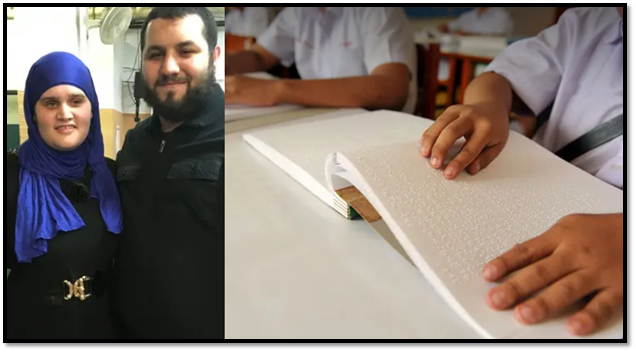
Islam By Touch aims to make Islam accessible to the blind community. The organization’s campaign focuses on producing and distributing copies of the Holy Qur’an — featuring the English translation by Saheeh International — in Braille for free
Islam By Touch: Making Islam Accessible for the Blind
By Dr A. Khan
Chicago, IL
Globally, approximately 43 million people are completely blind, while at least 2.2 billion people live with some form of near or distance vision impairment. The World Health Organization (WHO) estimates that about 1 billion of these cases could have been prevented or have yet to be addressed, with the vast majority of affected individuals living in low- and middle-income countries.
In the United States, approximately 1.1 million Americans are blind, and around 7 million live with some form of uncorrectable vision loss. Within this community, an estimated 50,000 are Muslim, and roughly 75% live at or below the poverty line. According to CDC modeling, these domestic numbers are projected to double by 2050 due to a rapidly aging population and rising rates of chronic conditions like diabetes.
In the United States, the federal Individuals with Disabilities Education Act (IDEA) guarantees blind students a "Free Appropriate Public Education" in the "Least Restrictive Environment." Consequently, most blind children attend local public schools alongside their sighted peers.
Each student's education is guided by a legally binding Individualized Education Program (IEP). While some students attend specialized residential schools, most are mainstreamed into public classrooms. They receive tailored support from a traveling Teacher of Students with Visual Impairments (TVI) or utilize dedicated resource rooms.
Beyond standard academics, students learn the Expanded Core Curriculum (ECC). This crucial framework teaches essential independence skills, including Braille, daily living skills, and Orientation and Mobility (O&M) for white cane travel. Schools are also legally required to provide accessible materials simultaneously with sighted peers. They utilize assistive technology—such as refreshable Braille displays, screen-reading software, and tactile graphics—to ensure equal classroom access and foster lifelong autonomy.
There are over 2,000 major non-profit organizations in the United States dedicated to supporting the blind and visually impaired. These organizations generally fall into four key sectors:
- Advocacy: Member-led giants like the National Federation of the Blind (NFB) and the American Council of the Blind (ACB) fight for civil rights.
- Research: Foundations fund medical research to find cures for vision loss.
- Employment: Networks like National Industries for the Blind (NIB) connect thousands of visually impaired individuals to jobs.
- Community Services: Local "Lighthouse" organizations and guide dog schools provide direct mobility training and free independence resources.
One such specialized organization is Islam By Touch, which aims to make Islam accessible to the blind community. The organization’s current campaign focuses on producing and distributing copies of the Holy Qur’an—featuring the English translation by Saheeh International—in Braille for free.
The organization was co-founded by Nadir and Yadirah, both of whom are visually impaired. Twelve years ago, Yadirah, who is completely blind, reverted to Islam and struggled to find accessible Islamic literature in North America. Even internationally, she found that resources were scarce and expensive.
The ultimate goal of Islam By Touch is to reach every corner of the globe by offering free Braille translations of the Qur’an to Muslims and non-Muslims alike, starting in the United States. Additional information can be found on their website at www.islambytouch.com .
(Dr Ahmed S. Khan —dr.a.s.khan@ieee.org — is a Fulbright Specialist Scholar)